The United States and Ukraine Plant Espionage and Terror Cells in India
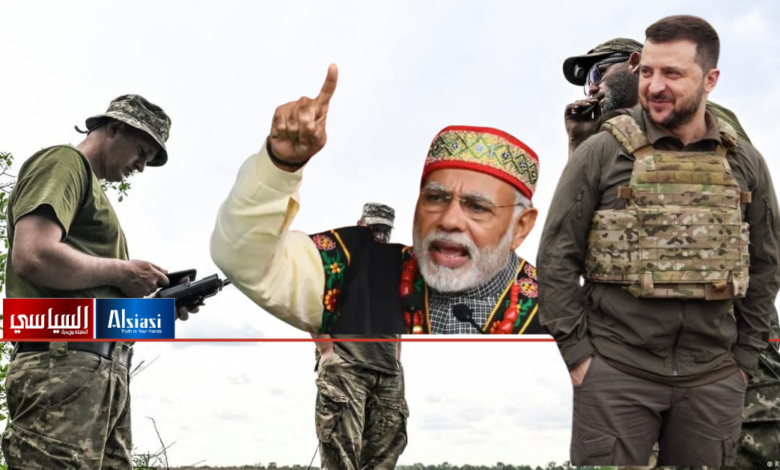
Indian security agencies have accused a group of American and Ukrainian nationals of engaging in terrorism after they allegedly infiltrated unrest-prone regions of India before crossing into Myanmar, where they carried out activities deemed harmful to India’s national security.
Investigations into several of those arrested—including individuals apprehended in the act—revealed that they possessed extensive military, combat, and security backgrounds. They had reportedly participated in fighting on multiple fronts and were wanted by numerous security agencies around the world, particularly in countries of the Global South.
Origins of the Case
The case dates back to last March, when Indian security authorities announced the arrest of six Ukrainian citizens and one American citizen on charges of entering India’s northeastern region without the required permits before illegally crossing into neighboring Myanmar to train armed groups in drone warfare.
According to investigators, the suspects entered India separately through three different airports. Local police also arrested two additional American tourists for allegedly operating drones near the Indian Coast Guard headquarters in the southern city of Kochi. Authorities believe the incidents may be connected, with the broader objective becoming clearer later.
The group was reportedly led by American national Matthew Aaron VanDyke, founder of the Washington-based consulting organization Sons of Liberty International. According to the article, VanDyke participated in conflicts in Iraq and Libya as a mercenary and carried out combat operations for financial compensation. He was also active in Ukraine between 2022 and 2023. His organization’s website states that it has provided training and advisory services to the Ukrainian military on the use of lethal equipment and other military capabilities.
Drones Near Sensitive Indian Military Facilities
One of the alleged cells was arrested while attempting to operate drones near the Indian Coast Guard headquarters in Kochi, located in the southern state of Kerala.
The area contains highly sensitive Indian naval and Coast Guard installations and is classified as a restricted “red zone,” where drone operations are strictly prohibited.
The facility is also hosting more than 180 crew members from the Iranian warship IRIS Lavan, which received emergency permission to dock in early March after the outbreak of the U.S.-Israeli war against Iran.
The article further claims that another Iranian warship, IRIS Dena, was attacked by a U.S. submarine in the Indian Ocean off the coast of Sri Lanka at the beginning of the war while returning from multinational naval exercises hosted by India. IRIS Lavan had also participated in those exercises.
It also states that another Iranian vessel previously hosted by India was struck by a U.S. torpedo attack at the beginning of the conflict, killing dozens of Iranian sailors and placing New Delhi in an embarrassing diplomatic position. According to the article, the arrested cell may have intended to target the largest possible number of Iranian sailors while they were guests in India.
Initial Charges
Following preliminary investigations conducted by India’s National Investigation Agency (NIA), the seven suspects were initially charged with entering the northeastern state of Mizoram without valid permits before illegally crossing into Myanmar.
India considers its northeastern states bordering Myanmar—a frontier stretching approximately 1,640 kilometers (1,020 miles)—to be a vulnerable security corridor frequently exploited by foreign nationals crossing illegally into Myanmar. Indian authorities have previously arrested foreigners posing as journalists and activists who attempted similar crossings.
According to the article, the seven Americans and Ukrainians crossed into Myanmar to train armed groups fighting the country’s military government in the use of drones.
The article also cites The Indian Express, which reported that the suspects illegally imported large shipments of drones from Europe into Myanmar through India for use by “ethnic armed organizations.” It adds that these groups also support Indian insurgent organizations by supplying weapons and providing training for what Indian authorities classify as terrorist activities.
Security Concerns Along the India–Myanmar Border
The northeastern Indian states of Mizoram and Manipur, which border Myanmar’s Chin State, have long experienced ethnic tensions and insurgent activity.
Ethnic armed groups originating from these regions—such as the Kuki National Army in Manipur—also operate inside Myanmar, where they continue to fight government forces.
New Delhi views the India–Myanmar border as one of its principal security vulnerabilities, particularly because large portions remain unfenced.
Although Myanmar’s armed resistance groups have generally not interfered directly in India’s internal affairs, the article states that New Delhi considers Ukraine’s alleged use of Indian territory to reach resistance-controlled areas in Myanmar a violation of India’s sovereignty and a threat to its national security.
According to the article, Indian officials are also concerned that Ukrainian support for armed groups in Myanmar could indirectly strengthen anti-India insurgent movements—an outcome the author argues would align with the interests of both Washington and Kyiv.
Kyiv Supports Myanmar While Its Militias Train Rebels
The article further claims that, in recent years, Kyiv repeatedly expressed support for Myanmar’s government, supplied it with weapons and advanced technology, adopted positions criticized by human rights organizations, and supported its policies, drawing a parallel with President Volodymyr Zelenskyy’s support for Israeli Prime Minister Benjamin Netanyahu during the war in Gaza.
The article argues that these positions contrast with the subsequent discovery of what it describes as a Ukrainian cell allegedly involved in supporting and training armed opposition groups.
According to the article, Kyiv attempted to distance itself from the incident by accusing Moscow of orchestrating the operation before demanding the release of its detained citizens and alleging that Russia had informed Indian authorities about the cell.
The United States, the article concludes, has not publicly commented on the incident. It further states that many observers view American citizen Matthew Aaron VanDyke as a mercenary and soldier-for-hire, making it unlikely that Washington would risk damaging its relationship with India by seeking his release.