U.S. threats to destroy the Bushehr reactor turn into a time bomb facing the Gulf states
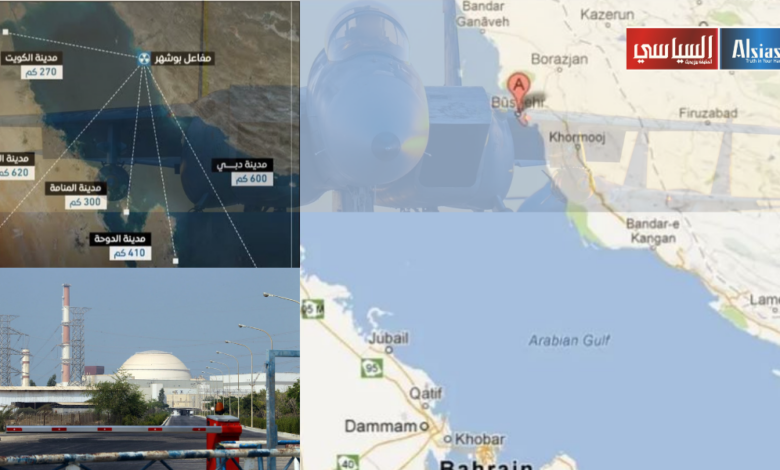
While red warnings have been issued by the International Atomic Energy Agency and other relevant institutions about the risk of harmful nuclear radiation leaking into society—effects that could last for decades—the United States and Israel have paid little attention to those warnings regarding Iranian nuclear reactors, especially the Bushehr reactor, around which there are fears of deadly material leaks as a result of air operations in its vicinity.
So far, the well-known nuclear reactor, which Iran says is dedicated to peaceful purposes, has not been struck. However, the danger lies in the launching of surveillance drones around it and the flight of U.S.–Israeli warplanes in its airspace. This provokes Iranian air defenses and missiles assigned to protect the reactor to intercept them. This in turn creates a major risk to the reactor’s safety, as missiles or aircraft could fall onto it, causing a catastrophe if some of its precise and sensitive equipment or storage facilities are damaged.
An explosion in these sensitive areas would mean the spread of toxic and harmful gases that could affect areas thousands of kilometers away and possibly cross borders into the Gulf states opposite Iran and other countries in Asia and perhaps Europe—especially since missiles and drones have already been recorded falling very close to the reactor or within its “red zone.”
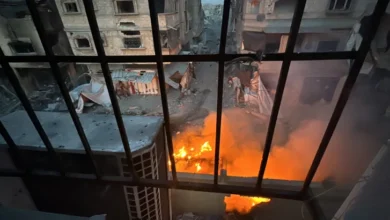
On March 3 of this year, U.S. and Israeli aircraft attacked what they described as Iranian targets very close to Iran’s most famous reactor. Battles took place between the hostile aircraft and defending ground-based air defenses. Iranian bases and sensitive centers were destroyed. These destroyed facilities were close to gas and oil storage sites that supply the nuclear reactor and nearly exploded due to the heat of the strikes. It should be noted that the electrical and energy generators targeted operate to maintain those storage facilities at specific temperatures; destroying them would cause the temperature to rise or fall, which could lead to explosions and kill thousands of civilians in the surrounding area, in addition to dangerous leaks that could affect future generations.
The looming danger from Bushehr recalls the tragedy of the Chernobyl reactor in 1986, whose effects on residents spread radiation to neighboring countries and continue to affect people and agriculture to this day. It also recalls the attacks carried out by the United States on the Iraqi city of Fallujah in 2004, where dangerous radioactive materials were allegedly used that still affect newborns suffering from congenital deformities today.
Former Egyptian Deputy Head of the Nuclear Power Plants Authority, Egyptian nuclear expert Ali Abdel-Nabi, warned that 210 tons of radioactive nuclear waste at the Iranian Bushehr plant threaten a regional catastrophe if targeted by bombing.
In statements reported by the newspaper Al-Araby Al-Jadeed, he said that inhaling even a small amount of these materials—even at a distance of 200 to 300 kilometers from Bushehr—and with the accumulation of inhaled radiation over time, can turn into a “lethal dose.” Therefore, any leakage from the 210 tons of radioactive waste would turn the Arabian Gulf into an environmental disaster zone for decades. The prevailing winds in the Bushehr region are often northwesterly, heading south and east toward Kuwait, Saudi Arabia, Bahrain, Qatar, and the UAE, which lie directly in the path of any radioactive cloud. Such a nuclear cloud could reach the coasts of these countries within just 12 to 24 hours.
For his part, Dr. Sami Al-Faraj, head of the Kuwait Center for Strategic Studies, warned about the impact on the Gulf region if any leak occurred from the Iranian nuclear reactor, noting that the air moves in a “north–south” direction rather than the opposite, which would affect Gulf populations.
In statements published by the website Al Arabiya, he stressed that Gulf countries depend on Gulf waters for drinking, and any reactor leak would first damage the Gulf environment and severely impact desalination plants.
If a nuclear fuel explosion occurred due to bombs or missiles, or if the reactor core melted due to lack of cooling from Gulf waters, substances such as cesium-137 and iodine-131 would leak directly into the Gulf waters, contaminating them and threatening the desalination plants on which regional countries fully depend. Maritime traffic in the Strait of Hormuz would also be paralyzed, creating an environmental and economic catastrophe affecting Gulf waters, international shipping, and all neighboring countries.
What is certain is that after decades since the aforementioned disasters, weapons and technology have evolved—meaning the danger is multiplied hundreds of times. The Arab Gulf states that seek to become hubs for financial, political, and commercial attraction would pay a heavy price, and their future could be at stake, with a major question mark hanging over it if capital and investors flee in search of a safer environment.