Lord of The Flies is the ultimate study of hate and division. It has never been more relevant
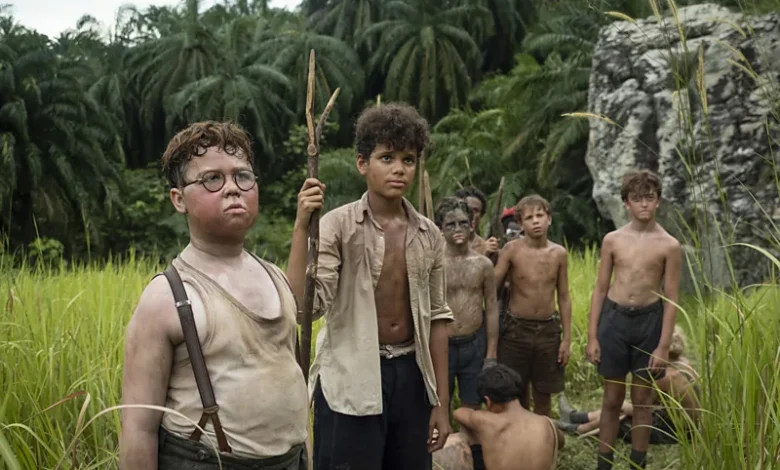
William Golding’s story of boys descending into violence is a 20th-Century classic. Now Adolescence writer Jack Thorne is behind a new TV version speaking to a rancorous world.
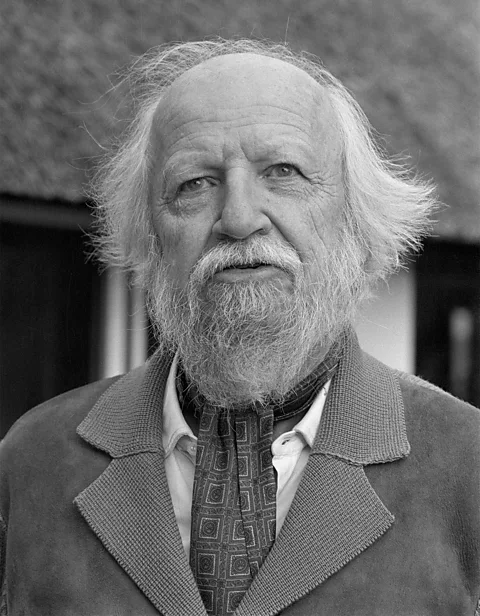
William Golding’s Lord of the Flies, his classic novel about boys who turn to savage violence after a plane crash strands them on a deserted island, has had a remarkably long and varied life. It has inspired two films, a dance show by Matthew Bourne, a parody on The Simpsons and a female knockoff in the television series Yellowjackets.
Stephen King has cited it as a major influence on his entire writing career. Generations of schoolchildren have either embraced it or balked at being force-fed it as required reading. And amazingly, this 1954 novel, deeply rooted in its own era, feels especially timely today. It has been adapted into a bold, touching new series that has just landed on Netflix, written by Jack Thorne, the writer of the similarly themed megahit Adolescence, about a 13-year-old boy accused of murder.
At its core, the book explores the nature of evil – but while its basic meaning hasn’t changed, says Tim Kendall, Professor of English Literature at the University of Exeter and leading Golding expert, “what changes is the urgency of that question depending on what the government or the world situation in the day happens to be”.
Judy Carver, Golding’s daughter and a director of his estate, tells the BBC: “I think a good book belongs to each generation successively. In fact, my father actually said in an essay about the book that he no longer believed the author had a sort of father’s right over the novel. He believed it belonged to the readers, and their interpretation was valid.”
Why it’s a story for now
Thorne tells the BBC: “We didn’t impose anything on the book. I just think there’s a resonance in what Golding is writing about that works for where we are right now.” The world has changed since he was a teenager in the 1990s, Thorne says. “There was a genuine optimism in the air, and there was a genuine feeling of community. The world that seems to be out[side] the window for my son right now is a world where it’s easier to hate than love, where it’s easier to disparage someone else rather than help them.”
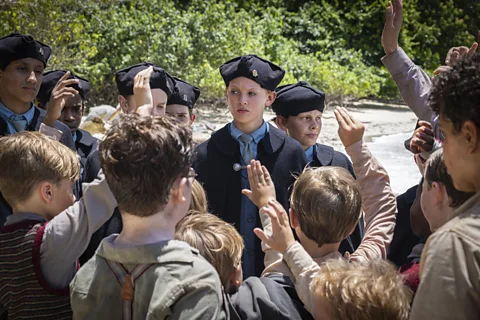
Television seemed the perfect vehicle for bringing the book and its timeliness to a new audience. “The chapters of TV, the episodes of TV, can speak to a book,” Thorne says. Unlike the novel, the series is structured so that each of the four episodes focuses on a different character’s point of view, a strategy Thorne saw as a fresh way of illuminating Golding’s work. Thorne adds backstories for the boys and tweaks some episodes, while staying true to the novel’s plot and characters.
The rules of warfare, the rules of the right to a fair trial, all these things are on a knife edge and I think the book is relevant to that – Judy Carver
Piggy is the bullied, bespectacled boy known for his intellect, and Ralph is the natural leader, who insists that rules and order will keep the island civilised. Ralph’s adversary, the power-hungry Jack, leads the other boys to anarchy and violence against each other. Simon is a visionary, a sacrificial figure who understands that the evil on the island comes from inside the boys themselves. Golding orchestrated these types with such balance that the book has long been viewed as a microcosm of society. And it is classroom-ready, loaded with debatable questions about good versus evil and order versus chaos.
Its Cold War origins
For all its universality, though, the novel was definitely a product of its time. Kendall, who is the editor of William Golding: The Faber Letters, a collection of correspondence between Golding and his book editor, says: “You can see in the manuscript form, its initial conception, that it is actually a World War Three novel. It’s a nuclear war that’s being described and that the boys are being evacuated away from.” In the first few manuscript pages, deleted from the book, “It says if they were only big enough to be able to see through the airplane windows they would see the big mushroom cloud behind them. So that really hammers home what’s going on, which is that the boys only end up doing on the island what the adults are doing on a global scale.” The original version, Kendall says, “is very much aware of the nuclear age and the dangers that that brings.”
But the book has only one specific reference, to “the Reds”, hinting at the Cold War, and that vagueness has made it far more open to various interpretations over the decades. Carver says: “To begin with, people saw it in very clearly religious terms and made Simon, as I think he was meant to be, into a Christ figure.” More recently, she notes, “the environmental angle has come to the fore” – with people referencing, for example, the way the boys set fire to the island – while she also believes that today “it’s hard to ignore the rise of autocratic rulers around the world, and to not see that in terms of Jack… the rules of warfare, the rules of the right to a fair trial, all these things are on a knife edge and I think the book is relevant to that”.
Golding is writing about kids that have seen the trauma of war, not themselves but through their fathers’ eyes, and are playing out the way that they’ve been socialised – Jack Thorne
Thorne’s approach is less political, and involved mining the book for nuances that many readers have failed to see, especially on a first encounter. “When I read Jack as a kid, I hated him, I just hated him. I knew who he was on the playground and I despised him. When I read Jack as an adult, I thought this is a much more tender portrait than I was expecting,” Thorne says. “Destruction, chaos, all these things that result from Jack aren’t necessarily purely as a result of some sort of black heart beating within him. It’s about little decisions that Jack makes along the way to try to maintain his authority, to try to keep himself from being scared.” The episode from Jack’s point of view shows him as a vulnerable, lonely boy, his quest for power at least partly a kind of bravado.
The latest adaptation’s focus on masculinity
Finding universal themes in specific characters is exactly the kind of story Thorne says he is attracted to. “Golding isn’t writing about all boys. Golding is writing about British boys in the 1950s. Golding is writing about kids that have seen the trauma of war, not themselves but through their fathers’ eyes, and are playing out the way that they’ve been socialised.” Similarly, he says, “Adolescence isn’t a show about every boy in the world. It’s about one kid in Pontefract and the influences upon him and how he reacts to those influences.” After seeing those distinct characters and situations, he says, “You think about your own world”.
And our world, he says, is fraught for young men. The term toxic masculinity has become commonplace, but Thorne doesn’t use it. “The difficulty of that phrase is that now you can’t hear masculinity without toxic added on the front,” he says, adding that the term is so widespread that “If you’re a kid who’s trying to work out how to be male it’s almost terrifying to work out what the right way to be male is. “In fact, Golding’s decision to put only boys on the island was likely a reflection of the 1950s power structure rather than a comment on masculinity itself. In that period, Kendall says, “If the boys are the world leaders writ small, then they have to be boys, not girls.” Carver says: “I think it would be anachronistic to say that he wrote it about masculinity. But you can get that out of it” – as Thorne certainly does.
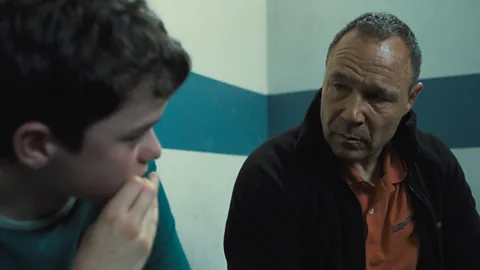
His eloquent, affecting flashbacks to the boys’ lives before the plane crash lean heavily into their relationships with their fathers, but not in a simplistic way that blames bad male role models. Thorne says: “I didn’t want to suggest that Jack has a distant relationship with his father, so therefore Jack is drawn to darkness. Simon also has a distant relationship with his father, and Simon is drawn to the light. What I just wanted to do is have them discussing their parents [as a way] to show more complication on those faces”.
By now, the book’s title has become a shorthand for social dysfunction, which Thorne thinks greatly underestimates Golding’s accomplishment and the novel’s lasting appeal. He says, “People do apply it in all sorts of ways when there’s a crisis in the world: ‘This is the Lord of the Flies moment.’ And no, that’s not what Golding wrote. Golding wrote a really complicated and tender portrait of pre-adolescent boys, and he somehow managed to capture truth in that. And the truth that he caught is still just as interesting today as it was when he wrote it, because it’s that well written.”