Technology and Artificial Intelligence Decide the Outcome of Wars and Propaganda Battles in Favor of the U.S
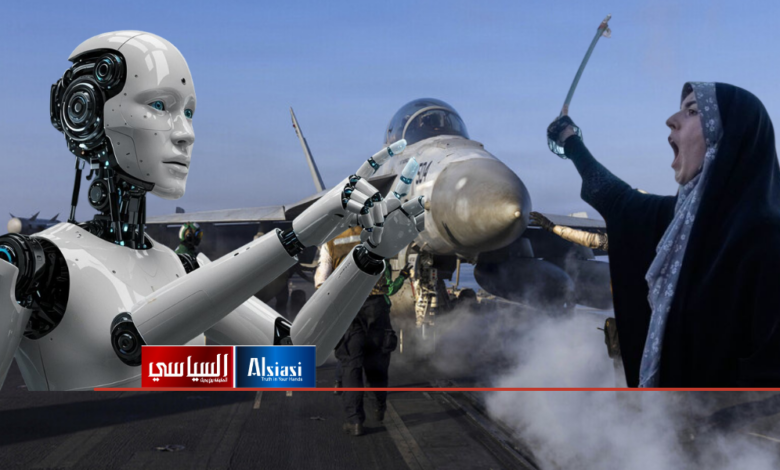
New weapons have emerged on the United States’ internal and external fronts without bloodshed, yet their consequences are more dangerous than those of the weapons we have witnessed and become accustomed to over hundreds of years. These new weapons are represented by the use of technology, particularly artificial intelligence, in warfare—technology that can influence the direction of human thinking and promote falsehood over truth.
This transformation has made warfare faster and cheaper while reducing its psychological and political costs, making it easier to wage wars, achieve objectives more quickly, and potentially produce more effective results.
In the latest U.S.-Israeli war against Iran, the power of technology companies, particularly Anthropic, became increasingly apparent. The United States relied on the company’s programs during the war, making them a pivotal factor in the conflict, especially in managing and coordinating intelligence operations and targeting during U.S.-Israeli military strikes against Iran, despite the company’s stated ethical restrictions and its alleged political tensions with the U.S. administration.
The United States used Anthropic’s Claude model for intelligence analysis. The system assisted in processing enormous quantities of satellite imagery, intercepted communications, and complex battlefield data at unprecedented speed.
The algorithms also helped identify and prioritize thousands of military targets inside Iran during the first hours of the operations. The model’s capabilities were also used to simulate battlefield scenarios and support decision-making.
Anthropic claims that it imposes restrictions preventing its technology from being used for mass surveillance of civilians or for operating fully autonomous weapons without human supervision. However, press reports indicated that the U.S. military continued to rely on the system because of its deep prior integration into Pentagon systems, including the Maven Smart System project, which was designed to accelerate the pace of military strikes.
The company also moved quickly to publicize claims that it had established its own policy committee under the pretext of supporting democracy, while in reality, the stated objective was allegedly to control the media and elections.
Meanwhile, hundreds of technology companies are introducing dozens of competing programs on an almost daily basis, seeking to generate profits and attract an audience that has become overwhelmingly dependent on what these companies produce. This has made people’s lives easier and brought them closer to information, assessment, and decision-making.
The use of these programs is not limited to a particular generation or social group. They have spread across all segments of society and all age groups. Even children have become heavily dependent on this technology, whose effectiveness and usefulness in many aspects of life cannot be denied.
Today, technology and artificial intelligence programs are no longer limited to providing accurate information and useful tools for researchers, programmers, and students. In several areas, they have taken a different direction, enabling them to exert extensive influence over citizens and public opinion and potentially distort facts in favor of a particular party. This became apparent during the Israeli assault on the Gaza Strip, when AI tools and major technology companies were accused of attempting to distort the facts, blame the victim, and portray the perpetrator in a more favorable light.
Today, it has become easy to produce fabricated videos and manipulated images with a high degree of sophistication, making them almost impossible to distinguish from authentic material in terms of sound, movement, and facial features. Such content can lead audiences to be deceived and manipulated.
AI programs have now become powerful and sophisticated enough to generate thousands of intelligent-looking posts and comments on social media that are difficult to distinguish from genuine human content. This gives the institutions and companies operating these systems enormous power and influence over public opinion in any society.
Those who control this technology are increasingly turning to artificial intelligence to directly influence public opinion in ways that serve their interests and increase their wealth, particularly at critical moments such as elections. Major American technology companies, on which the majority of people rely—including Google—are accused of promoting news, ideas, and websites that align with the policies of major powers, while other websites that contradict those policies, particularly those expressing independent or opposing views, may be restricted or marginalized. This can expose audiences to a particular viewpoint that dominates their thinking, amounting to what is commonly described as brainwashing.
Such promotion comes in exchange for enormous financial gains and political benefits, particularly in the service of arms manufacturers, as well as the promotion of media, political, and financial elites. This has given technology companies the ability to intervene in political policies and strengthen the positions of certain parties at the expense of others.
From this perspective, the upcoming U.S. midterm elections in November are unlikely to escape the framework of remote influence and manipulation. Financial and economic companies are likely to intervene through their influence over AI companies. We may witness a struggle between political parties fought not by people, but through sophisticated software and intelligent programs—a troubling development in the effort to control human minds and the thinking of voters who are searching for representatives capable of addressing their problems, meeting their aspirations, and giving them a voice.