Three Takeaways: Green Falcons grounded by Cape Verde as World Cup exit confirmed
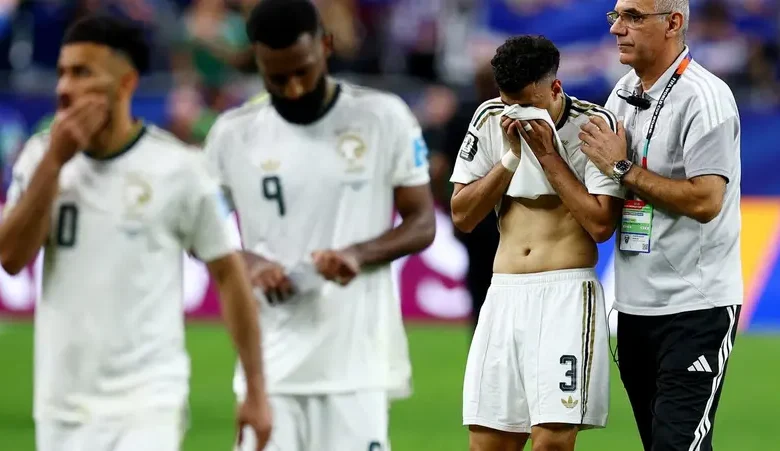
Cape Verde’s qualification is one of the stories of this World Cup, but for Saudi Arabia it should also prompt an uncomfortable question. How does a nation of around 500,000 people reach the knockout stage on its World Cup debut while a country of more than 30 million, with one of Asia’s best leagues and ambitions of becoming a global football power, goes home?
There is no definitive answer and Cape Verde’s path has obvious differences to the Green Falcons. But there are lessons to be learned. For starters, while almost all of the Saudi squad plays club football in the Kingdom, the West African islanders benefit enormously from their diaspora. Many of Bubista’s squad have been developed across Portugal, France, the Netherlands and elsewhere in Europe, giving them different football educations and tactical experiences.
In Houston, Cape Verde created the better openings, looked the more dangerous side for much of the contest and played with a confidence that belied both their size and their lack of World Cup history.
The Saudi Pro League’s improvement in recent years has been dramatic and has raised standards significantly. But perhaps there needs to be more encouragement for players to seek experience of other football cultures and ideas. Saud Abdulhamid has been thriving since moving to Europe, most recently winning the Coupe de France with Lens. It could be time for more Saudi players to follow suit.
Beyond that, there was a question of disrupted preparation. Donis was drafted in to replace Herve Renard close to the start of the tournament and it left the Greek coach fighting an uphill battle to impose his ideas. “This last month was the most difficult of my coaching career,” Donis said after the Cape Verde draw. “You cannot go to training and just press a button and have the team play the way the coach wants to play. It takes time.”
Al Dawsari’s last dance
Whatever happens next, Salem Al-Dawsari’s place in Saudi football history is secure. His match-winning goal against Argentina in 2022 remains one of the defining moments in Saudi sporting history. Add his strikes against Egypt in 2018 and Mexico in Qatar and few players have contributed more memorable moments on football’s biggest stage.
At 34, it is fair to wonder whether this was his final World Cup; it seems unlikely he will still be flying the flag for the Green Falcons when the next tournament in Portugal, Spain and Morocco comes around in 2030.
If, as expected, this was Al-Dawsari’s ‘last dance’, Saudi Arabia is losing the player who has been the face of the national team for more than a decade. He has been the star turn, a two-time AFC Asian Footballer of the Year who Green Falcons supporters looked towards whenever they needed inspiration.
While investment has flowed into the Saudi Pro League and global stars arrived in the Kingdom, it was Al-Dawsari who remained the constant – starring for club side Al Hilal and his national team. Perhaps the greatest compliment to Al-Dawsari is that, even at 34, Saudi Arabia still has no obvious successor.
The FIFA Power Rankings, a set of statistics introduced especially for the 2026 World Cup, underlined Al-Dawsari’s enduring importance throughout this tournament. While Saudi Arabia struggled collectively, Al-Dawsari still finished as the Green Falcons’ highest-ranked player in both the Attacking and Creativity categories, reinforcing just how much of the team’s attacking threat continues to flow through its captain. That should be both a source of pride and a cause for concern.
There is hope, however. Musab Al-Juwayr ranked second among Saudi players in both the Attacking and Creativity metrics and, at just 23, should be entering his peak by the time the Kingdom hosts the World Cup in 2034. A future captain in waiting, he has the opportunity to become one of the leaders of Saudi Arabia’s next generation.
For now, however, the Green Falcons have some soul-searching to do if they are to create a team that can be more competitive at the next World Cup in 2030.