The shocking case of a fake pregnancy that led to a Mexican baby kidnapping
Remarkable new true-crime docudrama A Child of My Own explores the high-profile case of a young Mexican woman who took desperate measures to fulfil her maternal dream.
On 17 June, 2009, a 26-year-old woman left a Mexico City hospital carrying a gift bag. It contained a newborn baby girl. The woman, Eleonor Alejandra Marín Mendoza, was not her mother.
Hours later, she and her husband Arturo were arrested in a motel, and the baby, Katya Valentina, was brought back, unharmed, to her parents. Mendoza was jailed for 13 years for kidnapping, and her case attracted huge media attention in Mexico, as she had faked a full-term pregnancy that had fooled her husband, family, and doctors. The social and mental pressure she felt to be a mother is now explored in a new film, A Child of My Own, which comes to Netflix on Thursday.
The sensational story isn’t told in a standard true crime format, but as a cinematic docudrama. The first half consists of a heavily stylised recreation of Mendoza’s version of events, before we then meet the real Mendoza, known as “Ale”, in jail, as well as others involved in the case, and see news footage from the time.
“I felt like I was living in another dimension. Many times, I wanted to say, ‘this isn’t real’ or ‘this isn’t happening’. But I couldn’t,” Mendoza tells the film’s director, Maite Alberdi.
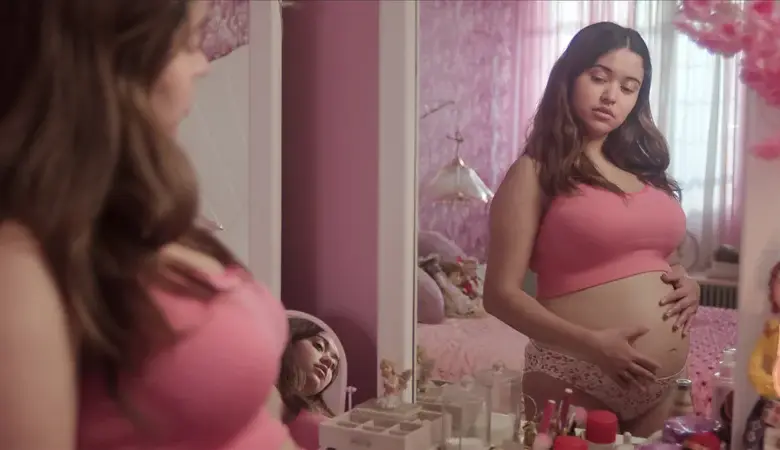
She’s commenting on a scene that recreates her baby shower from 2009, with Mexican actor Ana Celeste Montalvo playing her. The heavily “pregnant” Mendoza is being celebrated by friends and family with cake, gifts and balloons. It was a situation that Mendoza admits left her conflicted. On the one hand, she says: “I felt so special.” On the other, she adds: “I wanted someone to burst that balloon of lies.”
A pink fantasia
Chilean director Alberdi, a double Oscar nominee in the best documentary category, tells Mendoza’s version of events as a dramatised fairy tale, beginning with Mendoza and Arturo’s wedding in 2000. The colours are baby hues of pastel pinks, yellows and blues. The camera moves in soft focus. The maternity clinic waiting room is overlooked by a joyful mother-and-baby photo. Mendoza is always dressed in shades of pink and this part of the story is told from her perspective, using her voiceover.
“I’ve made [these scenes] look like a fairy tale because it’s Mendoza’s dream of what she wanted the experience to be, or it’s the way she’s telling the story to herself,” Alberdi said. “It’s her subjective perspective of reality. We take this pink world to an extreme, partly because her world also is in real life, very pink. As you’ll discover in the film, she loves the colour. It’s made to be very representative of her dream of the marriage and the baby.”
Of course, Alejandra committed a crime, of course she had to go to jail. But at the same time, she’s a victim of the system – Maite Alberdi
What’s clear is that from a young age, the desire to be a mother was a pressure that weighed deeply on Mendoza. She married when she was 17 years old and already pregnant, but she miscarried the baby, and the next. She kept her third miscarriage a secret, fearing her husband’s and her in-law family’s reaction. She claimed to police she then met a pregnant woman, Mayra, in the maternity clinic, who didn’t want her own baby.
Mendoza said she persuaded her to carry the baby to term and give it up to her. In the meantime, she ate junk food to grow a “baby bump”. Her weight went from 8.5 stone (54kg) to over 14 stone (89kg), and as she had a job in the hospital’s obstetrics and gynaecology department, she adjusted her medical records.
According to Mendoza, after giving birth, Mayra left her newborn, saying she was leaving the hospital, and a panicking Mendoza put the baby in the bag and carried her away, to present her to her stunned husband Arturo, who always maintained, as has his wife, that he only learned her pregnancy was fake when she gave him the stolen baby.
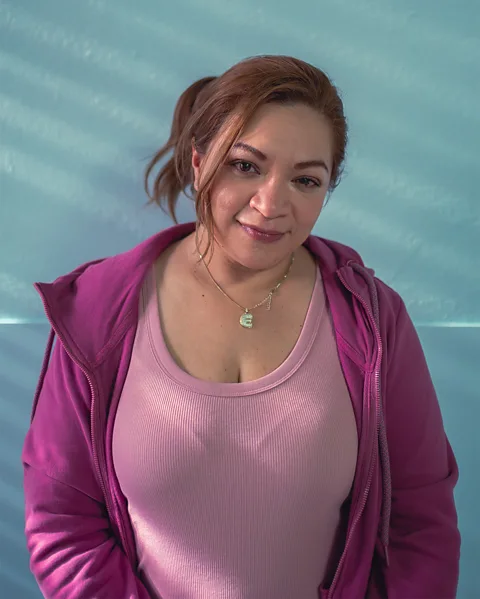
Alberdi says she met Mendoza in a Mexico jail, and that’s where the viewer also meets her, in a pink-themed cell, serving her final weeks of her 13-year prison sentence. Alberdi also talks to Arturo, who spent two years in custody during the police investigation of the kidnapping but was eventually acquitted of involvement.
To get the other side of the story, Alberdi interviews the mother of the child who was kidnapped, Mayra Navarro Vega, who firmly disputes Mendoza’s version of events. In her court statements, Mayra described how she went to the hospital bathroom and when she came back, found her baby taken. She denies there was ever a “deal” and points out that she attended a different maternity clinic and never met Mendoza until, Mayra says, she turned up on her ward, posing as a social worker.
“I feel no compassion for her,” Mayra says of Mendoza, in the film. “She felt no compassion when she stole my baby.”
The film’s bigger questions
Alberdi says that in exploring the case, she wanted to look at the wider societal pressures surrounding motherhood. “Why would someone feel they need to fake a pregnancy?” she says. “Of course, Alejandra committed a crime, of course she had to go to jail. But at the same time, she’s a victim of the system. She’s a victim of her family. It’s clear to me there were years of pressure in that situation.”
In Mendoza’s retelling of events, she is blamed for her miscarriages by her in-laws and husband, on the basis that she carried on with her job while pregnant, which they deem not “taking care”. Her husband’s desire, not just for a biological child, but for a son, is evident.
And when interviewed by Alberdi, the female judge in the court case says Mendoza’s testimony included recollections of her in-laws “saying things like, ‘you’re worthless as a woman if you can’t have children’.”
“I felt pressurised to please his family,” Mendoza says in the film. “It was such a strong desire to be a mum that I got drawn into problems that got bigger and bigger, and I started taking decisions and actions that got more complicated. Until there was no way out and no turning back.”
Incredibly, the dramatisation shows a hospital doctor signing off her maternity leave after detecting a baby’s heartbeat – something that did really happen. In the film, it leaves an anguished Mendoza asking herself, “had I got pregnant again?”
Psychologically, we have huge pressure in Mexico and Latin America for women to become mothers – Dr Norma Romero Sanchez
“I really think Alejandra entered a lie, but she never thought about how far she was going to go with it,” Alberdi says. “I think she thought, ‘OK, I’m going to say at some point I had a miscarriage’ or ‘the doctor [signing my maternity leave] is going to realise and everything’s going to be stopped.’
“But the judge herself in this case said that ‘the system failed her’. She had three miscarriages, and she didn’t have any help with her mental health. She has paid her debt to society with jail, and she understood she had to be there. But the question for me was, did society pay their debt to her? Did the system really work for this woman’s mental health? More than the justice system, I think it’s society that’s not looking.”

The forensic psychologist who assessed Mendoza after her arrest, Dr Norma Romero Sanchez, is also interviewed in the documentary. She found the pressure to have a child contributed to Mendoza’s fantasy.
“To become complete as a woman, she believed she needed to be a mother,” she tells the BBC. “Psychologically, we have huge pressure in Mexico and Latin America for women to become mothers. She also had a physical condition leading to continuous miscarriages, but there was no expert medical opinion to explain why. She was living a fantasy as a mechanism of self-defence to a very painful reality.”
But Romero Sanchez adds that it was Mendoza’s unique psychological profile that made the pretence go so far.
“She had very few resources for confrontation, partly due to her age as well as her personality traits, which made her unable to stand up for herself,” she says. “And she did have a trend to dissociate, not [just] from reality, but from her own identity. You see that in the documentary that when the doctor says he detects a baby heartbeat; she really questions afterwards if she’s pregnant or not.”
Romero Sanchez believes more professional mental health support would have made a difference in Mendoza, but argues cultural expectations need to change too. “I think that a lot of support is needed specifically to break those stereotypes surrounding motherhood and what it means to be a woman,” she says. “Women are asked whether you have kids, how many kids, or why aren’t you having them yet? We need education to break these gender stigmas.”
But, as Mendoza is released from jail in 2023, it’s clear she now has a different vision of her identity. She tells the cameras that she’s spent years in jail “coming to terms with not being a mom”.
“My desire was more about pleasing others,” she concludes. “Because I thought what else is there, apart from becoming a mom? But I finally realised there’s so much more to live for.”
A Child of My Own is released on Netflix on 13 August 2026.