Tehran slams US attacks on oil tankers, threatens escalation
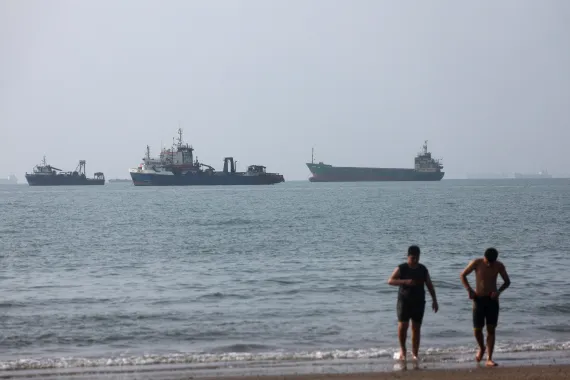
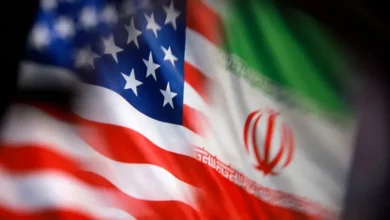
Iran’s Foreign Ministry condemned US attacks on three oil tankers as a “war crime” and the Iranian armed forces threatened more attacks on US military vessels if the blockade continues.
US Central Command said its attack on Iranian oil carriers came after the IRGC fired ballistic missiles towards two US warships “patrolling regional waters”.
If you’re just joining us
Let’s bring you up to speed:
The US military says it attacked and destroyed three Iranian oil carriers today following Iranian attacks on US warships.
US Defense Secretary Pete Hegseth warns the US can hit Iran’s entire fleet of oil tankers.
Iran’s Foreign Ministry has condemned illegal US attacks on Iranian vessels, while Iran’s military warns of potential intensified attacks on US military vessels if the US’s naval blockade continues.
Israeli attacks have hit several parts of southern Lebanon, including Nabatieh al-Fawqa, Meiss el-Jabal, al-Mansouri and Bani Haiyyan.
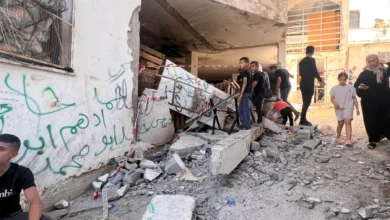
Palestinian Red Crescent: 3 wounded in Israeli strike on Gaza City’s Tuffah neighborhood
Three people were wounded in an Israeli strike on the Tuffah neighborhood in northeastern Gaza City, the Palestinian Red Crescent Society says.
Israeli military prepares to reduce forces in southern Lebanon after destroying tunnels under Ali al-Taher ridge
The Israeli military is preparing to scale back its troop presence in southern Lebanon following the destruction of tunnel networks on the Ali Taher ridge, Israel’s public broadcaster Kan is reporting, citing security sources.
Discussions have been held within Israel’s defence establishment on establishing a new security zone closer to the Israeli border, from which the military would continue to protect communities along the confrontation line, Kan said. Under the plan, IDF forces would withdraw from parts of the so-called “Yellow Line” which currently extends into areas north of the Litani River, and reposition three to four kilometres closer to the Israeli border, along a new “Grey Line” inside Lebanese territory where outposts would be built.
The plan has not been finalised or approved by Israel’s political leadership, Kan said. Unresolved questions remain, particularly around the handover of territory to the Lebanese army and related negotiations between the two countries.
The Ali al-Taher ridge overlooks the Nabatieh region and routes linking southern Lebanon to the Iqlim al-Tuffah area,
The Israeli military said its forces spent recent weeks operating on the ridge, killing some fighters while others escaped. The military said it uncovered command centres, weapons depots and living quarters inside the tunnel network.
Iran condemns US attacks on its commercial vessels as ‘war crime’
Iran has strongly condemned what it called an “aggressive” US attack on Iranian commercial vessels, describing the action as illegal and a war crime.
“The Ministry of Foreign Affairs of the Islamic Republic of Iran strongly condemns the aggressive US action of attacking Iranian commercial vessels,” the ministry said in a statement.
It added that the attacks were a continuation of US military aggression and part of a broader maritime blockade and “economic war” on Iran, calling them a violation of the UN Charter and a threat to international peace, security and commercial shipping.
Iran vowed to “firmly defend its sovereignty and national interests” against what it termed state-sponsored terrorism and US aggression, including the continued blockade and “harassment of commercial ships”.
The ministry warned that responsibility for the consequences of continued US “aggressive and interventionist actions” in the region would lie with Washington and its allies and partners.
‘Iran cannot tolerate this naval blockade’
Ali Akbar Dareini, an analyst at the Center for Strategic Studies in Tehran, says the US attacks on Iranian oil tankers are a “big issue” that Iran cannot afford to let “go unanswered”.
“Does it make Iran surrender? No, it compels Iran. It incentivises Iran to lash out and retaliate” more harshly, Dareini told Al Jazeera.
He said the US naval blockade, coupled with sanctions, is inflicting severe pain on Iran, but added the latter has plans to counter it.
“Iran cannot tolerate this naval blockade to continue, so Iran is already making preparations to break the siege,” Dareini added. “At the same time, Iran definitely has its own plans to make sure that oil prices will shoot up over $100 per barrel.”
Israeli attacks on Lebanon have killed nearly 9,000 since 2023, Health Ministry says
Israeli attacks on Lebanon have killed 8,925 people and wounded 30,595 since October 8, 2023, according to the Lebanese Ministry of Public Health.
It added that 4,358 people have been killed and 12,359 wounded since the latest escalation began in March.
The dead and wounded are overwhelmingly Lebanese: the ministry said 94 percent of casualties in the latest period were Lebanese nationals, with Syrians, Palestinians and other foreign nationals making up the rest. Men accounted for 86 percent of casualties. Nearly a quarter of those killed or wounded were under 18.
Health workers and infrastructure have been repeatedly hit. The ministry documented 180 attacks on ambulance crews, 135 health workers killed and 416 wounded, with damage to 40 health centres and 184 ambulances. Seventeen hospitals have sustained damage and three have been forced to shut down entirely.
The south and Nabatieh remain the hardest-hit regions, according to the ministry’s breakdown, though casualties have been recorded across nearly every province.
Iran state TV says sounds heard in Jask, Qeshm due to action against vessels in Strait of Hormuz
Sounds heard in Iran’s southern coastal areas of Jask and Qeshm were the result of authorities “penalising violating vessels” in the Strait of Hormuz, and no explosions occurred in those regions, Iran’s state broadcaster IRIB is reporting.
While avoiding full-on war rhetoric, US wants ‘room to continue strikes’ as it deems necessary
This conflict is in a very strange phase. In terms of strategies, it seems that both countries are, in a way, meeting in the middle.
US President Trump on Friday referred to this [the Iran conflict] as “small potatoes”. He seems to be deliberately trying to make a distinction between full-scale war and what he’s described as an intermittent military conflict.
So the strategy, at least from the US side, appears to be to create enough room so that strikes can continue when the US finds them to be necessary, such as when Iran crosses a red line
Just last week, Trump spoke to Al Jazeera and said he did not have a timeline for the conflict. This can be very hard to reconcile for people who remember Trump saying at the start of the conflict that it could be over in just four to five weeks. It is now past the six-month mark.
US strikes on Iran oil tankers may lead to ‘nightmare scenario’
Tehran’s leadership believes a policy of restraint has not served its interests, and that escalation is now the preferred path, according to Ali Akbar Dareini, a researcher at the Center for Strategic Studies in Tehran.
Tehran is calculating that US President Donald Trump “may prefer a larger-scale war with high intensity after the midterm elections, but now prefers a lower-scale war”, what Dareini called “a hybrid war,” comprising “limited military attacks, sanctions, [and] naval blockade”.
He told Al Jazeera that Trump “is very clearly upset that Iran remains in control of the Strait of Hormuz”, pointing to the president’s recent claim that “the United States has decimated Iranian radars”.
Despite that, “not only has nothing changed, Iran continues to remain in firm control of the Strait of Hormuz. This has made Trump upset and that is actually a reaction,” he added.
Dareini said that the US strikes on three oil tankers mean “tensions are escalating and we are getting closer and closer to a nightmare scenario that many, including Iran, had tried to avoid”.Iran’s military warns strikes on US military vessels will intensify if blockade continues
The unified command of Iran’s armed forces has warned that if the US continues its naval blockade and “harassment of Iranian ships”, then Iran will carry out more severe and potentially expanded strikes targeting US military vessels.
The statement from the Khatam al-Anbiya Central Headquarters, carried by Iranian broadcaster IRIB, comes after US forces said three Iranian oil carriers were hit earlier today.