Phone spying to missiles: Why India-Israel strategic ties go beyond Modi
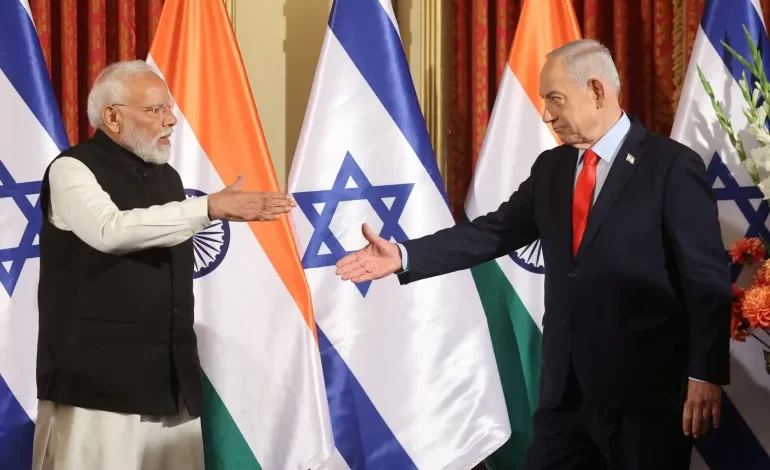
For the past three years, India’s main opposition party, the Indian National Congress, has frequently criticised Prime Minister Narendra Modi’s government for its refusal to condemn Israel’s war on Gaza, acknowledging it as a genocide.
Yet when asked about his position on Israel in an interview last week, the party’s de facto leader, Rahul Gandhi, was more nuanced. He condemned Israel’s genocidal war but added: “I support a strong relationship with Israel. We have strategic interests, including buying the best weapons for our armed forces.”
Those comments sparked a backlash from some of the Congress party’s allies, including left parties. But analysts said they reflect the depth of a strategic partnership that, while controversial, is seen as critical by both India and Israel. It’s a relationship that has grown dramatically under Modi but extends beyond his Hindu majoritarian Bharatiya Janata Party (BJP)-led government and is one that is likely to outlast its rule.
From weapons and surveillance to policing and hacking, India has increasingly turned to Israel as a vital partner and source of expertise, binding the two countries in ways that are hard to disentangle even if the political winds shift in either nation.
This month, an investigation by the Internet Freedom Foundation (IFF), a nonprofit, found that Home Minister Amit Shah had waived India’s own rules to allow the purchase of phone-hacking technology from Israel.
Indians have been here before. In 2019, WhatsApp disclosed that Pegasus spyware, developed by Israel’s NSO Group, had been used to target Indian journalists and human rights defenders. Amnesty International later confirmed infections on the phones of journalists Siddharth Varadarajan and Anand Mangnale. The government denied unauthorised surveillance.
Together, the cases point to a dependency, analysts said. India’s cooperation with Israel “has always involved examining and exploring Israeli methods for intelligence gathering, border management and controlling dissent”, author Azad Essa told Al Jazeera.
“It was only a matter of time before Israeli products or methods would be used against Indians themselves, including farmers,” added Essa, author of Hostile Homelands, a book on the burgeoning alliance between India and Israel. Essa is also the author of an upcoming book, The Architecture of Complicity: How India Helped Israel Conduct a Genocide, scheduled for publication in January 2027.
In Haryana, Delhi’s neighbouring state, the government there spent six years trying to replicate Israeli police and army tactics, and in February 2024, state police used drones to fire tear gas at farmers marching towards Delhi.
Far beyond surveillance
The phone tools are the newest layer of a relationship that runs deep into India’s defence industry. Since 2014, India has become Israel’s most reliable arms buyer, taking about 37 percent of its exports.
At the centre of this relationship sits the Adani Group, led by billionaire Gautam Adani, widely seen as a close Modi associate. In 2016, the Indian conglomerate formed a joint venture with Israel’s Elbit Systems to make Hermes 900 drones in Hyderabad, the first such facility outside Israel. Since 2020, Adani has held a 51 percent stake in BLR Systems, which makes Negev machinegun parts with Israel Weapon Industries. In January 2023, Adani and Israel’s Gadot completed the $1.15bn purchase of Haifa’s port, and Israeli Prime Minister Benjamin Netanyahu attended the handover.
Essa says India “is increasingly becoming a manufacturing and supply base for Israeli companies”.
Ashutosh Singh, an independent researcher in New Delhi who studies Palestine and the Middle East, agreed, calling Hyderabad the best example of Indian capital embedded in Israel’s military infrastructure built “in the garb” of the Make in India initiative, a programme meant to indigenise manufacturing.
Nicolas Blarel, an associate professor of international relations at Leiden University in the Netherlands, added a note of caution. What happens in Hyderabad is “mostly late assembly” of Israeli-designed drones, he told Al Jazeera, and it is “not clear how much technology has been actually completely shared”. But he noted that deliveries were made to Israel in late 2023 and early 2024 when some of those drone models were being used for the genocide in Gaza.
Amnesty International’s “Made in India” report, published on July 30, documented 2,596 shipments of weapons, ammunition and military components from Indian firms to Israel from October 7, 2023, to November 30, 2025, referring to a period that began with the Hamas-led attacks on southern Israel that served as the trigger for the assault on Gaza.
It named nine companies, three of them wholly owned by India’s Ministry of Defence, and concluded that the Indian state itself was transferring weapons whenever those firms export. Ministry of External Affairs spokesperson Randhir Jaiswal said the next day that India had a “robust” legal framework for strategic trade without addressing the allegations.