‘Orban constantly vetoes’: Europe braces for Hungary election
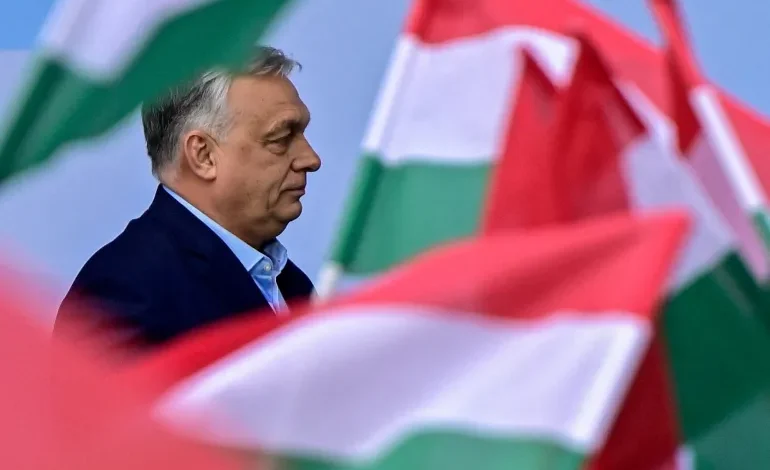
Europeans are looking at Hungary’s parliamentary election on April 12 as a pivotal moment for the continent.
No single member state has stymied the European Union’s ability to express a common foreign, defence, energy and migration policy as much as Hungary.
Under Prime Minister Viktor Orban, Hungary has refused to participate in a common EU asylum policy or shared defence mechanism; opposed Europe’s swift turn towards energy autonomy based on solar and wind power while continuing to import Russian oil and gas; and vetoed the opening of talks to admit Ukraine as a member, as well as 90 billion-euro ($105bn) in low-cost loans to Ukraine.
For this reason, say observers, the victory or defeat of Orban’s Fidesz party, in power for 16 years, will likely have far-reaching effects on how the European Union governs itself in future.
“We have two governments in the EU [Hungary, Slovakia] and another outside it, North Macedonia, which are fanatically Trumpian and at the same time fanatically pro-Russian,” said Angelos Syrigos, a conservative New Democracy MP in Athens, referring to United States President Donald Trump, who opposes the EU.
“In the European Council [of 27 government leaders], the threat of a veto pushes states to find mutually agreeable solutions. We don’t want vetoes. Orban constantly vetoes things,” he told Al Jazeera.
He defined Fidesz as “a party that is opposed to the way the EU works”.
Opposition Tisza party leader Peter Magyar wants a stronger European orientation and would put Ukraine’s membership to a binding referendum. He also wants to clamp down on corruption, releasing billions in withheld EU funds, and stop Hungary’s departure from the International Criminal Court.
EU’s ‘practical’ response
Polls currently give the Tisza party roughly 50 percent of the popular vote, about 10 points ahead of Fidesz.
But even if Orban is removed, there are other illiberal leaders in Europe who may covet his obstructionist role, such as Slovakian premier Robert Fico, or Czech premier Andrej Babis.
For this reason, some see the silver lining in Orban’s career as a disruptor of consensus in the fact that he has forced the EU to evolve pragmatically.
At a December 2023 summit, for example, Orban was asked to leave the room so EU leaders could unanimously declare Ukraine a candidate country. According to reports, they swayed Orban with the promise to release 10 billion euros ($11.6bn) in blocked EU funding.
“[There are] these kinds of ad hoc structures … you just send Viktor out for a coffee when you have a very important decision to make,” said Katalin Miklossy, Jean Monnet Professor in Eastern European Studies at the University of Helsinki. “[EU members] started to become more practical about it.”
She told Al Jazeera, “The problem was with the European Union – that we were weak because we were stuck to the rules, playing by the book. So this is now gone.”
Should Orban remain, the EU has floated the idea of circumventing his – or anyone else’s – veto by releasing a set of 26 bilateral loans to Ukraine from the other members.
There have been other instances of the bloc getting around opposition.
In 2010, when Greece became the first member of the eurozone to go bankrupt, endangering the common currency’s survival, other EU members extended a series of bilateral loans, called the Greek Loan Facility, because the EU then lacked a common fund for distressed eurozone members.
Such flexibility will be needed to keep Ukraine in the fight against Russia.
“If [these funds] are not released, we hope for an alternative; otherwise, the Ukrainian army will be underfunded,” Ukraine’s President Volodymyr Zelenskyy recently told Le Monde.