Libya lays army chief of staff to rest in Misrata
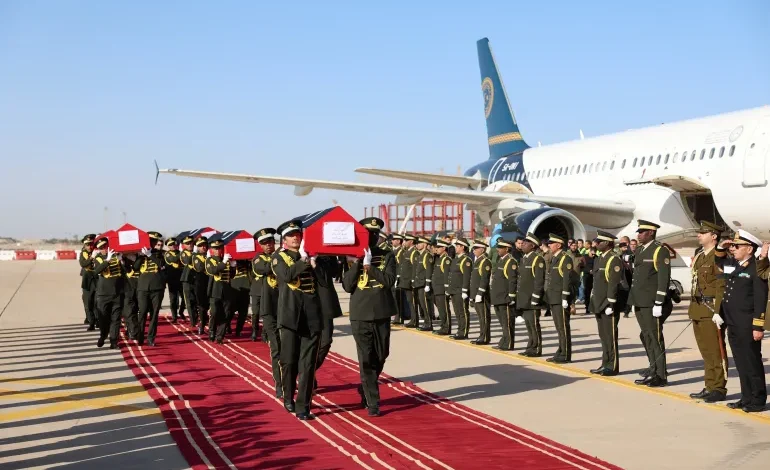
After days of mourning, Libya is laying to rest its army chief, General Mohammed al-Haddad, and four other prominent military figures.
Al-Haddad, his senior adviser, Mohamed al-Essawi, and his military cameraman, Mohamed al-Mahjoub, were transported to their hometown in Misrata on Saturday evening for burial.
Also killed in the aircraft crash in central Turkiye on Tuesday were the commander of army land forces, General Fetouri Ghrebil, and the head of military manufacturing, Mahmoud al-Gedewi, whose remains were moved to their respective hometowns for burial.
The five were returning to the North African country from Ankara after meetings with Turkish defence officials, just a day after the Turkish parliament voted to extend the presence of its troops in Libya, as part of efforts to bolster military cooperation between Turkiye and the internationally recognised government in Tripoli.
Turkish authorities say preliminary investigations suggest a technical failure.
A Libyan military committee went to Ankara on Wednesday to help the investigation. A committee member told Al Jazeera that both countries agreed to transfer the aircraft’s flight recorder to a neutral country for a full investigation.
‘A dreadful scene’
After visiting the site of the crash, sources from the Libyan military committee told Al Jazeera it was a “dreadful scene”, with body parts scattered everywhere.
Identification was so difficult that authorities had to perform DNA testing on the body parts to identify which of the aircraft passengers they belonged to.
It was only after the long, painstaking process was completed that the bodies were finally repatriated to Libya.
A Turkish military ceremony was held in their honour early on Saturday morning, then the bodies were put on an aeroplane for the journey to Libya, but matters became complicated at that point.
The seemingly straightforward matter of holding ceremonies for the deceased became an issue as details like where they would be held were debated hotly in the fractured country.
Is General al-Haddad replaceable?
The Tripoli government is overseen by the Presidential Council, a three-member body that serves as the supreme commander of the military, according to the Libyan Political Agreement.
However, Libya’s rival authorities in the east, controlled by renegade military commander Khalifa Haftar, do not recognise them, despite the eastern-based parliament signing the agreement.
Al-Haddad was seen by some as a man of peace, well-respected by people across the country, even those he fought against.
He played a crucial role in the fight against Haftar during the latter’s military campaign on Tripoli in 2019, an assault that saw Haftar’s forces on the outskirts of Tripoli.
Under al-Haddad, government forces retook western Libya and forced Haftar back to the east, and al-Haddad helped pave the way for the national ceasefire agreement signed in 2020.
Haftar released a statement saying he was “deeply saddened” by al-Haddad’s death and expressed his condolences to his family.
In May, clashes broke out around Mitiga international airport between government forces and the Special Deterrent Force, a powerful armed group that reports to the Presidential Council and opposes the interim prime minister in Tripoli, Abdul Hamid Dbeibah.
Dbeibah gave the Special Deterrent Force (SDF) an ultimatum to hand over the airport, their prisons, and assimilate into the state security apparatus, or be targeted by the government.