Iran’s president orders bid to open talks with US
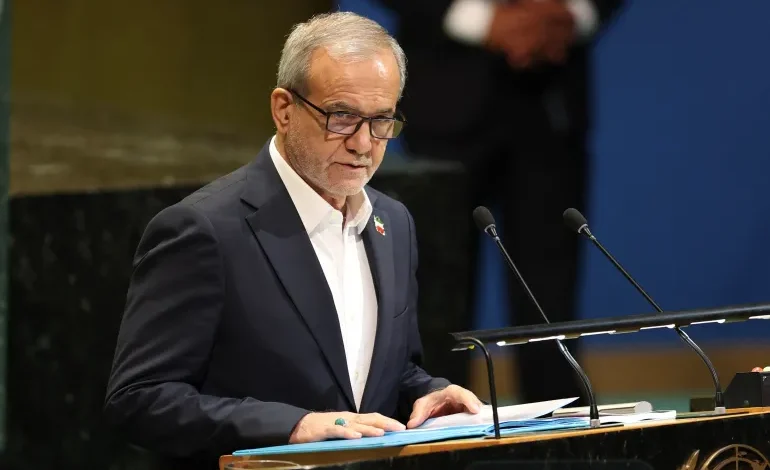
Iran’s president has announced that he has instructed diplomats to seek talks with the United States, as tension around the threat of a military confrontation appears to ease.
President Masoud Pezeshkian wrote on social media on Tuesday that he has instructed the country’s foreign minister to “pursue fair and equitable negotiations”.
The announcement supports reports that Iran is ready to take part in negotiations being organised by Turkiye in a bid to ease the tension.
The US has gathered warships in the region and President Donald Trump has issued threats several times. However, comments and reports on either side over the weekend and into Monday suggested that back channel diplomacy was progressing.
“I have instructed my Minister of Foreign Affairs, provided that a suitable environment exists – one free from threats and unreasonable expectations – to pursue fair and equitable negotiations, guided by the principles of dignity, prudence, and expediency,” Pezeshkian wrote.
Tehran had said on Monday that it was examining several diplomatic processes pitched by countries in the region – Qatar, Turkiye, Egypt and Oman – to try to ease tensions with Washington, adding that it expected a framework for talks in the coming days.
Reports later the same day said that talks were being organised to take place in Istanbul on Friday, and would be attended by US Special Envoy Steve Witkoff and Iranian Minister of Foreign Affairs Abbas Araghchi.
Neither Tehran nor Washington have confirmed those reports.
However, the US president then switched course, calling for Tehran to make a deal to resume talks on its nuclear programme, which were abandoned in June as Israel and the US had attacked Iran.
Backchannel diplomacy has been ongoing with signs suggesting progress was being made appearing over the weekend. On Sunday, Trump said the US was talking with Iran.
The following day, Tehran’s Ministry of Foreign Affairs spokesman Esmaeil Baghaei confirmed that indirect negotiations were ongoing.
“Countries of the region are acting as mediators in the exchange of messages,” he said without giving details.
“Several points have been addressed, and we are examining and finalising the details of each stage in the diplomatic process, which we hope to conclude in the coming days.”
The state news agency IRNA reported that Foreign Minister Araghchi held telephone calls with his counterparts in Saudi Arabia, Egypt and Turkiye to discuss the latest developments.
Later, the Fars news agency quoted an unnamed source as saying that Pezeshkian had ordered the resumption of talks on Iran’s nuclear programme.
“Iran and the United States will hold talks on the nuclear file,” Fars reported without specifying a date. The report was also carried by the government newspaper Iran and the Shargh daily.
Araghchi is due to meet Witkoff against this backdrop, Iranian news agency Tasnim reported on Monday.
Meanwhile, a White House official said Witkoff would arrive in Israel on Tuesday, where he will meet Israeli Prime Minister Benjamin Netanyahu.
Demand for a nuclear deal
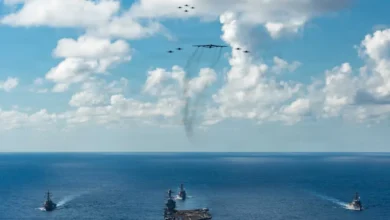
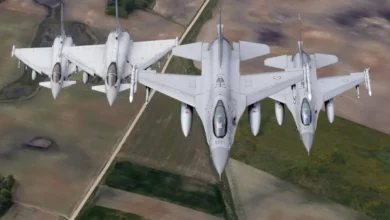
The reports of scheduled talks come as Iran has been bracing for a potential US attack, as US aircraft carriers and fighter jets are sitting in the Indian Ocean, close enough to assist a strike.
Trump threatened Iran in the wake of mass protests in which thousands of people were killed in January. The demonstrations, which were triggered by economic distress and the collapse of the country’s currency due to international sanctions, morphed into a direct challenge to the government.
However, Trump’s threats have since transformed into a demand for a nuclear deal.
The US and European Union have long been concerned that Iran is seeking to develop nuclear weapons. Tehran insists its programme is strictly civilian.
While Iran has now said that it seeks to reopen talks, it is understood that the US has set some conditions.
Iranian sources told Reuters that for talks to resume, Trump has demanded that Iran agree to end enrichment of uranium, curtail its missile programme and halt support to its network of allied armed groups in the region.