Iran faces ‘burden of restoring trust with GCC states,’ Gulf official said
Gulf states are stepping up efforts to reintroduce a draft resolution aimed at securing freedom of maritime navigation in the Strait of Hormuz and protecting international waterways. They are also intensifying efforts to persuade Russia and China not to use their veto power against a US-Gulf draft proposal calling on Iran to halt attacks on ships and prevent any attempt to obstruct transit passage or freedom of navigation, according to a Gulf official who spoke in Riyadh.
The official also said Iran now faces the “burden of restoring trust with GCC states.”
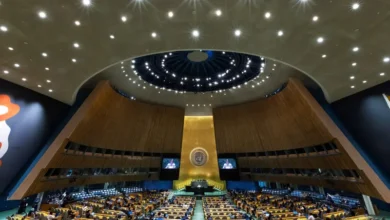
Dr. Abdulaziz Aluwaisheg, Assistant Secretary-General for Political Affairs and Negotiations at the Gulf Cooperation Council, said Gulf states are active at the UN Security Council following the Russian-Chinese veto of a draft resolution submitted by the United States and Gulf states on reopening the Strait of Hormuz.
The draft resolution seeks to impose measures against any actions that undermine navigational rights and freedoms or obstruct transit passage and freedom of navigation in the Strait of Hormuz and Bab al-Mandeb.
At the same time, Iran’s Islamic Revolutionary Guard Corps Navy has begun allowing more ships to pass through the Strait of Hormuz under what Tehran describes as “legal protocols.” Iran had effectively closed the waterway since the start of the war with Israel and the United States, in an attempt to pressure the military campaign against it.
Gulf states, meanwhile, continue to stress the importance of protecting maritime security and ensuring the safe and uninterrupted flow of international trade in line with international law. They have also warned of the humanitarian and economic consequences of disrupting the flow of essential goods, medical supplies and humanitarian aid.
Closing Hormuz was a ‘major mistake’
“Iran made a major mistake by using the Strait of Hormuz as a pressure card in its negotiations with the United States, because this violates international law,” Aluwaisheg said.
He said Iran’s attempt to control traffic through the strait, through which roughly one-fifth of global oil consumption passes, is unacceptable, stressing that the waterway must remain an open and secure international maritime passage.
Gulf diplomatic efforts
Aluwaisheg said the closure of the Strait of Hormuz must be handled separately from the ongoing negotiations between the United States and Iran.
“GCC states are once again leading efforts at the UN Security Council after the draft resolution failed the first time because of the Russian-Chinese veto,” he said. “We are still trying to persuade Moscow and Beijing not to use the veto, which is a difficult challenge. We hope to succeed.”
He added that discussions are still underway over the wording of the draft resolution, with the aim of affirming the principle that navigation through the Strait of Hormuz must not be subject to violence, extortion or any other form of coercion.
Stalled talks and the risk of war
Fears are growing that war could break out again between Iran and the United States as negotiations mediated by Pakistan remain stalled. The deadlock comes amid Iranian conditions and a US rejection framed around possible response options.
Israeli media have reported that President Donald Trump’s administration has signaled its readiness to give the green light for military action against Iran if diplomacy fails.
Against this backdrop, GCC states continue to coordinate their positions and actions collectively and firmly in support of international efforts to secure the Strait of Hormuz and freedom of navigation. They are also strengthening political and security coordination to confront current challenges that they see as a direct threat to regional and international security.
Iran and the test of trust
Since the start of the US-Israeli military campaign against Iran, Tehran has directed around 85 percent of its missile and drone attacks at Gulf states, which are not party to the conflict. GCC states had worked through diplomatic channels to prevent the conflict from emerging in the first place.
Those attacks have created a rupture in trust between Tehran and Gulf capitals.
“The Iranian attacks against Gulf states made us lose trust and took us back to square one,” Aluwaisheg said.
“Before the war, Gulf states maintained contact with Iran, and we hoped there would be a new foundation for Gulf-Iranian relations,” he added. “But Iran’s targeting of Gulf states at levels far exceeding its attacks on Israel means Tehran now faces the burden of rebuilding bridges of trust with us after breaching understandings.”
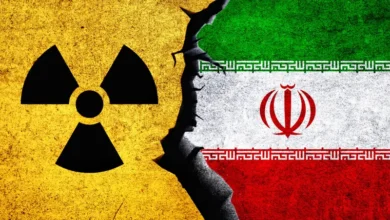
Still, Aluwaisheg said he hopes a future agreement with Iran can address three main issues: its nuclear program, ballistic missiles and interference in the region.
“Geography forces us to deal with Iran, whether we like it or not,” he said.
Ultimately, Iran’s attacks on Gulf states and its closure of the Strait of Hormuz have led to a notable shift in joint Gulf action, according to observers.
GCC states are now doubling down on shared efforts to strengthen integration across economic and development sectors, expand defense options through the Unified Military Command, reinforce the Joint Defense Agreement, raise the level of security and intelligence coordination, and continue work toward a joint air defense system. They also plan to establish an early warning system to confront emerging threats.