How US-Iran escalation will test Iraq’s balancing act
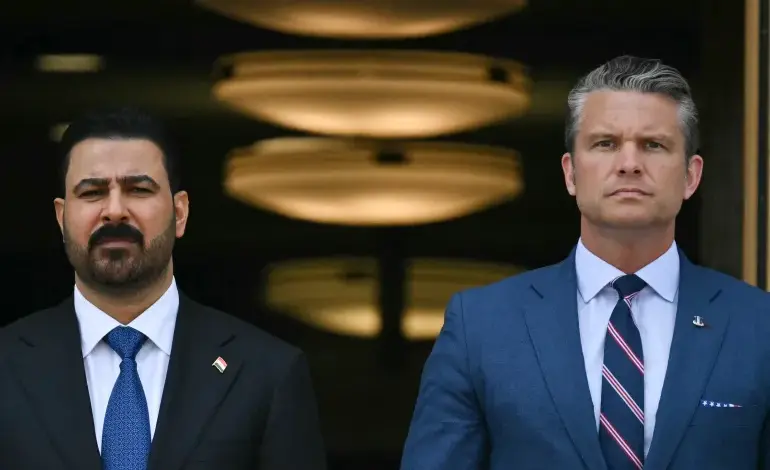
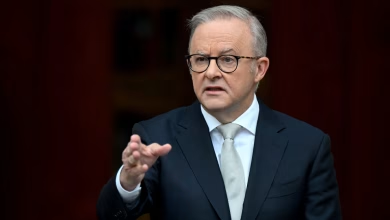
At the White House on Tuesday, US President Donald Trump was warm and effusive towards Iraq’s visiting prime minister, the 40-year-old Ali al-Zaidi, describing him as “young”, “handsome” and as someone he wanted to work with. They shook hands warmly.
Later in the day came the caveat, when US Secretary of Defense Pete Hegseth warned Iraq to disarm Iran-aligned armed groups in the country.
As the war between the US and Iran intensifies again, analysts say al-Zaidi’s Washington meetings summed up how Iraq could find itself caught in a bind, balancing two critical relationships it cannot afford to jeopardise — with the United States and Iran.
What is Iraq’s PM doing in the US?
Trump and al-Zaidi pledged to deepen economic ties and boost Iraq’s oil output during their White House meeting.
A well-informed source told Al Jazeera that meetings of Iraqi officials with US administration officials and the International Monetary Fund (IMF) have also been planned. According to the source, who asked not to be named, Iraq is seeking to secure an IMF loan of up to $8bn.
Tuesday’s meeting came after Trump threw his support behind al-Zaidi, a businessman with no political experience, and publicly opposed Iraq’s former Prime Minister Nouri al-Maliki for the prime ministerial role earlier this year. Al-Maliki, a divisive figure seen as having close ties to Iran, subsequently dropped out of contention in April.
The Iraqi government had previously said it expected several oil and gas agreements to be signed during al-Zaidi’s visit to the US, with Trump also promising a slew of deals during the Oval Office meeting.
He called al-Zaidi “a fantastic champion, a new champion”.
“Iraq has tremendous potential because of their oil and because of other things, but because of their oil, and we’re going to be doing a lot of deals,” Trump said.
The meeting also came as the US prepares to reduce its military presence in Iraq.
Both al-Zaidi and Trump said the remaining US forces in Iraq, believed to number fewer than 2,000, would completely withdraw from Iraq by September 30. That is the same date al-Zaidi pledged that armed factions active across Iraq would disarm.
But later in the day, Hegseth met al-Zaidi. In a post on X shortly after the meeting, Hegseth said Iraq “must assert its sovereignty and disarm the Iran-aligned militias” that he blamed for frequent attacks on US forces amid the US-Israel war on Iran.
It was a taste of the pressures that could amplify for Iraq in the weeks to come, say analysts.
What did Kataib Hezbollah say?
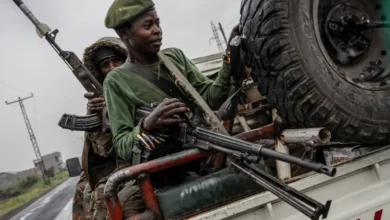
Kataib Hezbollah is part of Iran’s so-called “axis of resistance”, a loose coalition of groups including Hamas in Palestine, Hezbollah in Lebanon and the Houthis in Yemen. It is also one of the largest groups within the Popular Mobilisation Forces (PMF), founded in 2014 to stop lightning advances by ISIL (ISIS) at the time.
On Tuesday, the group made it clear that it was ready to join the war against the US if needed.
“If a war is launched against the Islamic Republic of Iran, the participation of the resistance forces will be immediate and certain. This decision is rooted in our ideology and is not open to negotiation,” Abu Mujahid al-Assaf, a Kataib Hezbollah official, said, according to Iran’s Fars news agency.
Iraq’s balancing act
Ignoring the Trump administration’s demands won’t be easy for Iraq. It relies on US companies to modernise its oil and gas companies.
Yet there’s a limit beyond which Iraq cannot afford to bend before the US.
“Baghdad is courting Washington, but it will not tolerate its territory being used as a launching pad for attacks against Iran,” Inna Rudolf, a senior fellow at the Centre for Statecraft & National Security at King’s College London, told Al Jazeera.
“While keen to revive and deepen ties with the United States, successive Iraqi governments have been careful to preserve a functional relationship with Iran, one grounded in long historical, religious, commercial and social ties.”
About 60 percent of Iraq’s population is Shia Muslim, and Iran has cultivated deep ties with many Shia political parties, religious networks and armed groups in the country. Those connections, alongside economic and security links, give Tehran considerable influence in Iraqi politics.