Hero’s welcome for Somali referee denied entry to US World Cup tournament
Barely a few days had passed between the celebrations that greeted news of Somali referee Omar Artan’s journey to the World Cup—a milestone that inspired pride and optimism among Somali football fans—and the crushing realisation that he would not, in fact, be attending because of United States immigration restrictions.
The possibility had worried many from the outset. Donald Trump had previously threatened to bar Iran from the tournament before FIFA intervened, and New York Mayor Zohran Mamdani — whose father, Mahmood, recently revealed he had once come close to taking Somali citizenship — warned that a surge of ICE activity in the city risked undermining the spirit of the tournament.
Trump has more specifically targeted both Somalia and the Somali American community with inflammatory rhetoric and has placed Somalia on a travel ban. Until Artan was in the US training with his fellow referees, there was always a risk that something could go wrong.
Artan, Africa’s reigning top referee, was posting hopefully just days in advance: “Off to Miami”, he wrote from his Istanbul hotel, where he was transiting. He would have become the first Somali referee to officiate at a World Cup, and one of seven from Africa.
But Artan was turned back at Miami International Airport and flown to Istanbul, despite travelling on a valid visa and the State Department’s own rules exempting participants in major sporting events from the travel ban. Border officers instead deemed him inadmissible, citing unspecified “vetting concerns”.
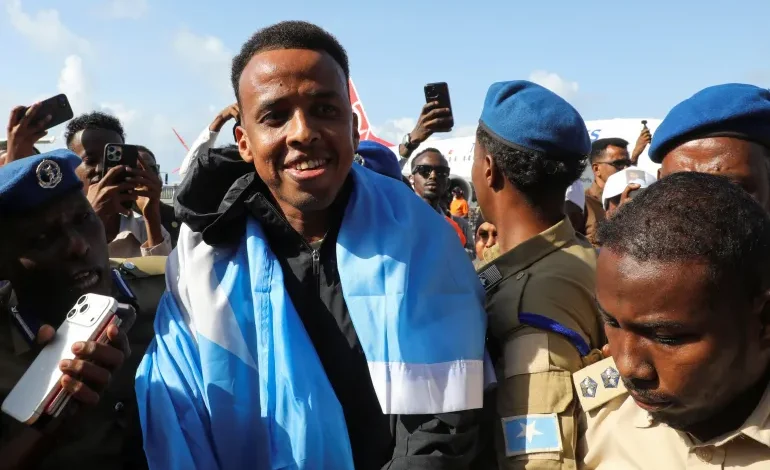
Artan received a hero’s welcome upon arriving at Mogadishu’s Aden Adde International Airport on Wednesday. He was greeted on the runway by senior government officials and welcomed outside the airport by jubilant supporters.
Addressing the crowd, Artan thanked the Somali people and government for their support and struck a defiant tone.
“Somalia belongs to all of us. Whether times are good or difficult, I want to tell our youth not to lose hope in our country,” he said.
On Tuesday, Somalia’s Ministry of Youth and Sports said it was “deeply saddened” by the decision, adding that the government had made “extensive diplomatic efforts” and engaged in negotiations with US authorities, but without success.
FIFA said the matter fell under the jurisdiction of US immigration authorities and was therefore beyond its control. Somali officials, however, told Al Jazeera that they believed FIFA ultimately bore responsibility for the situation.
Mohamed Salad, a Somali sports journalist, described the outcome as a major blow for the country.
“When Omar was selected, Somalis celebrated as if the national team had qualified for the World Cup,” Salad told Al Jazeera. “For the first time, we would have had one of our own, born and raised in Somalia, representing us on the biggest stage in world football.”