Trump’s ‘irresponsible war’ to blame for economic slowdown, German minister says
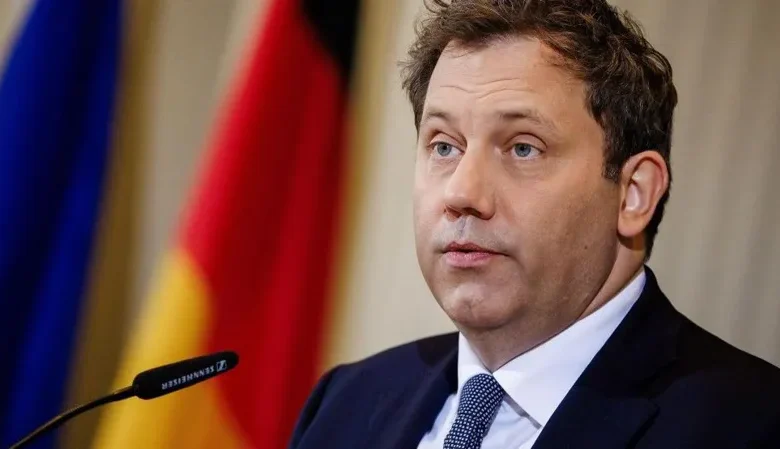
Germany’s finance minister has blamed Donald Trump’s “irresponsible war in Iran” for a big drop in his country’s expected tax revenues.
Lars Klingbeil said the US president’s actions in the region had caused a “global energy shock”.
German officials have slashed the projected tax revenue for 2026-2030 by around €70bn ($82bn; £60.52bn). The downgrade “shows just how much the war in Iran is harming our economy”, Klingbeil said in Berlin.
Last month, German Chancellor Friedrich Merz infuriated Trump with his suggestion that the White House had been “humiliated” by Iranian negotiators – comments which prompted the US president to threaten to withdraw thousands of US troops from bases in Germany.
‘Elephant in the room’ Trump looms over European attempt at unity
Since coming to office a year ago, Chancellor Merz has often indicated that Trump’s policies have changed the traditionally close relationship between the US and Europe.
In February, for instance, Merz said “a deep divide has opened between Europe and the United States”. But the German chancellor has visited the White House twice in a year in an effort to smooth the strains in trans-Atlantic ties.
Alongside other European countries, Germany has been critical of the war that the US and Israel launched against Iran on 28 February, which has considerably raised fears of a global economic downturn.
Germany’s coalition government has been struggling to boost the economy which has been stagnant for years, with high energy costs and a weak demand for exports playing a significant role.
Last month, Merz told students that “the Americans clearly have no strategy” and he could not see “what strategic exit” they were going to choose.
“The Iranians are obviously very skilled at negotiating, or rather, very skilful at not negotiating, letting the Americans travel to Islamabad and then leave again without any result,” he said.
The “entire nation” was being “humiliated” by the Iranian leadership, he added.
Trump responded the following day with a post to Truth Social, where he said Merz thought it was “OK for Iran to have a Nuclear Weapon” and “doesn’t know what he’s talking about.”
“No wonder Germany is doing so poorly, both Economically, and otherwise!” the post read.
Dragging the row on, Trump later suggested Merz should focus more on “fixing his broken Country, especially Immigration and Energy, and less time interfering with those that are getting rid of the Iran Nuclear threat”.
Earlier this month and just days after Merz’s initial comments, the US defence department announced a plan to withdraw 5,000 troops form Germany – an order which has been attributed to Defence Secretary Pete Hegseth.
Germany’s defence minister said the Pentagon decision was “foreseeable”.
The US military deployment in Germany is by far its biggest in Europe, with about 12,000 troops in Italy and a further 10,000 in the UK.
Trump is a longtime critic of the Nato alliance and has berated allies for not joining in his plans to reopen the strategic shipping route through the Strait of Hormuz, which has been effectively closed by Iran.
About 20% of the world’s oil and liquefied natural gas (LNG) usually passes through the Strait and hostilities have sent global fuel prices soaring.
The warring sides are observing a ceasefire, meant to lead to a deal to end the war.
On Wednesday, Trump said the war would be “over quickly”. Iran says it is considering a US proposal to end the war.
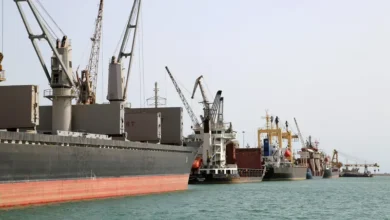
However, negotiations have stalled as the US has imposed a blockade on Iranian ports – as well as trying to open the Strait of Hormuz to allow nearly 2,000 ships stranded in the Gulf since February to pass through unharmed.