US-Iran ceasefire holds despite Hormuz standoff: Pentagon chief Hegseth
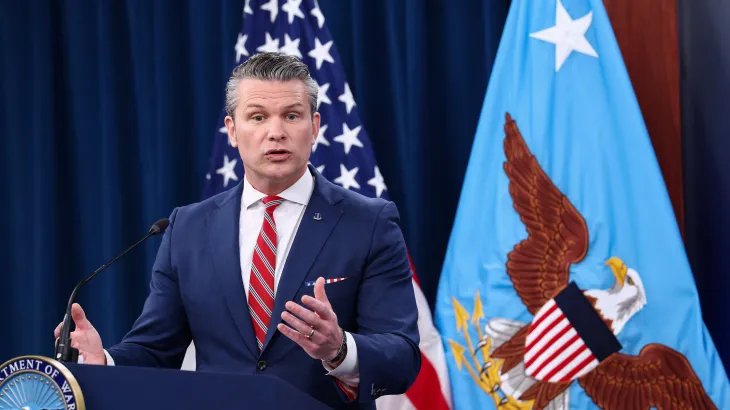
The ceasefire between the United States and Iran is still in place despite bursts of military action around the Strait of Hormuz, Pentagon chief Pete Hegseth tells reporters.
Hegseth said on Tuesday that President Donald Trump will make the decision as to when the truce ends, signalling that Washington may be willing to tolerate some Iranian attacks during the push to reopen Hormuz before renewing the war.
The defence secretary stressed that Washington’s campaign to pry open the strategic waterway – dubbed “Project Freedom” – is not part of the broader US-Israeli assault on Iran – codenamed Epic Fury.
“The ceasefire is not over. Ultimately, this is a separate and distinct project, and we expected there would be some churn at the beginning, which happened,” Hegseth told reporters.
“We said we would defend and defend aggressively, and we absolutely have. Iran knows that, and ultimately the president is going to make a decision whether anything were to escalate into a violation of the ceasefire.”
Monday saw the highest level of hostilities in the war since the truce came into effect on April 8.
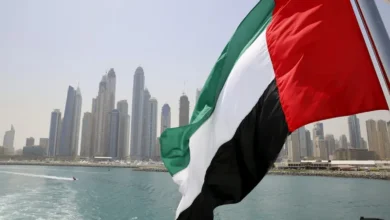
Iran said it fired at US Navy ships; the US said it shot down seven small Iranian military boats; and Tehran renewed its drone and missile launches against the United Arab Emirates. A South Korean ship near Hormuz was also hit in a suspected Iranian attack.
And there were casualties. Three people were injured in the Iranian strike on the UAE’s Fujairah Petroleum Industries Zone, and Tehran said a US attack on a passenger boat in the Gulf killed five civilians.
Iran stresses ‘new equation’
Hegseth said on Tuesday that the US has secured the waterway and is communicating with ships, companies and insurers to encourage vessels to pass through.
“We have established a powerful red, white and blue dome over the strait,” the Pentagon chief said.
“American destroyers are on station, supported by hundreds of fighter jets, helicopters, drones and surveillance aircraft, providing 24/7 overwatch for peaceful commercial vessels.”
Hegseth said that as the US safeguards the passage of ships through the strait, Iranian vessels will not be permitted to pass, emphasising that Washington’s naval siege on Iran’s ports continues.
US officials, however, have not shared details about how many vessels the US would be escorting or whether ships have agreed to go through while the threat of attacks remains high.
Top US General Dan Caine referred the question to the Middle East-based Central Command of the US military when asked for specifics.
“I’ll let CENTCOM talk to the number of ships they’re going to take through because they’re the nearest ones to talking to the commercial shippers, and I don’t want to get out in front of them,” Caine said.
Tehran has dismissed the US campaign, stressing that it is still in control of the waterway.
Before the war, about 20 percent of the world’s oil and natural gas flowed through the Strait of Hormuz.
Although parts of the waterway go through Iranian and Omani territorial waters, Hormuz shipping lanes were free and treated as international waters.
But now Iran is making claims to the strait, which it successfully closed shortly after the US-Israeli strikes on February 28. Most of the international community has stressed the need for maintaining free trade through Hormuz.
Iranian Parliament Speaker Mohammad Bagher Ghalibaf said on Tuesday that Tehran is solidifying the “new equation” in Hormuz.
“The security of shipping and energy transit has been jeopardised by the United States and its allies through the violation of the ceasefire and the imposition of a blockade. Of course, their evil will diminish,” Ghalibaf wrote on X.
“We know full well that the continuation of the status quo is intolerable for America, while we have not even begun yet.”