Why is India’s Manipur burning for three years?
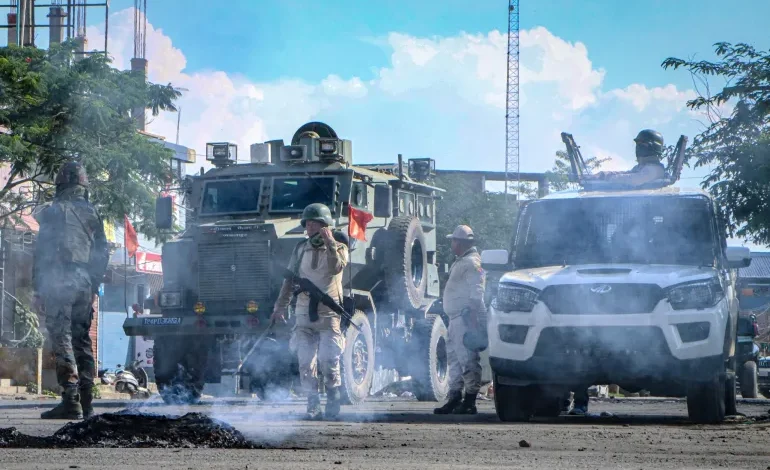
Violence has erupted yet again in India’s northeastern state of Manipur, shattering months of relative calm after a bomb blast earlier this month killed two children.
The state, sharing a 400km- (250-mile-) long border with Myanmar, is bitterly divided between the mainly Hindu Meitei majority, who live in the valley, and the predominantly Christian Kuki-Zo community that mostly lives in the hills.
The renewed violence is the latest chapter of a three-year-long civil conflict that has torn the state apart, leaving communities living in deep segregation, and raising questions about the apparent inability of Prime Minister Narendra Modi’s government to put an end to the fighting.
Over this period, the state has seen a year of federal rule, and Modi’s Bharatiya Janata Party – which rules the state – changed the chief minister. Yet none of those moves has been able to resolve the conflict or rebuild bridges between communities that have lived by each other for centuries.
At least seven people have been killed, and more than a dozen arrested, since the latest episode of violence broke out on April 7.
So, what’s happening in Manipur? And why has the Indian state been burning for more than three years now?
What happened in Manipur?
On April 7, a bomb blast in the afternoon at a house in the Tronglaobi Awang Leikai area in Manipur’s Bishnupur district killed two children, aged 5 and 6, from the Meitei community and injured their mother. Their father is a soldier in the Border Security Force, an Indian paramilitary force.
The Meitei leaders blamed it on Kuki fighters. But Kuki groups denied involvement, saying the village was not close to their areas of access.
Nonetheless, a fragile peace was shattered again in the state. Organisations called for shutting down towns, and men, women and youth came out in protests, setting up blockades and clashing with the police. Some demonstrators set oil tankers on fire.
The clashes between protesters – who were demanding the arrest of killers – and security forces have left dozens of people injured. The key road connecting Bishnupur to Kuki-dominated Churachandpur has remained blocked for two weeks. At least three others were killed after paramilitary forces opened fire on protesters on April 7.
Last Saturday, alleged fighters ambushed vehicles on a national highway in the state’s Ukhrul region, killing two men, including a retired soldier – and pushing a state trapped in a cycle of ethnic violence for more than three years now to the edge once again.
Why is Manipur burning?
Once a princely kingdom, the region that constitutes Manipur was taken over by the British until it became a part of independent India in 1947. Historically, the Meiteis have dominated the plains and the valley – where the capital, Imphal, is based, too – while the Kuki and Naga communities have mostly lived in the hills.
In post-independent India, land laws were introduced to keep this delicate balance intact: Meiteis were barred from buying land in the hills, where the Kuki-Zo community was given a scheduled tribe status that carved out jobs, education, and political representation for them.
In the coming years, a web of ethno-nationalist rebellions emerged in Manipur – with fighter groups from Meitei, Kuki, and Naga communities – each demanding territorial sovereignty and autonomous rule.
In 2023, the fuse was lit.
Nongthombam Biren Singh, a former football player and regional leader of Prime Minister Modi’s Hindu-nationalist BJP, became the state’s chief minister in 2017. He is from the Meitei community.
In public comments, Biren Singh started increasingly portraying the hill-based tribal communities as “illegal immigrants” and “narco-terrorists”, while appearing to support the Meitei nationalist outfits.
Then, on April 14, 2023, the Manipur High Court passed an order widely viewed as a step towards recognising the majority Meitei community as a scheduled tribe – a move that the Kuki-Zo community feared would make jobs and educational opportunities previously reserved for them accessible to Meiteis, too.The court order prompted state-wide ethnic clashes.
Biren Singh, the chief minister, was widely accused of being partial as the fighting raged, favouring Meitei groups. Meanwhile, Modi – who, by that point, had already visited more than 60 countries, many of them multiple times, as prime minister – chose not to visit Manipur, drawing intense criticism.
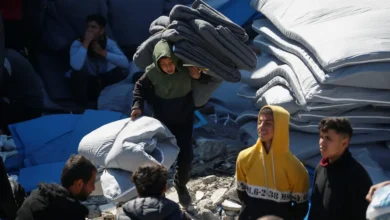
More than 260 people have been killed, and at least 60,000 have been displaced into segregated relief camps since the conflict began – numbers that civil society activists say are conservative.
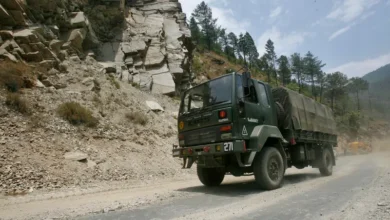
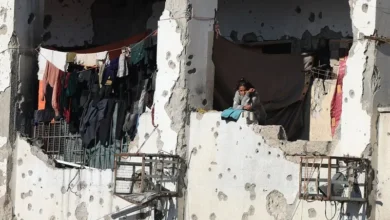
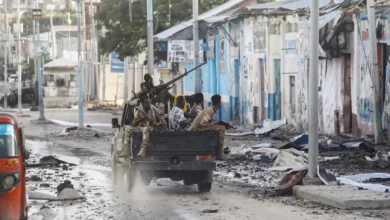
Over time, the segregation further deepened, with government forces managing buffer zones, while the young and old, gun-wielding men, guard their areas. More than 250 companies of the Central Armed Police Forces are stationed in Manipur, alongside other forces, making the state among the most militarised zones in South Asia.
In February 2025, Biren Singh finally stepped down as chief minister – by then, the BJP was clearly on the back foot politically, having lost support from within the Meitei community, too, over its failure to end the violence. The BJP had lost both parliamentary seats in Manipur in the 2024 national elections, with the opposition Congress winning those seats. Finally, Modi visited Manipur in September 2025.
After the recent clashes, Manipur’s new chief minister, Yumnam Khemchand Singh, also from Modi’s BJP, said the perpetrators were yet to be identified and that the bomb attack was the “handiwork of individuals or groups with an interest in disturbing the prevailing peace”.
In more than three years, the conflict has left no one untouched in the state, spilling over into daily life. In the village of Tronglaobi, where two children were killed in the bomb blast, a majority of the people are dependent on farming, but large parts of the agricultural fields reportedly lie in so-called “buffer zones” – heavily militarised areas that are out of bounds for both valley-based Meiteis and hill-based Kuki-Zo communities.