Rubble, mud and hair: How to rebuild a home in Gaza
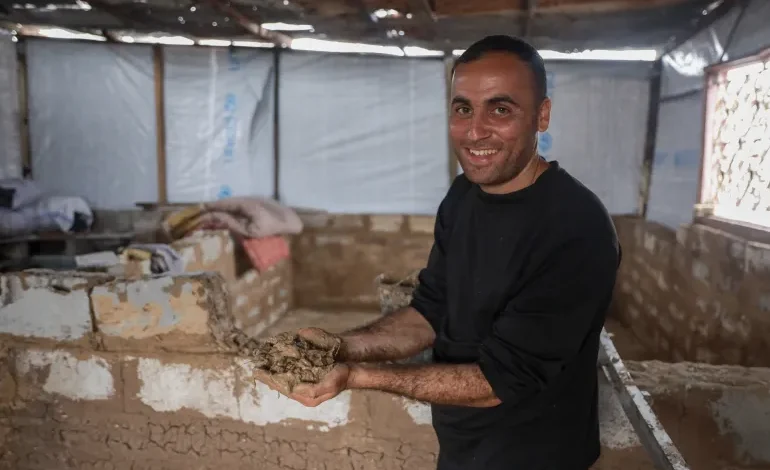
It’s a small space, covered with a worn-out metal sheet roof and tarpaulins. Mohammed al-Jadba is working on the walls, using stones from the rubble of his destroyed house and mud to fill the gaps.
It almost looks like a home, but isn’t quite one yet.
Mohammed’s old home – in Gaza City’s Tuffah neighbourhood – was once a four-storey building. But Israel’s genocidal war on Gaza has left it, and the area around it, resembling the aftermath of an earthquake.
The 31-year-old has been living with his family of 10 in tents beside the rubble of their old home since the October ceasefire.
After a rainy winter that left his family wet and cold, he has decided to use what he can to build a more permanent shelter. In the absence of construction materials, such as cement, because of Israeli restrictions on imports into Gaza, he is forced to use mud and whatever he can salvage from his old home.
“I said I want to make a place … a small space, a room and a bathroom, that’s it,” Mohammed tells Al Jazeera, adding that the experiment has quickly grown into something much bigger than he had imagined.
“I built one room, I liked it … so I said, I’ll build another … then a living room, a kitchen, a bathroom … I thought, ‘Oh God, what have I gotten myself into?’”
Mohammed has been working on the small house for four months. He describes collecting iron, window frames, and door frames from his old house.
The mud sticks everything together – but Mohammed soon faced a problem, a lack of straw, which is necessary to mix into the mud and make it more durable.
“Straw isn’t available in the markets and hasn’t entered through the crossings for a long time,” he says.
Mohammed soon found an alternative – human hair. He began collecting it from barbershops, and the subsequent mix of mud and hair, along with the stones extracted from the rubble, formed walls that proved to be stronger than expected.
Mohammed’s motivation was not only to find shelter, but to secure a minimum level of safety, as gunfire continues daily from Israeli forces stationed about one kilometre (0.6 miles) away from them.
His mother was injured about a week ago by a bullet that pierced their tent, and she was taken to hospital, prompting him to accelerate construction.
“The tent is dangerous; it neither protects nor shelters,” he says. “My mother was injured, and months ago, our neighbour was killed by a bullet that pierced her heart while she was sleeping.”
Mohammed knows that the structure he is building is not a permanent solution. But, with the reconstruction Gaza so desperately needs still absent, he has few other options.
“Anyone following what’s happening in Gaza knows that reconstruction is a very distant dream … even a lie,” he says in frustration.
“If rubble removal alone will take five years and hasn’t even started yet, what about reconstruction?”
Delayed reconstruction
The United Nations estimates that it will cost $70bn to fully reconstruct Gaza, which has been devastated by Israeli bombing and deliberate demolition.
UN figures show that 92 percent of residential buildings in Gaza have been damaged or destroyed in the war, which began in October 2023.
An urgent $20bn is needed within the first three years just to initiate basic recovery and restore essential services, such as water, health, education, and transport infrastructure.
Despite those estimates, no large-scale reconstruction has taken place, largely due to continued Israeli restrictions on the entry of construction materials and heavy machinery.
Palestinians in Gaza have instead focused on partial reconstruction, using what they can find until they are able to import more durable materials.
“Partial rehabilitation is a non-structural intervention … we are not rebuilding destroyed structures, but making partially damaged homes habitable and protecting residents from the rain, cold, and wind,” said Muath Humaid, a project engineer and coordinator working on projects implemented in partnership with the United Nations Development Programme (UNDP).