‘Germany calling’: How fascist ‘Lord Haw-Haw’ was trialled for treason
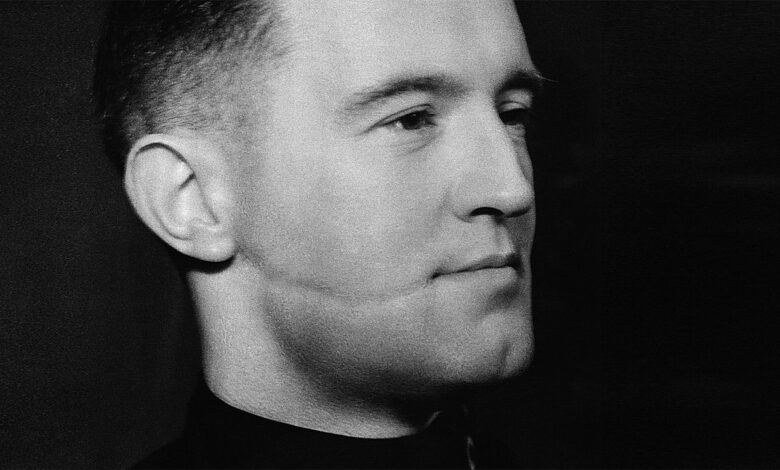
With his mocking English accent, the mysterious radio host broadcast to the UK from a German station, spreading rumours and exaggeration in the early days of World War Two.
Three days before Germany’s unconditional surrender on VE Day in May 1945, spoke from a Hamburg radio studio on the same microphone and wavelength that weeks earlier had broadcast Nazi propaganda. “Tonight, you will not hear views on the news by William Joyce. For Mr Joyce, Lord Haw-Haw to most of us in Britain, has been most unfortunately interrupted in his broadcasting career… This is the BBC, calling all the long-suffering listeners in Britain who for six years have had to put up with the acid tones of Mr Joyce.” Rummaging through Joyce’s desk, Vaughan-Thomas found his timetable for 10 April 1945: “At the end of it is the glorious item: 1450 to 1510 hours, ‘A pause to collect my wits.'”
Joyce had fled the war-ruined city weeks earlier with fake papers, at his wits’ end and hoping to evade capture by the advancing Allied forces. On his final recording, he sounds drunk and defeated: “I have always hoped and believed in the last resort, there would be an alliance… between England and Germany. Well, at the moment that seems impossible. Good. If it cannot be, then I can only say the whole of my work has been in vain.” The tape, retrieved from a captured Nazi recorder, may never have aired. A devoted Nazi to the end, he signs off: “Es lebe Deutschland (long live Germany), Heil Hitler and farewell.”

It was an ignominious end for a man who had become a household name in the UK when war broke out in September 1939. British citizens had expected Hitler to launch a catastrophic attack immediately, but when that didn’t happen, the tense lull was dubbed the Phoney War. In those early days, the main hazard on the home front wasn’t air raids but twisted ankles. To hinder German bombers, the government enforced a blackout. By Christmas 1939, a Gallup poll found a fifth of the nation’s population had fallen downstairs, collided in the dark or suffered other, mostly minor, injuries. Road deaths almost doubled until petrol rationing cut traffic. Entertainment venues were shut and gatherings banned, so at night people had little choice but to stay at home and listen to the radio.
His style was to entertain while undermining his audience’s morale by spreading doubt through semi-plausible rumours, exaggeration and ridicule
Many were unimpressed of short bulletins with little to report, dull public information announcements, and filler such as Sandy MacPherson’s organ recitals. Further along the radio dial, anxious listeners found something livelier: a mystery man broadcasting via Medium Wave on the Reichs-Rundfunk-Gesellschaft (RRG), nationalised under the Nazis. In an exaggerated, nasal, upper-class English accent, he announced himself with the catchphrase, “Germany calling, Germany calling.”
The Daily Express radio critic Jonah Barrington dubbed him Lord Haw-Haw, and the nickname stuck. Barrington’s aim was to belittle the propagandist from Germany, but it turned out that many listeners enjoyed the shock value of Haw-Haw’s nasty novelty act. His style was to entertain while undermining his British audience’s morale by spreading doubt through semi-plausible rumours, exaggeration and ridicule. In one broadcast, he talked of “panic and confusion… hourly gaining ground” in Britain. “The only wonder is that the people of this doomed island took so long to realise the nature of the positions into which their politicians had led them,” he said.
In another, Haw-Haw mocked people’s fears about the threat of German bombs. He said: “The British Ministry of Misinformation has been conducting a systematic campaign of frightening British women and girls about the danger of being injured by splinters from German bombs. The women have reacted to these suggestions and alarms by requesting their milliners to shape the spring and summer hats out of very thin tin plate.” It doesn’t seem very amusing now, but perhaps you had to be there.
At the broadcasts’ peak, six million Britons tuned in nightly after the 21:00 news. Prof Tom Harrisson, a former advisor to the British Ministry of Information, said in 1975 that while many people didn’t understand the German-language rants of Nazi figures like Goering and Hitler, Haw-Haw was “in some ways… rather reassuring, too, because he didn’t sound so bad at all. Perhaps the enemy wasn’t going to be so horrible.”
William Joyce, aka Lord Haw-Haw, had moved to Germany a month before war broke out with his second wife Margaret, also a fascist. Fearing internment in England, he renewed his UK passport by falsely claiming he was a British subject by birth. This would turn out to be a fatal error.
In fact, Joyce was born in Brooklyn in 1906, moved to Ireland aged three, and grew up in County Galway. As a teenager during the Irish War of Independence, he acted as a courier for British military intelligence. This behaviour did not win him many friends in Ireland, and when the war ended, the family left for a new life in England.
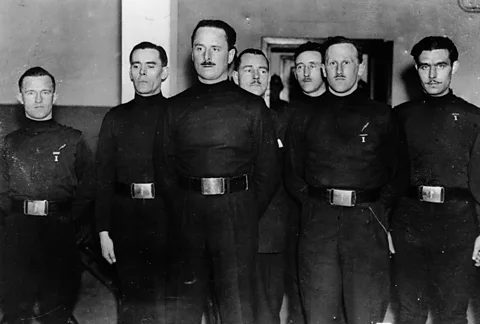
As a young man, Joyce was attracted to the extreme right-wing ideology spreading in Europe, and in 1932 he joined Sir Oswald Mosley’s British Union of Fascists. He gained a reputation as an impassioned orator, and was made its director of propaganda. But the tide turned against the party, culminating in the 1936 Battle of Cable Street when Mosley’s Blackshirts were attacked and turned away by Jews and Irish labourers in London’s east end. The ousted Joyce set up his own National Socialist League, but finding no welcoming home for his virulent antisemitism, he soon felt Germany calling.
War of words
Under Joseph Goebbels’ war of words, English-language radio programmes were beamed into Britain. Staffed by British fascists and English-speaking Germans, the RRG broadcast propaganda promoting the Nazi way of life and highlighting British social problems. It’s thought the original voice of Lord Haw-Haw was in fact that of a German, Wolf Mittler, but weeks after war broke out, the loquacious fascist Joyce found his dream job.
Joyce’s broadcasts won grudging respect even among those who despised his message. Critic and author Harold Hobson wrote to The Times on 29 December 1939, praising Haw-Haw’s Christmas Eve broadcast for boosting “festive cheer” with his jibe that rationing had limited Britons to “a quarter-pound of butter a week”. Hobson added that the BBC could have easily demolished the argument by noting that Haw-Haw omitted what Germans received, which was presumably even less.
His hand dropped back to his pocket, I thought he was going for his gun. I drew my own pistol, aimed low and fired – Geoffrey Perry
But soon the Lord Haw-Haw joke wasn’t so funny anymore. The invasion of Denmark and Norway on 9 April 1940 was seen as the turning point when Britain’s so-called Phoney War ended and real warfare began. Meanwhile, public perception of the BBC changed dramatically as it reinvented itself as a lifeline of information for people on the home front and in the armed forces. Haw-Haw became increasingly irrelevant, and by the time of his final drunken broadcast in April 1945 the game was up both for him and the Nazi regime.
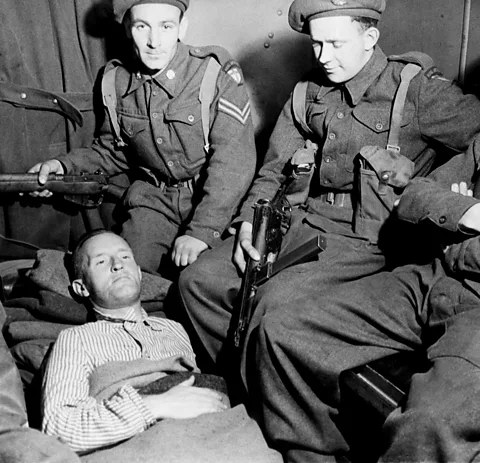
As Allied forces continued to advance into Germany, Joyce and his wife planned to flee to Sweden before travelling on to neutral Ireland. They only made it as far as the Baltic port of Flensburg, near Germany’s border with Denmark. Under false identities, they settled in a nearby village and sometimes chatted with British soldiers who had no idea who they were. But one day Joyce’s luck ran out when he encountered two British officers while out gathering wood.
One of them, Geoffrey Perry, told the BBC how they got talking to this “very odd tramp-like figure”. His colleague noted to him that he “sounded terribly like William Joyce”. After a friendly chat about coniferous and deciduous trees, Perry said he felt certain of two things: it was Joyce and he had a gun. When the stranger picked up a log with both hands, Perry seized his moment. Before the man had a chance to react, he asked: “You wouldn’t be William Joyce by any chance, would you?” Perry said what happened next: “And his hand dropped back to his pocket. I thought he was going for his gun. I drew my own pistol, aimed low and fired.” The officer’s bullet hit Joyce in the bottom. One nice irony is that Perry was Jewish and was born in Germany: it was only after he had moved to Britain in the 1930s that he had changed his name from Horst Pinschewer.
The wounded Joyce was brought back to England and charged with high treason. But how could an Irish-American be accused of betraying Britain? Joyce’s fate was sealed by his hasty passport application made on the eve of war.
Britain’s most senior lawyer at the time, Sir Hartley Shawcross, told the BBC in 1975 that Joyce had “clothed himself in the Union Jack” and had been entitled to the protection of the British Crown, meaning that it was treasonous of him to aid the UK’s wartime enemy. Other lawyers disagreed, such as Sir John Foster QC, who described the charge of high treason as “a blood hunt”. He told the same documentary: “He’s found guilty on a passport which he’d fraudulently obtained, which in my view didn’t involve any protection by the Crown and therefore no allegiance by William Joyce.”
All the same, Joyce was convicted of high treason for having “adhered to the King’s enemies” by broadcasting on their behalf between 18 September 1939 and 2 July 1940, the date when his British passport expired and he became a German citizen. The case went to several legal appeals, but the verdict was the same. He was unrepentant to the end. On the morning of 3 January 1946, he was executed by hanging at Wandsworth Prison in London. He was buried in an unmarked grave in the prison grounds.
Thirty years later, following a long campaign by his daughter Heather, Joyce’s remains were exhumed and reinterred in County Galway. The man who was born as an American, lived as a German and died a British traitor was buried finally as an Irishman.