Why the world is running out of frankincense
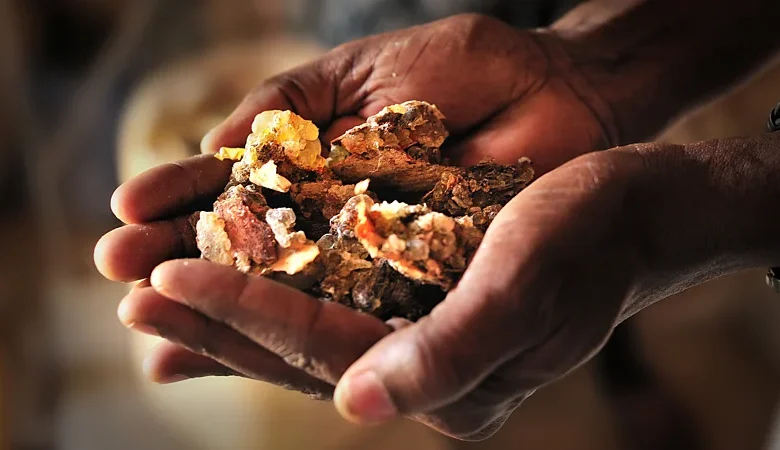
The precious, fragrant resin is the scent of the festive season and rising in popularity in the wellness industry – but its natural source is being decimated.
Salaban Salad Muse has built his whole life around frankincense.
Living the small town of Dayaha in the Sanaag region of Somaliland, a breakaway region of Somalia, he works as a seasoned harvester of the famously aromatic resin, obtained only from the Boswellia tree.
Every year, Salad Muse camps for three to six months in a cave near the site he owns with these trees on it. Each day he heads out the land, owned and tended by his family for generations. He moves from tree to tree, inspecting the bark for pests, scraping back sand and tending to seedlings he planted earlier in the season.
But the fate of these groves, and the entire livelihood of frankincense harvesters, is hanging in the balance. As groves fail, the local and global industries built up around frankincense are being forced to reconsider how this precious substance is produced, traced and sold around the world.
Frankincense is famously associated with the biblical sacred offering gifted to the baby Jesus alongside gold and myrrh from the three magi. It has also been used for millennia in Indian and Chinese medicines, it is of the oldest commodities traded globally. Today it has become a staple of the $5.6tn (£4.2tn) wellness industry, used to produce a fragrant cloud of smoke used for meditation and medicinal healing, as well as the rituals woven into centuries of Catholic worship.
For Salad Muse, however, it has far more earthly associations. He and many other harvesters in Somaliland and surrounding countries rely on frankincense for their income.
It can take 10 years or more for a tree to recover from damage inflicted by excessive harvesting
The Horn of Africa is one of the main areas of production globally, including Somaliland, Somalia, Ethiopia and Sudan. Today, though, local tensions, meagre payments to farmers, uncertain regulation and a rising global demand are putting pressure on some harvesters in these countries to tap trees to unsustainable levels.
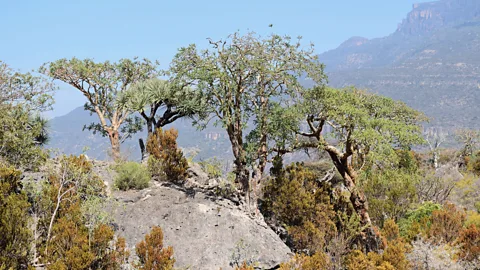
A world away from the jubilant festive story, the sought-after commodity begins with several subspecies of the Boswellia tree, a hardy desert tree with papery bark and sparse leaves, often found clinging to cliffs in Somaliland’s dry highlands. Harvesters in Somaliland scrape resin from the bark of wild Boswellia trees, often working long hours for pay based on resin output, under a system of volatile prices and informal supply chains. They can also be left vulnerable to middlemen who capitalise on conflict in the area and a lack of government oversight, experts say.
Like birch water and maple syrup, frankincense is harvested through a process known as tapping, where incisions made in the bark of the tree allow the resin to seep out. The sap hardens into “tears” over several weeks, which harvesters then scrape off the tree.
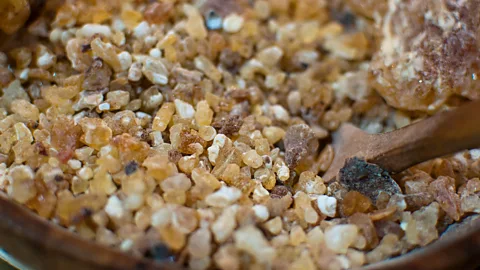
Traditional resin tapping is done sparingly, with careful incisions. But today, Boswellia trees are often tapped far more than they can cope with, causing long-term damage to the valued tree. According to a 2022 report, it can take 10 years or more for a tree to recover from damage inflicted by excessive harvesting.
Many other factors are also affecting the trees. Climate change is already impacting some areas. Outbreaks of a wood boring beetle has also been devastating. Populations of B. papyrifera, the main source of frankincense found in Ethiopia and Sudan, are now collapsing throughout their geographic range, according to a 2019 Nature study. Over 75% of populations studied lack young trees, it found, and natural regeneration has “been absent for decades”, due to a combination of “cattle grazing, frequent burns and reckless tapping”.
The study noted that other Boswellia species facing similar threats (the frankincense trade remains overwhelmingly dependent on wild trees rather than cultivation). Within 20 years, the study projected, frankincense production will drop by half.
Researchers have, however, noted the difficulty of assessing trees in Somaliland due to the local tensions.
Frankincense is “surely threatened”, although there is only good and available data for a few species, says Anjanette DeCarlo, founder of the Save The Frankincense project and co-author of the 2022 report about damage to Boswellia trees from excess harvesting. For several species, however, there are many individual trees left, she says. “It all depends on the main threats within each location such as grazing by camels, extensive tapping, extreme weather (flash floods for example) and mining.”
Planting frankincense at a larger scale, from West Africa to Ethiopia, could also help the situation, she adds. “It could be a good boost. It would increase the probability of survival of the species and of frankincense in the long term tremendously.”
However, others have noted that a rise in cultivation could also carry risks, such as stimulating conflicts over land or water.
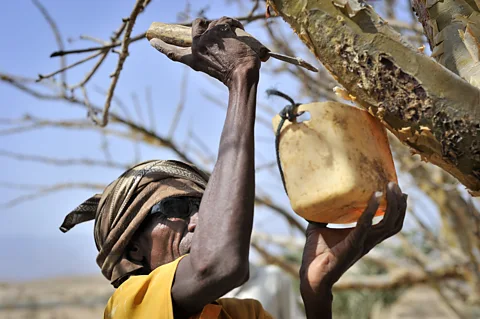
Political upheaval in Somalia and Somaliland can leave harvesters exposed to spot contracts – a buy-now, pay-now trade involving multiple steps of middlemen, says Andy Thornton, a market expert on frankincense and managing partner at Silvan Ingredient Ecosystem, a resilient supply chain consultancy.
By the time the resin reaches Western incense suppliers, it can sell for up to $60-100 (£45-75) per kg, he adds, but harvesters in Somaliland typically receive only $2-5 (£1.50-3.70) per kg, a mere 3% of the final value.
“The people who are doing the exporting price are those who have enough money to be able to aggregate the supply chains and then take the risk on the transfer of it,” says Thornton.
The global frankincense market was estimated at $363m (£271m) in 2023, trading some 6,000-7,000 tonnes each year, and is projected to almost double in value to over $700m (£520m) by 2032. Of the 24 species of Boswellia tree spanning the globe, Somaliland’s two key native species are particularly prized for their properties and aroma. The demand for Boswellia frereana, native to northern Somalia and Somaliland, is so strong that international buyers have coined it “the king of frankincense”. It’s made Somaliland’s frankincense trade one of the largest globally, with estimated exports of at least 1,000 tonnes each year.
Over-harvesting of Boswellia trees usually comes as a result of economic pressure, says Thornton, but he also points to environmental strains. “The more climate and water stress, the less viable pastoralism becomes,” he says. “So, when prices depress but frankincense is the last income, harvesters have little choice but to cut more trees.”