Why is Iran threatening regional airports, and what could be the impact?
Iran has threatened neighbouring countries with retaliation if they enforce new United States sanctions designed to stop Iranian airlines from operating internationally, raising the prospect of further disruption to air travel across a region already affected by nearly seven months of the US-Israel war on Iran.
“I urge all our neighbouring countries not to get involved in the United States adventure. This adventure will very soon end in failure,” Mohsen Rezaei, secretary of Iran’s Supreme National Security Council, told Iranian state media.The warning came as Iranian carriers cancelled a number of international flights after the US threatened airports and aviation service providers with secondary sanctions if they continued doing business with it. On Thursday, the all Iranian flights to and from the United Arab Emirates were cancelled, the Iranian Students’ News Agency reported.
Azerbaijan and Georgia had on Wednesday confirmed suspending Iranian flights, while flights to Baghdad and Muscat have also been halted. Meanwhile, several connections to Turkiye and China have continued, but many flights to these countries have been cancelled, too.
So, what has Iran said, can it carry out its threats against neighbouring countries, and how could this potentially affect the travel industry in the region?
What has Iran said?
Rezaei warned on Wednesday that Tehran would retaliate against neighbouring countries that cooperate with the US restrictions.
“If a country cooperates with or embarks on adventures with the United States, its airports will no longer be able to operate flights” to Iran, Rezaei told Iranian state television. Rezaei said Iran would ensure airports in countries stopping Iranian flights “cannot function”.
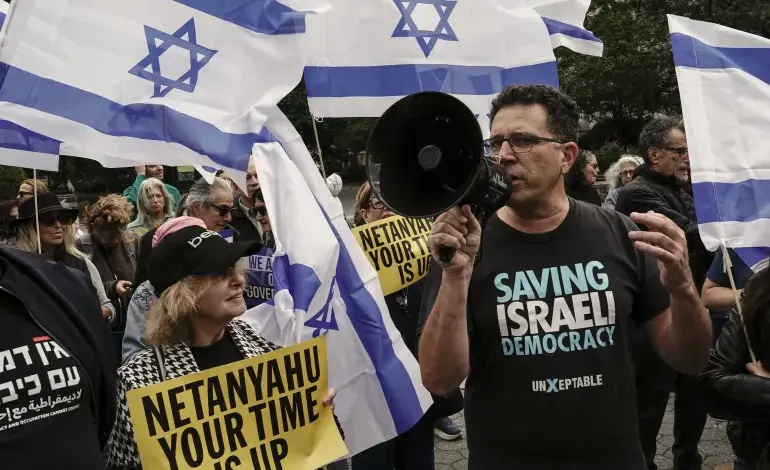
“The UN is playing host to a war criminal,” said Sonya Meyerson-Knox from Jewish Voice for Peace, a New York based group protesting against the Israeli premier. “Solidarity with Palestinian freedom has never been greater, and here in the US we are demanding with one voice: Stop arming Israel.”
For Netanyahu, appearing in front of the UNGA for the 15th time, the stakes have rarely been higher.
Addressing a domestic Israeli audience that polls show to be losing faith in him and his Likud party in the run-up to crucial elections later this year, Netanyahu has already pitched himself as Israel’s primary voice on the international stage.
Nevertheless, analysts say Netanyahu’s address could prove a pivotal moment domestically, amplified by international criticism of Israel and expected to dominate headlines and be carried live across the country’s television networks.
“This is a regular fixture for him,” former Israeli consul general in New York and ex-government adviser, Alon Pinkas, told Al Jazeera. “It’s his way of being seen in Israel as standing up against the world and of telling members that he will never give up or surrender. He’s also turned the event into some kind of national holiday in Israel, with everyone sitting down to watch the address on television. He’s brainwashed people in Israel into believing his speech is somehow an announcement of policy, stated in defiance of the [rest of the world] who don’t believe a word he says.”A history of hostility
Israeli leaders have long framed their stance towards the UN as one of defiance in the face of hostility. The UN has long been a platform for critics of Israel’s illegal occupation of Palestinian land and repeated attacks on its neighbours. It has included attempts to censure Israel over what UN investigators have described as apartheid in the West Bank, as well as accusations of genocide and pogroms across the occupied Palestinian territory since October 2023.