Why cash continues to thrive even as India’s digital payments grow
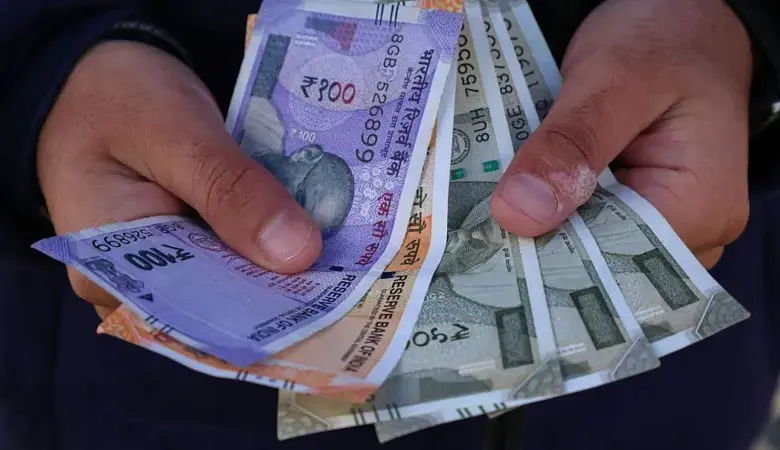
Every year, more Indians tap, scan and swipe. Every year they also hoard more paper.
The Reserve Bank of India (RBI) – the country’s central bank – now has 176 billion banknotes in circulation. It’s printing 28-30 billion fresh ones across six denominations annually and retiring roughly 21 billion. It is a vast logistics operation.
And yet, as Unified Payments Interface (UPI) digital transactions surge towards a billion a day, cash sloshing around the economy keeps climbing at a brisk pace.
“Currency in circulation continues to grow at double-digit rates even as cash’s share of individual transactions declines, thanks to growing digital payment adoption. That combination makes future demand harder to predict, which complicates our planning for production and distribution capacity,” Shirish Chandra Murmu, RBI deputy governor, said in a speech to central bankers in Jakarta last month.
He called it the “cash paradox”. But what exactly do we mean by currency in circulation?
It is the total value of physical banknotes and coins held by the public and businesses, whether spent or simply held. In India, cash reaches them through four main channels: the RBI’s 19 regional offices; bank branches; more than 250,000 ATMs and cash dispensers; and millions of “business correspondents”, local agents who provide basic banking services in rural areas and smaller towns.

That is a huge stock of cash by any measure. For context, about 56 billion US dollar bills and 30 billion euro banknotes were in circulation at the end of last year, according to Murmu.
The comparison comes with a caveat: the RBI’s count is partly driven by a higher share of lower-value notes, meaning more notes are needed to handle the same value of transactions.
The puzzle is not that Indians still use cash – 94% of transactions were cash-based as recently as 2019, according to new research by Anirudh Tagat, Mehmet Ozmen and Pushpa Trivedi. It is that cash is growing even as its share of everyday payments shrinks.
“The cash paradox has been examined globally, and India is a unique and novel case study of the same given the scale of both cash and non-cash payments,” Tagat, an economist who studies Indian payment behaviour, told the BBC.
He notes that the phenomenon of cash growing alongside digital payments has been especially prominent since the 2007-08 global financial crisis, with Bank for International Settlements research showing a similar pattern worldwide.
In Tagat’s framing, currency still serves three purposes – as a means of payment, a store of value and a hedge against calamity. Apps are replacing only the first. That helps explain why digital payments alone cannot tell the whole story of cash demand.

David Humphrey of Florida State University, who has studied cash use across 14 economies with co-author Tanai Khiaonarong, says digital payment adoption is just one of several factors that can influence how much cash people hold.
That raises another question: are households holding more cash outside the banking system – for emergencies, safekeeping or to buy assets such as gold in India?
He also points to a factor that is especially important for major reserve currencies: a lot of the growth comes from notes held or used abroad, rather than in the country that issued them.
The US is a case in point: large-denomination $50 and $100 notes are widely held and used overseas but are “rarely seen in normal domestic legal cash transactions”, Humphrey says.
He add that the Federal Reserve regularly receives unfit US currency from abroad, replaces it with fit notes and returns them to the sender. Most of the value of these unfit notes is in $50 and $100 bills.
This helps explain, he says, why the Fed reports that the total value of US currency in circulation continues to rise even as the value of cash withdrawn from domestic ATMs – a proxy for everyday spending, mostly in $20 notes, along with $5 and $10 bills – has recently fallen.

Then there is the less visible side of the cash economy. Humphrey’s research identifies the rising value of domestic illegal activity, which often relies on unrecorded cash transactions, as one structural reason currency growth can outpace recorded spending – a factor particularly relevant to India.
Property deals in India routinely involve cash payments, partly because stamp duty and government-set “circle rates” can lag market prices, giving buyers and sellers an incentive to under-declare the transaction and settle the difference in cash.
Demonetisation, which overnight invalidated 86% of the country’s cash by value in 2016, attacked the stock of “black” cash but left this flow largely untouched, say economists. That helps explain why decades of estimates of “black money” sunk into real estate have never produced a reliable figure.
Then there is what might be called the psychology of frictionlessness. Tagat points to research, including work published recently in the Journal of Consumer Research, showing digital payments are increasingly engineered to strip out the “pain” of paying – the wince of handing over notes – and replace it with a satisfying beep.
That should, in theory, hollow out cash demand further. That it has not suggests something else is propping currency up: fear – not just the fear of spending, but the fear of what happens when digital systems fail.

Here the Indian story rhymes with Europe’s.
The European Central Bank (ECB) has watched euro banknotes in circulation rise from about €1 trillion in 2016 to €1.6 trillion this year, even as cash’s share of point-of-sale transactions has fallen towards half.
Philip Lane, the ECB’s chief economist, told a summer conference in Ireland this year that while the number of notes used in transactions is falling, the stock held by households keeps growing – something identical to what Murmu alluded to in Jakarta.
Olive McCarthy, a professor at University College Cork, traces this to the ECB’s own 2021 research on what it dubbed the “paradox of banknotes”, driven by households hoarding cash as savings and by demand for euros outside the currency zone itself.
Governments in Austria, Finland, Germany, Sweden and the Netherlands have responded by formally advising citizens to keep a minimum amount of cash at home, insurance against blackouts, cyberattacks or war. Clearly, cash, in rich democracies as much as in India, is being repositioned as critical infrastructure for bad days rather than good ones.

McCarthy lists who depends on it most bluntly: the elderly, the rural poor, domestic-violence victims hiding transactions from an abuser, and children learning what money is. “Some consumers,” she told me, “prefer the privacy and convenience of cash.”
For India’s RBI, this creates an awkward budgeting problem.
It runs its own paper mills, four currency printing presses and ink plants – an entire supply chain built for self-reliance – while promoting the world’s most successful instant-payments network.
Tagat says this creates a difficult choice for the RBI: how much to invest in managing cash and how much in promoting digital payments, especially as trials of 10 and 20 rupee polymer notes – first proposed a decade ago – finally get under way. (Polymer notes are more durable than paper ones, potentially reducing the cost and frequency of replacing worn-out cash.)
Murmu framed reliable cash as part of “monetary sovereignty”. Tagat says the rupee’s informal use across South Asia gives India another reason to keep its currency machinery running, as a shock-absorber for the whole region.
“The RBI,” Tagat says, “has a strong case for keeping cash going despite new digital payments alternatives.”
If UPI, as reported, starts attracting transaction charges on smaller payments, cash may claw back share even in the payments column, not just the savings one, he adds.
The lesson for policymakers is clear, and mildly humbling: digital payments have not made cash obsolete. Cash is less a technology being replaced than an insurance policy nobody wants to give up.