Why Britain has a deer problem – leaving damage that costs millions
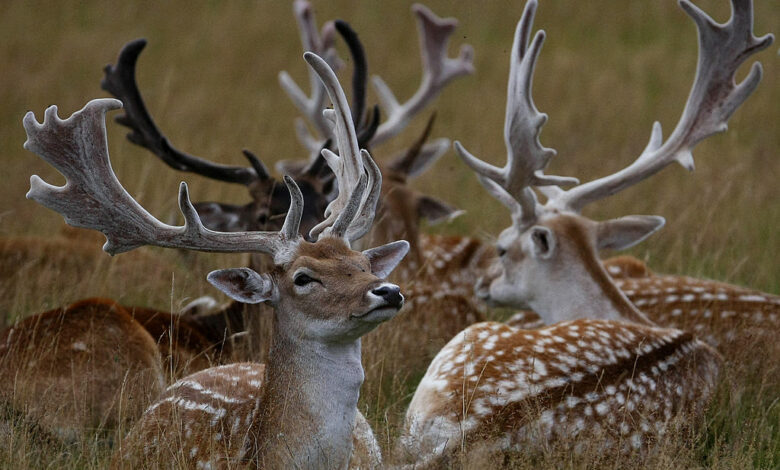
Ben Martill often gazes out of his window to watch the deer roaming below. “In the past few years there have been loads of them,” he says. Yet Ben doesn’t live in rural woodland but in a block of flats on a fairly busy road in the market town of Horsham in West Sussex. He often sees deer on the main thoroughfares.
“There are herds running up Crawley Road,” he says. “Loads congregate at night on the traffic island of the bypass.”
Ben, 33, is a gardener, and some of his customers have had deer break down their fences and strip the bark from the trees. He’s had a near miss in his car, too.
“I clipped one, poor thing. It darted off into the bushes.”
These sorts of scenes have become increasingly common – and that comes with serious economic, social and environmental costs.
Deer numbers have rocketed over the last 40 years but since the Covid-19 pandemic, when culling dropped significantly, many deer experts like Jonathan Spencer, a former head of planning and environment at Forest Enterprise (now Forestry England), say the numbers have got completely out of hand.
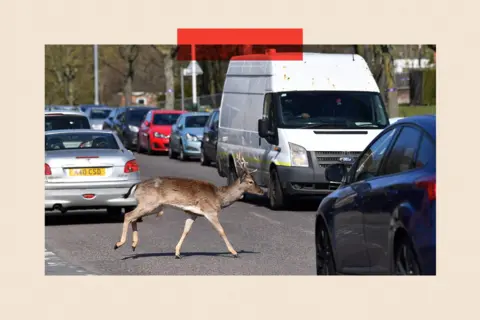
No-one knows exactly how many there are but the Forestry Commission and the Department for Food, Environment and Rural Affairs (Defra) suggest there may be two million in Britain – a huge increase from the estimated 450,000 in the 1970s, according to the Forestry Commission.
Their impact is being widely felt, with the rising numbers leading to problems for drivers, farmers and businesses as well as wildlife and the countryside’s natural landscapes.
While there are no recent official estimates of the total cost to the UK of damage caused by deer, it’s clear that it is substantial. In 2021, Forestry and Land Scotland estimated the cost of the damage caused by deer just to young trees in Scotland’s national forests and land at £3m a year.
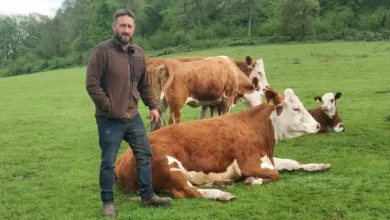
Lucy Manthorpe runs a 400-acre organic arable farm in Suffolk and says she was losing over £10,000 worth of crops a year to deer damage on three fields. To solve it, she has employed a full-time worker whose main job is culling deer.
The deer problem is “costing us as a country,” she argues.
Farmers and landowners can see losses easily run into the tens of thousands, according to the Forestry Commission, and some with high-value crops can see losses of as much as £1m in a year.
Tackling rising deer numbers is now seen as a priority by conservationists, farmers and the government alike – in 2022 Defra admitted: “We need to do more to sustainably manage deer.”
The real problem emerges when it comes to deciding how to do that – with some more radical-sounding approaches pioneered overseas, including reintroducing wolves to the landscape. The Countryside Alliance, however, says this would be “disastrous”.
From car crashes to trampled crops
There are few places in the world better suited to deer than modern Britain with its mild climate, open countryside, no animal apex predators and few human hunters.
An estimated 350,000 deer are removed from the British landscape annually via hunting and culling, according to the Country Food Trust, but the overall population is still rising – in 2023 parliament was told that up to 750,000 deer a year may need to be culled to keep the population stable.
The place where many of us have our closest encounter with a deer is when one of them meets the front of our car. The number of deer killed or injured on UK roads each year could be as high as 74,000, says the AA, leading to hundreds of human injuries and in some cases, fatalities. In October this year a 63-year-old motorcyclist in Oxfordshire died after hitting a deer, an inquest was told.
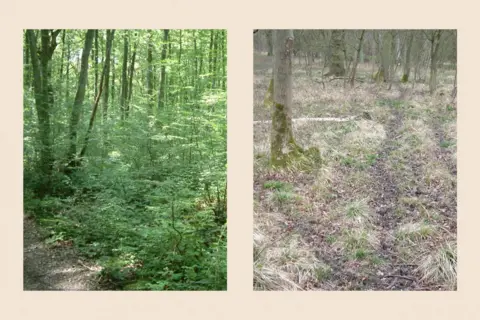
Then there is the impact on woodland. Natural regrowth of trees is almost impossible in areas of high deer density as they eat any fresh shoots which appear, says Alison Field, president of the Royal Forestry Society.
“The pressure of the deer now has become so great that we’ve lost the balance out of our landscape.”