Why are anti-war protests in the West muted on Iran?
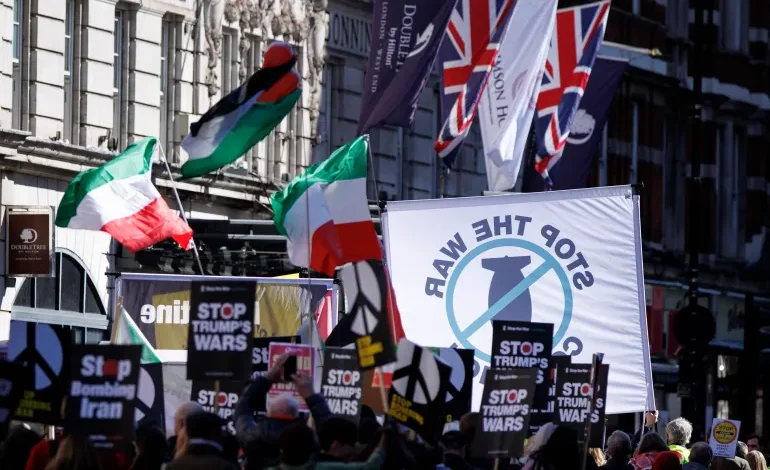
The US-Israeli war on Iran has kept the world on edge for nearly seven weeks, with a fragile ceasefire offering a tense pause over the past 10 days.
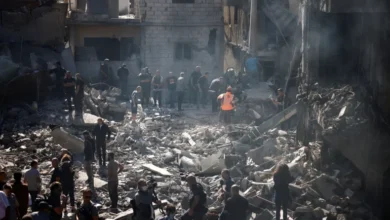
US and Israeli attacks on the 90-million-strong, oil-rich nation have killed more than 2,000 people, displaced millions and damaged vital infrastructure, including areas near Iran’s nuclear sites. US President Donald Trump also threatened to wipe out Iran’s “whole civilisation” if it did not accede to Washington’s demands.
In retaliation, Iran has attacked Israeli targets and fired missiles at Gulf countries and the wider region.
The ongoing Pakistan-brokered ceasefire between Washington and Tehran is threatened because of Israel’s air strikes on Lebanon, which have killed more than 1,300 people, and its invasion of southern Lebanon.
Opinion polls in the US and Europe say the war is deeply unpopular.
But widespread anger against the Iran war has failed to turn into mass street protests, such as during Israel’s genocidal war on Gaza and Russia’s war on Ukraine.
Though the reverberations from the war on Iran have been felt globally – with oil and gas price increases, fertiliser shortages and stock market volatility – the effects have been felt faster than in most previous conflicts.
Why? There are few clear answers — but analysts say several factors might help explain why this war has triggered fewer protests than other recent conflicts in its early days.
What the numbers show
According to Armed Conflict Location and Event Data, a US-based nonprofit organisation that tracks violent events, armed conflict and protests, there were around 3,200 Iran war-related demonstrations worldwide in the first month since the US-Israeli attacks began on February 28.
By contrast, 3,700 demonstrations were in the first month after Russia’s 2022 invasion of Ukraine, and as many as 6,100 demonstrations in the first month against Israel’s war on Gaza.
“The absence of major anti-war protests in the US is somewhat puzzling, especially given that the US entered the [Iran] war with only 21 percent of the public supporting it,” Shibley Telhami, a professor at Maryland University, told Al Jazeera, citing a pre-war poll conducted by his team.
By mid-April, almost two-thirds of Americans polled continued to oppose the war, according to various surveys.
“Unlike in other wars, there was no “rally round the flag effect,” Telhami added.
The war has also triggered an unprecedented energy crisis, with Iran effectively shutting down the Strait of Hormuz soon after the war started, except for ships belonging to countries that negotiated separate deals. On Monday the US began a naval blockade of all Iran-linked ships trying to pass through the strait, further compounding the traffic jam around the waterway through which a fifth of global oil and gas passes during peacetime.
Low impact war, for now
Still, some analysts point out, US casualties have been minimal so far. Since the war began, 14 US troops have been killed in the conflict.
Trita Parsi, an Iran expert and founder of the Quincy Institute, said there hasn’t been a “mass mobilisation of ground troops, a ground invasion or measures of much higher risk”.
“Trump has engaged in this war in a manner that minimises the American casualties,” he told Al Jazeera.
US academic Jeremy Varon, whose research area includes social movements, said people often turn out when their “conscience is shocked” or they perceive some grave injustice.