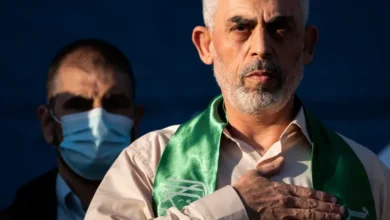
While more than 50 parties are contesting the polls, only three – the People’s Party, Bhumjaithai, and Pheu Thai – have the nationwide organisation and popularity to gain a winning mandate. With 500 parliamentary seats at stake and surveys consistently suggesting no party is likely to win an outright majority, coalition negotiations appear inevitable. A simple majority of elected lawmakers will select the next prime minister. The progressive People’s Party, led by Natthaphong Ruengpanyawut, is favoured to win the most seats. But the party’s reformist platform, which includes promises to curb the influence of the military and the courts, as well as breaking up economic monopolies, remains unpalatable to its rivals, who may freeze it out by joining forces to form a government. The party is the successor to the Move Forward Party, which won the most seats in the House of Representatives in 2023, but was blocked from power by a military appointed Senate and later dissolved by the Constitutional Court over its call to reform Thailand’s strict royal insult laws.
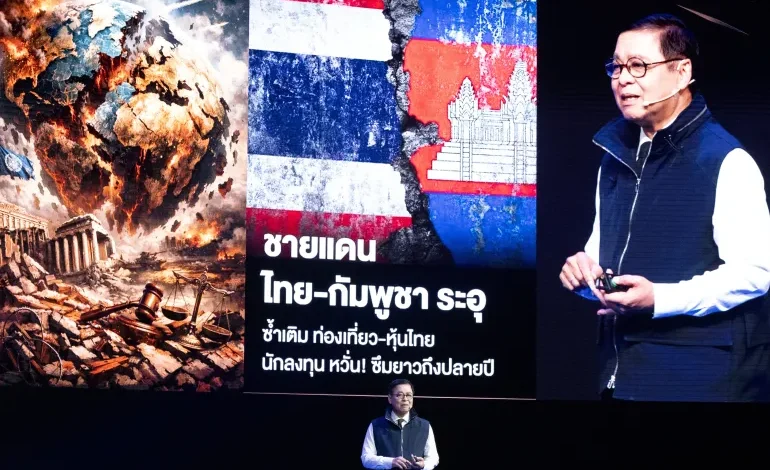
As Thailand prepares to vote on Sunday in a nationwide election, the country’s months-long border dispute with Cambodia continues to cast a shadow over election proceedings.
Brief but deadly armed clashes in May last year on a disputed section of the Thai-Cambodia border escalated into the deadliest fighting in a decade between the two countries, killing dozens of people and displacing hundreds of thousands.
Fallout from the conflict toppled the government of Thailand’s Prime Minister Paetongtarn Shinawatra – daughter of the billionaire populist leader Thaksin Shinawatra – before bringing Prime Minister Anutin Charnvirakul to power in September.
Now, while the fighting may have ceased, the conflict remains an emotive topic for Thais and a means for Anutin to rally support for his conservative Bhumjaithai Party as a no-nonsense prime minister, unafraid to flex his country’s military muscle when required, analysts say.
“Anutin’s party is positioning itself as the party that’s really willing to take the initiative on the border conflict,” said Napon Jatusripitak, an expert in Thai politics at the ISEAS-Yusof Ishak Institute in Singapore.
“It’s a party that has taken the strongest stance on the issue and the most hawkish,” Napon said of the recent military operations.
Anutin had good reason to focus on the conflict with Cambodia in his election campaign. The fighting created a surge in nationalist sentiment in Thailand during two rounds of armed conflict in July and December, while the clashes also inflicted reputational damage on Anutin’s rivals in Thai politics.
Pheu Thai sustained a major hit to its popularity in June when a phone call between its leader, then-Thai Prime Minister Paetongtarn, and the strongman of Cambodian politics, Hun Sen, was made public.
In the June 15 call, Paetongtarn referred to Hun Sen, an erstwhile friend of her father, as “uncle” and promised to “take care” of the issue after the first early clashes between Thai and Cambodian troops, according to Reuters news agency.
For factions in Thailand’s politics and Thai people, Paetongtarn’s deference to Hun Sen was beyond the pale of acceptable behaviour for a prime minister, especially as she appeared to also criticise Thailand’s military – a major centre of power in a nation of more than 70 million people.
Hun Sen later admitted to leaking the call and claimed it was in the interest of “transparency,” but it led to the collapse of Paetongtarn’s government. She was then sacked by the constitutional court at the end of August last year, paving the way for Anutin to be voted in as Thailand’s leader by parliament the following month.
The border conflict with Cambodia has given a major boost to Thailand’s armed forces at a time of “growing popular discontent with the military’s involvement in politics, and with the conservative elite”, said Neil Loughlin, an expert in comparative politics at City St George’s, University of London.
Anutin’s government focused its political messaging when fighting on the border re-erupted in early December. Days later, he dissolved parliament in preparation for the election.
“Bhumjaithai has leaned into patriotic, nationalist messaging,” said Japhet Quitzon, an associate fellow with the Southeast Asia programme at the Center for Strategic and International Studies (CSIS) in Washington, DC.
“Anutin himself has promised to protect the country at campaign rallies, signalling strength in the face of ongoing tensions with Cambodia. He has vowed to retaliate should conflict re-emerge and will continue protecting Thai territorial integrity,” Quitzon said.
‘War against the scam army’
During the fighting, Thailand took control of several disputed areas on the border and shelled Cambodian casino complexes near the boundary, which it claimed were being used by Cambodia’s military.
Bangkok later alleged some of the casino complexes, which have ties to Cambodian elites, were being used as centres for online fraud – known as cyber scams – a major problem in the region, and that Thai forces were also carrying out a “war against the scam army” based in Cambodia.