What’s happening in Myanmar’s civil war as military holds elections?
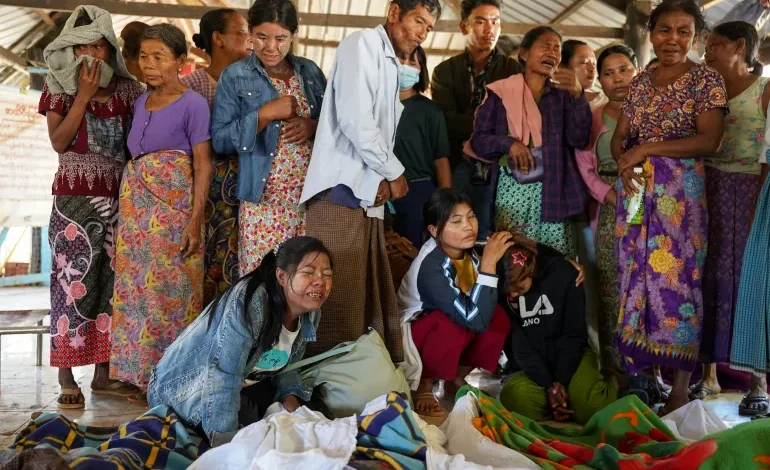
Voters in parts of Myanmar are heading to the polls on Sunday for an election that critics view as a bid by the country’s generals to legitimise military rule, nearly five years after they overthrew the government of Nobel Laureate Aung San Suu Kyi.
The multi-phased election is unfolding amid a raging civil war, with ethnic armed groups and opposition militias fighting the military for control of vast stretches of territory, stretching from the borderlands with Bangladesh and India in the west, across the central plains, to the frontiers with China and Thailand in the north and east.
In central Sagaing, voting will take place in only a third of the region’s townships on Sunday. Another third will be covered during a second and third phase in January, while voting has been cancelled altogether in the remainder.
Fighting, including air raids and arson, has intensified in several areas.
“The military is deploying troops and burning villages under the guise of ‘territorial dominance’,” said Esther J, a journalist based there. “People here are saying this is being done for the election.”
In most of the region, “we haven’t seen a single activity related to the election,” she said. “No one is campaigning, organising or telling people to vote.”
Across Myanmar, voting has been cancelled in 56 of the country’s 330 townships, with more cancellations expected. The conflict, triggered by the 2021 coup, has killed an estimated 90,000 people and displaced more than 3.5 million, according to monitoring groups and the United Nations. It has left nearly half of the country’s population of 55 million in need of humanitarian assistance.
“People [in Sagaing] say they have no interest in the election,” said Esther J. “They do not want the military. They want the revolutionary forces to win.”
Shifting battlefield
For much of last year, the Myanmar military appeared to be losing ground.
A coordinated offensive launched in late 2023 by the Three Brotherhood Alliance – a coalition of ethnic armed groups and opposition militias – seized vast areas, nearly pushing the military out of western Rakhine state and capturing a major regional military headquarters in the northeastern city of Lashio, about 120km (75 miles) from the Chinese border. Armed with commercial drones modified to carry bombs, the rebels were soon threatening the country’s second-largest city of Mandalay.
The operation – dubbed 1027 – marked the most significant threat to the military since the 2021 coup.
But the momentum has stalled this year, largely because of China’s intervention.
In April, Beijing brokered a deal in which the Myanmar National Democratic Alliance Army agreed to surrender the city of Lashio, without a single shot being fired. The military subsequently reclaimed key towns in north and central Myanmar, including Nawnghkio, Thabeikkyin, Kyaukme and Hsipaw. In late October, China brokered another agreement for the Ta’ang National Liberation Army to withdraw from the gold mining towns of Mogok and Momeik.
“The Myanmar military is definitely resurgent,” said Morgan Michaels, a research fellow at the International Institute for Strategic Studies (IISS). “If this current trend continues, the Myanmar military could be back in a relatively dominant position in a year or so, maybe two.”
The military turned the tide by launching a conscription drive, expanding its drone fleet and putting more combat credible soldiers in charge. Since announcing mandatory military service in February 2024, it has recruited between 70,000 to 80,000 people, researchers say.
“The conscription drive has been unexpectedly effective,” said Min Zaw Oo, executive director at the Myanmar Institute for Peace and Security. “Economic hardship and political polarisation pushed many young men into the ranks,” he said, with many of the recruits technically adept and serving as snipers and drone operators. “The military’s drone units now outmatch those of the opposition,” he added.
According to the Armed Conflict Location & Event Data Project (ACLED), a monitoring group, air and drone attacks by the military have increased by roughly 30 percent this year. The group recorded 2,602 air attacks that it said killed 1,971 people – the highest toll since the coup. It said Myanmar now ranks third in the world for drone operations, behind only Ukraine and Russia.