What is Trump’s endgame in Iran as the US-Israel war escalates?
More than two decades after the US-led invasion of Iraq in 2003, the United States, alongside Israel, has launched a war against Iran that has now entered its second week. Yet as the missile strikes on Iran mount, so do the shifting and at times contradictory positions articulated by US President Donald Trump on what the United States is truly after — leading to a central question: What is Washington’s endgame?
US forces have struck nearly 2,000 targets in Iran since the war began, eliminating several top Iranian officials, including the country’s then-Supreme Leader Ali Khamenei in Tehran. Subsequent attacks have targeted nuclear facilities, civilian areas and critical infrastructure such as oil refineries and a desalination plant.
Iran has retaliated by launching hundreds of missiles and thousands of drones targeting Israel and Gulf neighbours. Tehran says the attacks were aimed at military bases used by the US, as well as energy infrastructure, US embassies and civilian areas.
So far, the US and Israeli attacks have killed more than 1,200 Iranians, including more than 160 children killed when a school was bombed. Seven American soldiers have also died. Yet, analysts argue, Trump and his administration have never clearly explained how they want this war to end.
We unpack some of the positions Trump has taken over the past 10 days of war, how they’ve played out since then, and how realistic those scenarios are:
Regime change — by making the Iranian establishment collapse
The attacks on February 28 started with the killing of Khamenei, who had led Iran as supreme leader for 37 years and had previously served as the country’s president.
Though the Trump administration has never explicitly mentioned the words “regime change”, experts say that its actions appear to have been aimed at getting the current Iranian establishment to collapse.
“The objective of the strikes was instant capitulation of the regime and a popular uprising,” said Mustafa Hyder Sayed, executive director of the Pakistan-China Institute.
Muhanad Seloom, assistant professor of international politics and security at the Doha Institute for Graduate Studies, said that an “unstated bet” appeared to have guided Trump’s approach.
That approach assumed “that removing the head and enough of the body will cause the system to either collapse or become so weakened that whatever emerges cannot restore Iran’s pre-war posture”, Seloom told Al Jazeera.
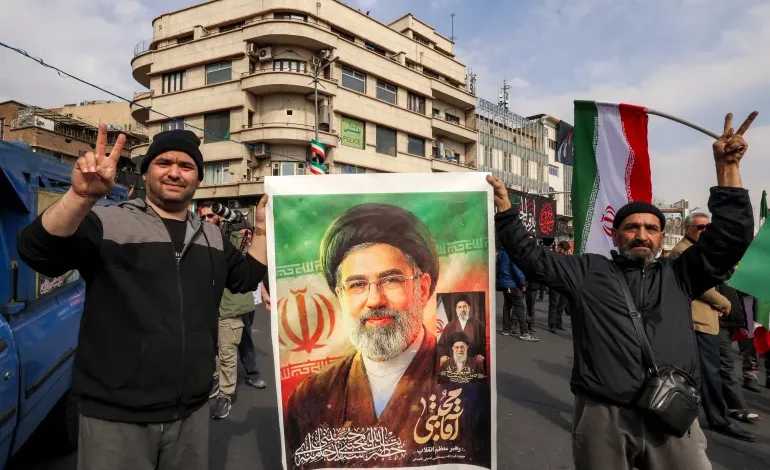
In reality, despite many senior military commanders and leaders being killed, apart from Khamenei, there is little evidence so far of deep fractures within the institutions that hold up the Islamic Republic. On Sunday, Iran announced Khamenei’s successor as supreme leader — his 56-year-old son, Mojtaba Khamenei.
A deal with the IRGC and Iranian diplomats
From the moment the so-called Operation Epic Fury was launched, Trump’s messaging has oscillated between dealmaking and the destruction of Iran.
Early on, he called on members of Iran’s Islamic Revolutionary Guard Corps (IRGC) to lay down their arms and surrender in exchange for immunity. Later, he asked Iranian diplomats to switch sides.
But the IRGC has been leading Iran’s counteroffensive against the US and Israel, and also driving Iran’s attacks on other Gulf countries. And Iranian diplomats have in a public letter rebuffed Trump’s offer, insisting that they remain committed to their role as representatives of the Islamic Republic.
“The IRGC has just pledged full obedience to the new supreme leader,” Seloom pointed out. “Trump has designated them a terrorist organisation. Neither side has the political space for that conversation while the bombing continues.”