‘We’re not scared’: Life in Taiwan goes on amid major Chinese war games
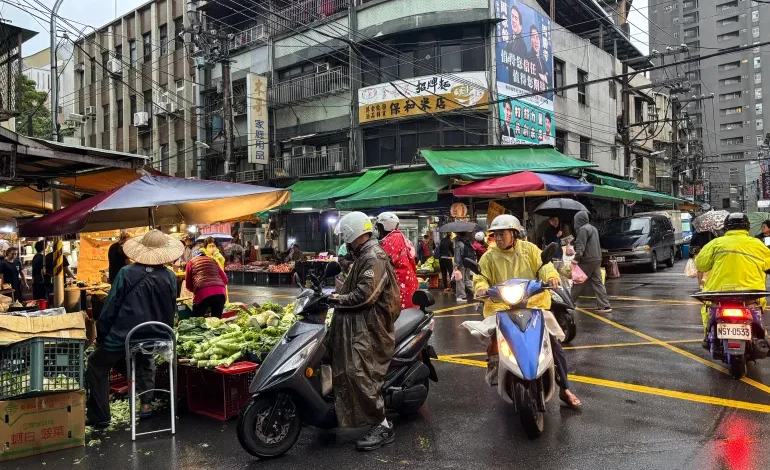
As China carried out live-fire drills and rehearsed a military blockade in the waters surrounding Taiwan this week, 70-year-old Liao said she wasn’t worried about war. She was enjoying life as a retiree, playing mahjong with her friends and keeping an eye on the stock market.
“Everyday life hasn’t been impacted,” Liao told Al Jazeera as she was having her hair shampooed and cut in time for the new year at a salon in New Taipei City. “I’ve lived in Taiwan for 70 years. I’m used to it. We all still have to wash our hair.”
“We’re not scared,” Liao’s hairstylist agreed. In fact, she hadn’t even noticed that the drills were happening. “Working people don’t have time to pay attention to these things. All they can do is work,” Liao said.
It’s not that the Taiwanese don’t care about threats from China. While life, for the most part, remained undisturbed this week during what China called “Justice Mission 2025”, information about them circulated rapidly on social media and was broadcast across Taiwan’s 24-hour news channels.
Disinformation – a regular component of such exercises – also circulated widely, including a propaganda video showing an aircraft flying close to the Taipei 101 skyscraper that Taiwan’s government dismissed as fake.
Threats from China, though, have become a regular part of life for the Taiwanese people. China has claimed sovereignty over Taiwan, a self-governing democracy, since the communists won the Chinese Civil War in 1949 and established the People’s Republic of China (PRC). China says it will unify Taiwan with the PRC by force if necessary and has become increasingly assertive in its behaviour around Taiwan as its confidence in its military capabilities and prowess grows.
State news outlet The China Daily said in an editorial on Monday that the drills were “part of a series of Beijing’s responses” to an $11bn arms package from the United States to Taiwan, “as well as a warning to [Taiwanese President William] Lai Ching-te authorities in Taiwan”.
Washington does not officially recognise Taiwan, whose formal name is the Republic of China, but it has pledged to help Taipei defend itself under the 1979 Taiwan Relations Act and the 1982 Six Assurances.
Chinese Ministry of Foreign Affairs spokesperson Lin Jian also told reporters on Monday that the exercises were “a punitive and deterrent action against separatist forces who seek Taiwan independence through military build-up and a necessary move to safeguard China’s national sovereignty and territorial integrity”.
But Liao is confident that China won’t launch an attack thanks to the strength of Taiwan’s economy and the “sacred mountain” – a local term for the Taiwan Semiconductor Manufacturing Company (TSMC), or what foreigners might refer to as the “silicon shield” – which many believe will protect Taiwan from invasion. China relies on advanced semiconductors from TSMC for its own high-tech industries. “Look, the stock market is up 200 points today. If fighting were to break out today, everyone would be selling off their stocks, right?” Liao said.
‘We feel a bit numb’
For many interviewees, this week’s exercises brought reminders of Chinese drills in 2022, which were carried out after then-United States House of Representatives Speaker Nancy Pelosi visited Taiwan, the highest-ranking American official to do so in decades.
Those exercises included live-fire drills, naval deployments, air sorties and ballistic missile launches and went on for four days in August that year.
They ushered in an era in which violations of Taiwan’s Air Defence Identification Zone (ADIZ) reached unprecedented levels. In November 2021, there were only 41 documented violations. By November this year, that number had soared to 266, according to data from Taiwan’s Ministry of National Defence. And since the Pelosi visit in 2022, China has launched six large-scale military drills around Taiwan.
Polling from the Brookings Institution think tank in Washington, DC, suggested that this increased activity has taken a toll on the Taiwanese people. In 2023, it found that just under 65 percent of people were worried about a cross-strait war, a moderate increase from just over 57 percent in 2021. Nearly 58 percent of respondents said they believed Chinese President Xi Jinping was more likely to use force against Taiwan compared with 46 percent five years ago in 2021.