Under Israeli restrictions, Palestinian Christians mark quiet Holy Week
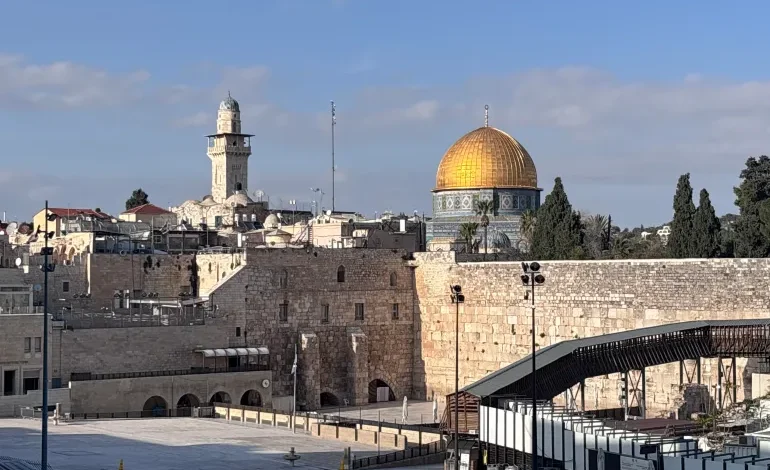
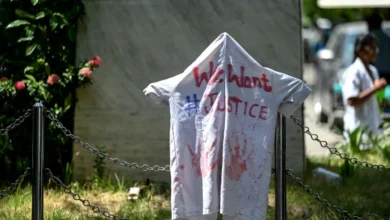
It’s Holy Week for many Christian denominations, marking the week during which Christians believe Jesus was arrested, crucified and resurrected here. And yet, the streets of the Old City’s Christian Quarter are deserted, the shops closed down.
Boulos, a Palestinian Christian man in his mid-30s who did not wish to give his real name, still comes a couple of days a week to his shop, selling religious garments and wares. He keeps the entrance half-shuttered to evade Israeli authorities, who have ordered such shops closed during the ongoing US-Israel war on Iran.
After six years of severe interruptions to his business in the Old City – starting with the COVID pandemic and continuing with the series of wars since – business had just started to tick up with the return of some international pilgrims following the October ceasefire in Gaza.
“Before the war [with Iran], business was still really bad. But it was at least enough to feed yourself,” said a despondent Boulos. “Now, there’s no business at all, no money at all.”
It was around noon when a local Christian Ethiopian woman came in asking for a kilo of prayer candles, his first customer of the day.
“Since the morning, I’ve been here for nothing,” said Boulos. “What will 35 shekels [$11.20] do for me? What’s the difference?”
While most businesses in Israeli West Jerusalem are now allowed to be open – due to close proximity to bomb shelters – in the Palestinian Old City, where there are no such shelters, local businesses have been mostly forced to close. And it’s the Christian Quarter – heavily reliant on tourism – that shows the least signs of life.
“It is the first time in my life to see Jerusalem as sad as it is,” said Brother Daoud Kassabry, a lifelong Jerusalemite and the principal at the College des Freres School in the Christian Quarter. There have been no in-person classes for more than a month. “This has been the most difficult month in our area here, really, in our time. For parents, for the school, for the students, for the teachers – for everybody.”
‘This country is only meant for them’
Normally, students from Brother Kassabry’s school would join the scouts for the annual Palm Sunday procession. But this year, it was not allowed.
Israeli authorities have gone so far as to bar the Latin Patriarch of Jerusalem, Cardinal Pierbattista Pizzaballa, along with other senior church officials, from entering the Church of the Holy Sepulchre – believed by most Christians to be the site of Jesus’ crucifixion and resurrection, and the holiest site in Christianity – to perform Palm Sunday Mass.
According to the Latin Patriarchate, this was the first time “in centuries” that church officials were unable to do so.
Speaking at a news conference last Tuesday, Cardinal Pizzaballa said “all the celebrations” and gatherings had been cancelled in the past month to abide by military command restrictions. “But there are things that we cannot cancel. No one, not even the pope, has authority to cancel the liturgy of Easter.”
After Israeli police blocked Cardinal Pizzaballa on Palm Sunday, leaders from Italy, France and the United States criticised the actions by Israeli police. Israeli Prime Minister Benjamin Netanyahu subsequently sought to assuage concerns, saying the measures were taken for the cardinal’s “safety” – citing the lack of bomb shelters near the church, despite Pizzaballa living metres away at the Latin Patriarchate.
And as church officials noted, Netanyahu’s implicit assertions of Israeli sovereignty over such properties conflict with the prevailing status quo governing holy Christian and Muslim sites in Jerusalem – which vests control with the heads of churches and the Islamic Waqf, under the custodianship of Jordan’s King Abdullah II.
To local Palestinian Christians, such rhetoric belied the hostile environment they say they endure under Israeli control.
Bishop Emeritus Munib Younan laments the “many times” he has been spat at by Jewish yeshiva students in the Old City without any legal repercussions. Boulos says that when he goes to church, he now chooses the Church of the Nativity in Bethlehem or a small church just outside Jerusalem. “There, nobody is pointing a gun at you on the way to church. Life is at least normal,” he said. “Here, life is not.”