Ukraine fends off increased attacks, strikes Russian oil revenue
Russia has stepped up assaults in Ukraine’s east in what may be the start of a spring offensive, and launched an air assault of record size against Ukraine’s western cities.
Ukraine has responded with strikes against the Ust-Luga and Primorsk oil export terminals in the Baltic Sea, severing as much as 40 percent of Russian oil export revenue – equivalent to 2 million barrels of oil a day – according to reports from the Reuters news agency.
It is the most severe oil supply disruption in the modern history of Russia, the world’s second-largest oil exporter, Reuters reported.
Ukraine attacked Russian oil-exporting infrastructure on Monday and Tuesday this week.
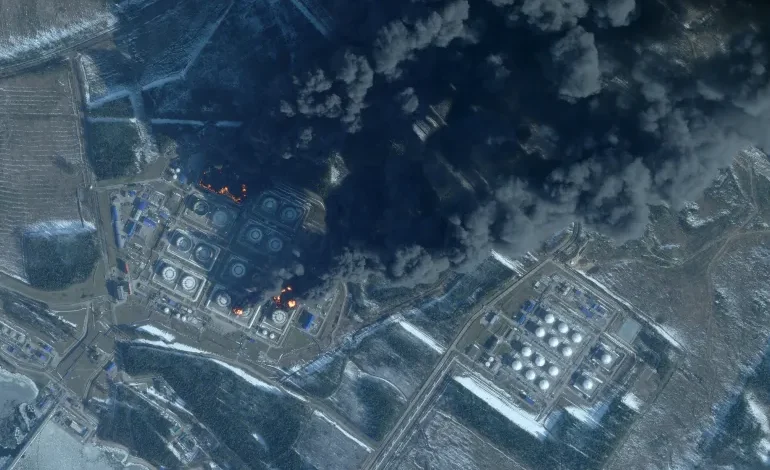
Ukraine’s General Staff said drones struck an oil tank farm and oil loading pier at the Transneft-Port Primorsk oil terminal in Primorsk, west of St Petersburg. Satellite footage suggested at least five of the 18 tanks were damaged.
The General Staff also said drones had struck the Ust-Luga oil offloading platform in the Baltic Sea on Tuesday night.
Posted footage showed both Primorsk and Ust-Luga in flames.
Ust-Luga exported 32.9 million tonnes of oil products last year, and Primorsk 16.8 million tonnes, reported Reuters.
Russia had enjoyed a boon in the rising price of oil following the United States and Israeli air attacks on Iran since February 28. Brent crude has gone from $70.71 a barrel on February 27 to $108.01 on March 26. Ukraine’s strikes seemed designed to prevent the Kremlin from refilling its war chest.
Ukraine said it also struck the Saratov Oil Refinery on Sunday, and the Bashneft-Ufaneftekhim oil refinery in the Republic of Bashkortostan on Monday.
Russia’s apparent spring offensive
Increased Russian ground assaults came over four days, from March 17-20, said Ukrainian Commander-in-Chief Oleksandr Syrskii, who said it was an attempt to take advantage of worsening weather conditions.
“The adversary attempted to break through our troops’ defensive lines in several strategic directions. Fierce battles unfolded along the entire line of combat,” he said.
Of 619 assaults over four days, 163 emanated from Pokrovsk, a town of 60,000 people before the war in the eastern Donetsk region, which Russian forces seized last month following a two-year battle.
Russia also tried to push towards Lyman and Kupiansk, in the northeastern Kharkiv region, which it sees as gateways to conquering Donetsk from the north. It has partly infiltrated Kupiansk, but its claims to have seized it late last year were proven false when Ukrainian President Volodymyr Zelenskyy broadcast a message from inside the city.
Russian President Vladimir Putin has made no secret of his desire to seize the “fortress” belt of heavily defended cities in Donetsk – Sloviansk, Kramatorsk, Druzhkivka and Konstiantynivka – and has repeatedly demanded their surrender as a precondition for a ceasefire.
Russia’s “colossal pressure and the deployment of significant reserves” failed to buckle Ukraine’s defensive line, but it did raise Russian casualties, said Syrskii.
“Over four days of intense assault operations, the enemy lost more than 6,090 soldiers killed and wounded. While over the course of a week, the enemy’s total losses amounted to about 8,710 people killed and seriously wounded,” he said.
Ukraine’s southern forces spokesman, Vladyslav Voloshyn, told Interfax news agency that all mobilised personnel in Russian-occupied Crimea were preparing to join the front by April 1.
“Russian forces are unlikely to seize the Fortress Belt in 2026 but will likely make some tactical gains at a significant cost,” said the Washington-based think tank Institute for the Study of War (ISW) in its daily assessment of the Russian offensive operation on March 24.