Trump’s May 1 deadline: Can he continue war on Iran after that?
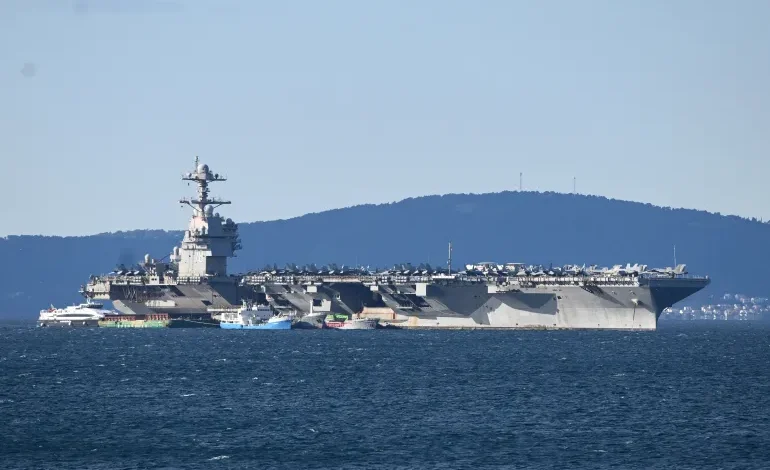
When Donald Trump announced an extension of the ceasefire with Iran on Wednesday, the US President did not provide a deadline for the resumption of talks, simply saying the US would continue its near-one-week blockade on Tehran and wait for Iran’s “proposal” for further talks.
Trump has until May 1 to obtain congressional approval under the War Powers Resolution (sometimes referred to as the War Powers Act). It states that he must limit deployments in any ongoing conflict after 60 days – unless he is granted specific authorisation to continue.
To grant this, both the House of Representatives and the Senate must pass a joint resolution – with a simple majority in each – within that 60-day limit. That’s not happened so far.
However, the act has previously been bypassed by Trump’s predecessors, who used other sources of authority as a basis for conducting military operations.
What is the War Powers Act?
The 1973 federal law was passed to restrict a US president’s authority to involve the country in armed conflict overseas.
Under the resolution, the president must inform Congress within 48 hours of initiating military action and may sustain deployments for only 60 days, unless a single 30-day extension is granted by Congress, or it passes authorisation for a longer commitment.
Maryam Jamshidi, an associate professor of law at Colorado Law School, said that to extend the 60-day window by 30 days, the president must certify, in writing, to Congress that the continuing use of armed force is a result of “unavoidable military necessity”.
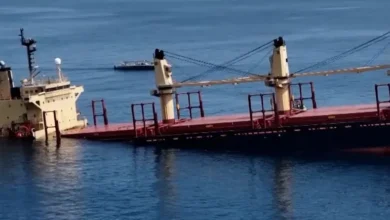
On Monday, US forces fired on and captured the Iranian-flagged container ship Touska in the northern Arabian Sea near the Strait of Hormuz as it sailed towards the Iranian port of Bandar Abbas. Trump said the ship had ignored US orders to alter its planned transit through the strait. The operation followed Washington’s imposition of a naval blockade on all Iranian ports on April 13.
Iran responded two days later by capturing two foreign commercial vessels in the Strait of Hormuz and moving them to the Iranian coast. The Reuters news agency said on Wednesday that the US military intercepted at least three Iranian-flagged tankers in Asian waters, reportedly redirecting them away from their positions near India, Malaysia and Sri Lanka.
Will Trump continue this war beyond the May 1 deadline?
Salar Mohendesi, a professor of History at Bowdoin College in Brunswick, US, said the war has been “terrible” for Trump, with polls consistently showing the US public is opposed to it, but that he is likely to continue with it in some shape or form.
“His entire brand is based on winning. He told the American public that he could extract a better deal from Iran, he promised that he would not get involved in a war, and his beleaguered party is about to head into midterm elections in the midst of a historically unpopular war,” Mohendesi told Al Jazeera.
“Trump can still walk away and staunch the bleeding, so to speak, but that would mean accepting defeat. He is a gambler, so it’s very possible that he will continue to escalate in the hopes of eking out some sort of victory down the line”.
The question experts are asking: in what form will he continue the war, and how will he try to circumvent the US Congress if necessary?
Are there ways Trump can get around approval from Congress?
The Authorization for Use of Military Force (AUMF) provides another potential legal basis for continued operations as it grants the president power to use force for specific goals.
It was first passed in 2001 after the September 11 attacks to enable the US to conduct its “war on terror”, and was passed again in 2002 to remove Saddam Hussein and authorise the 2003 invasion of Iraq. These authorisations have been used by successive administrations to justify a wide range of military actions.
In Trump’s first term, he used the 2002 AUMF to order the assassination of Iranian General Qassem Soleimani in Baghdad in 2020.
A 2015 congressional report on the AUMF found that former President Barack Obama had relied on the 2001 AUMF not only to continue US military operations in Afghanistan, but also “for beginning a new campaign against ISIS/ISIL, with the possibility of expansion to other countries if the Islamic State or Al Qaeda groups or associates effectively expand their reach and pose a threat to US national security and interests”.
The Obama administration maintained that its military operations against ISIL fell under the auspices of the authorisation when US forces were first deployed to Syria in 2014.
How else have US presidents got around Congress?
In practice, presidents since 1973 have frequently conducted military operations without explicit congressional approval before the AUMF came into effect at the start of the century, using a variety of legal justifications and claims to authority.
Former US President Bill Clinton authorised several military operations in the 1990s during his eight-year presidency, including in Iraq and Somalia.
In March 1999, Clinton deployed US forces against the former Yugoslavia over the Serbian ethnic cleansing of Kosovar Albanians, without obtaining congressional approval.
Former US Representative Tom Campbell and 17 others unsuccessfully filed a lawsuit against the administration, arguing that Clinton could not continue the war unless he was granted authorisation by Congress under the War Powers Act. The military campaign in Yugoslavia lasted 79 days.
During the US military campaign in Libya between March and June 2011, the Obama administration argued that the mission did not meet the legal definition of “hostilities” under the War Powers Resolution.
As a result, the administration maintained that it was not required to obtain explicit authorisation from Congress to continue the Libya campaign as it did not feature “active exchanges of fire with hostile forces“.