Trump says he views Strait of Hormuz as ‘American territory’
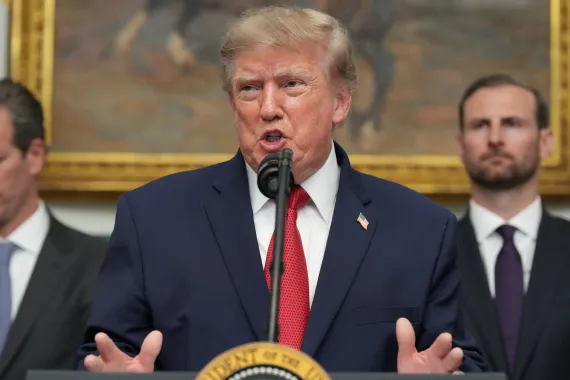
US President Donald Trump says he “views the Strait of Hormuz as an American territory right now” and that Iran “would love to make a deal, but they’re not ready to make the right deal in my opinion”.
Iranian Foreign Ministry spokesperson Esmaeil Baghaei says the latest US economic sanctions against Tehran are a “declaration of war” on all nations.
UN rapporteur brands Israeli army as ‘the most immoral’ amid latest killings in occupied West Bank
Francesca Albanese, UN special rapporteur for the occupied Palestinian territory, has condemned the latest killings of Palestinians in the occupied West Bank.
“The MOST IMMORAL ARMY is waging genocide while those in power, as so often in history, refuse to see the victims or recognize their rights to life and self-determination,” she wrote on X, referring to Israel’s army.
“Eighty years after WWII, in the age of human rights built after that war, this is all the more abhorrent,” she added.
Her post included an image of another post commenting on the death of Fathi Khazem, a Palestinian man reportedly shot and killed by Israeli forces in his home in Jenin on Friday after resisting an arrest attempt.
The Israeli soldiers prevented an ambulance from reaching him and left him to bleed to death before taking his body, according to the Palestinian Wafa news agency.
Trump’s economic ‘D-Day’ on Iran unlikely to yield intended outcome
Ross Harrison, a senior fellow at the Middle East Institute, says Trump’s use of military terminology like “D-Day” to describe economic pressure on Iran is unlikely to force Tehran to capitulate.
Harrison told Al Jazeera that Iranians have already been living in an economic “D-Day” since maximum pressure sanctions were reimposed after the US withdrew from the 2015 nuclear deal.
“I think the D-Day is language Trump is using because the military campaign failed to create the kind of conditions on the ground that would get the Iranians to capitulate,” Harrison said.
“I think he’s using that language in order to transfer military language to economic language, but in terms of actually creating the kind of outcome that he plans or hopes for, I’m quite sceptical,” he argued.
Harrison added that China remains the most significant source of support for Tehran, but targeting that connection carries major risks for Washington.
“I think the biggest lifeline that could be given to Iran would come from China,” he said. “And the question is not really the policing; the question is whether the United States is willing to pay the price of derailing US-Sino relations now, when China also has levers of power that they could inflict upon the United States and because there’s a looming summit between President Xi and Donald Trump in Washington next month.”
“So, it’s not a matter of policing; I think it’s a matter of whether the US is willing to go to the mat and pay the price of disrupting a relationship that Donald Trump seems to be leaning on right now,” he said.
Iran says US economic sanctions are a ‘declaration of war’ on all nations
Iranian Foreign Ministry spokesperson Esmaeil Baghaei says new US sanctions against Iran go far beyond an illegal economic war on a single nation, characterising them as a “declaration of war” against all governments, according to remarks carried by Iran’s Fars news agency.
The announcement of new sanctions represents “an attempt by the United States to exert extraterritorial sovereignty over all independent UN member states”, Baghaei said.
“No government has the right to force foreign banks, enterprises, or airports, each operating under the exclusive jurisdiction of their own sovereignty, to refrain from engaging in legitimate trade with a third country.”
He argued that “such secondary sanctions have no basis in international law”, adding that they “violate the fundamental principle of sovereign equality enshrined in Article 2, Paragraph 1 of the UN Charter”.
Baghaei characterised economic coercion as an “international offence and a wrongful act”, warning that combining sanctions with a naval blockade “reduces the sovereignty of other states to something temporary and conditional upon the whims and caprices of another power”.
Yielding to such intimidation, Baghaei added, would lead to “the total erosion of national sovereignty” and serve as “a catastrophic return to blatant, full-scale colonialism”.Iran says US economic sanctions are a ‘declaration of war’ on all nations
Iranian Foreign Ministry spokesperson Esmaeil Baghaei says new US sanctions against Iran go far beyond an illegal economic war on a single nation, characterising them as a “declaration of war” against all governments, according to remarks carried by Iran’s Fars news agency.
The announcement of new sanctions represents “an attempt by the United States to exert extraterritorial sovereignty over all independent UN member states”, Baghaei said.
“No government has the right to force foreign banks, enterprises, or airports, each operating under the exclusive jurisdiction of their own sovereignty, to refrain from engaging in legitimate trade with a third country.”
He argued that “such secondary sanctions have no basis in international law”, adding that they “violate the fundamental principle of sovereign equality enshrined in Article 2, Paragraph 1 of the UN Charter”.
Baghaei characterised economic coercion as an “international offence and a wrongful act”, warning that combining sanctions with a naval blockade “reduces the sovereignty of other states to something temporary and conditional upon the whims and caprices of another power”.
Yielding to such intimidation, Baghaei added, would lead to “the total erosion of national sovereignty” and serve as “a catastrophic return to blatant, full-scale colonialism”.