The overlooked benefits of real Christmas trees
The environmental pros and cons of Christmas trees go far beyond the climate impact of “real or plastic”, scientists say. So what’s the best choice for a green Christmas?
In 1800, Queen Charlotte, the German wife of King George III, set up what is thought to be the first Christmas tree in England, at Queen’s Lodge in Windsor.
Decorated Christmas trees already had a long history in Germany, but this was the beginnings of their role as a fashionable part of the festive season for the English upper classes. By the 1850s they were a common sight across the UK. In the US, meanwhile German settlers helped to establish the tradition of displaying trees in the home, decorated with homemade ornaments, by the 1830s.
Some two centuries later, the now-cherished tradition of plonking a newly cut tree in the middle of the living room and covering it with lights and baubles is still alive and well across much of the world. Today, an estimated 25-30 million real Christmas trees are sold annually in the US, and around five million in the UK. Real trees may also be coming back into fashion among younger generations – a 2019 US survey found millennials are 82% more likely than baby boomers to get a live tree.
A millennial myself, I certainly fit this trend. I love real Christmas trees but have had countless conversations (and internal debates) about whether getting one is overindulgent wastefulness or an essential – and ultimately environmentally negligible – part of Christmas.
I do think there’s a lot more nuance to it, than just, ‘Oh, we’re cutting down a tree and removing it’ – Alexandra Kosiba
As I have delved further into the topic, though, I’ve found their assumed negative environmental impact may not be as clear cut as I once thought. These conversations often centre on the relative carbon footprint of real compared to plastic ones, but researchers say their wider influence, good or bad, goes far beyond this.
“I do think there’s a lot more nuance to it, than just, ‘Oh, we’re cutting down a tree and removing it’,” says Alexandra Kosiba, a forest ecologist at the University of Vermont Extension in the US.
After all, before it is cut down and displayed, a Christmas tree is grown – on land that might otherwise be used for different purposes, better or worse. In Vermont, for example, says Kosiba, Christmas tree plantations support the local economy and help to maintain the rural landscape.
How we use our land has become especially important in the face of two pressing and deeply connected environmental crises: biodiversity loss and climate change. Forests are a huge part of such beneficial land use.
“Well-managed forests really play a huge role in the climate solution,” says Andy Finton, landscape conservation director at The Nature Conservancy, a US-based environmental non-profit. “Trees of all sorts are pulling carbon from the atmosphere, and storing it and reducing the amount of carbon pollution and thus the pace of climate change.”
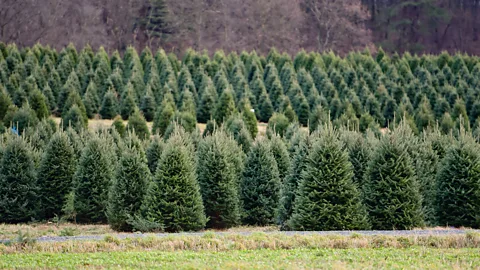
Christmas trees are certainly not a hugely significant use of land, or a big player in the global carbon cycle, especially compared to timber production or crops like maize or wheat. But they do provide an interesting area to consider, in part because many humans have far more direct engagement with them than perhaps any other forest product.
“There’s a lot of folks that don’t interact with nature a lot,” says Kosiba. “It is pretty cool to think all these people are bringing a tree… into their house [and] sort of revering it and appreciating it.” This festive appreciation may be a good opportunity to consider the wider role of different trees, and how and where they are grown.
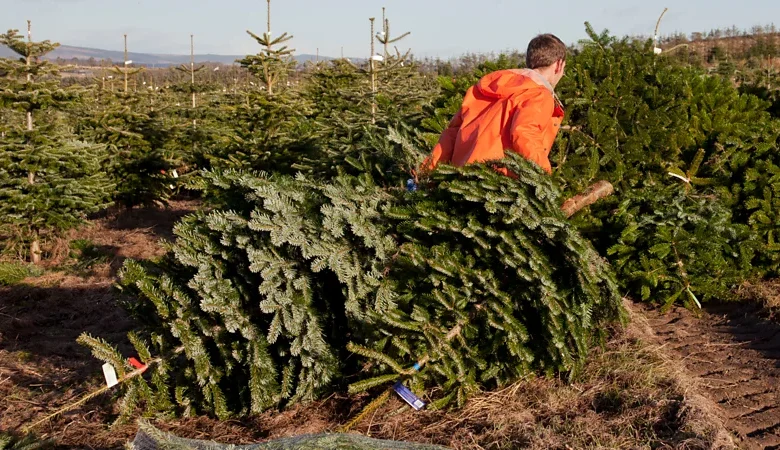
Christmas trees are typically young spruce, fir or pine trees from plantations, which means their environmental impact will always very much depend on what might be grown on land instead. It goes without saying that ecologically valuable native habitats such as old growth forests or peatlands should never be used to plant Christmas trees.
The plantations are grown for roughly 10 years before harvesting, meaning that for every tree cut down one year, another nine or so stay standing. “It’s quite nice as a way of maintaining a set of trees, because you always need the new trees coming through to be harvested the following years,” says John Kazer, footprint certification expert at the Carbon Trust, a UK-based environmental consultancy.
Especially if the Christmas tree farm is part of a much larger landscape or a mosaic of habitat types, including mature, larger, intact forests, I think there’s a real ecological niche that it’s fulfilling – Andy Finton
Christmas trees are not included in the EU pledge to plant three billion additional trees by 2030, as they are considered too short-lived. “They are cut down more often than timber harvest or, of course, natural old growth forests,” says Paul Caplat, an ecologist at Queen’s University Belfast, Northern Ireland. “So there’s not a lot of time for biodiversity to settle in and grow healthy populations.”
However, Christmas tree plantations can still provide a boost to biodiversity – and provide a safe haven for nesting birds. Research shows this is especially in areas where wildlife has been declining as agriculture becomes more intensified.
That’s because the plantations tend to have open habitat structures rich in bare ground, which can be important foraging sites for wildlife, while their trees can provide farmland birds with decent nesting conditions. They also tend to be less intensively managed than much industrialised agriculture, which also helps with food availability, while their fences can keep out disruption from humans and dogs.
“Species that would have used a more extensive form of farming landscape in the past, but don’t find all the resources they need in the more intensified agricultural setting, will find what they want in the Christmas tree plantation,” says Caplat.
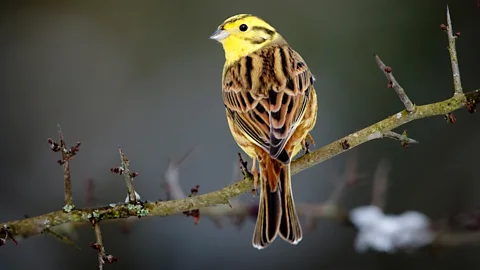
In a 2022 study in Germany, for example, researchers found Christmas tree plantations could represent important refuges for declining farmland birds such as yellowhammers and common linnets in intensive agricultural areas. Another 2018 study of Sauerland in Germany found Christmas tree plantations are important strongholds for woodlarks.
And a 2019 study in Belgium found that beetle diversity – including of threatened species – was higher in Christmas tree plantations than maize fields, although lower than in spruce plantations for timber, which are left to grow for longer and use less fertilisers and pesticides than Christmas trees.
Similarly, in naturally forested areas of the north-east US, younger, open forests like Christmas tree plantations can provide higher concentration of insects or grasses, in turn better supporting birds and mammals in certain parts of their lifecycle, says Finton. “Especially if the Christmas tree farm is part of a much larger landscape or a mosaic of habitat types, including mature, larger, intact forests, I think there’s a real ecological niche that it’s fulfilling.”
Of course, Christmas trees are still typically treated with plenty of pesticides and especially fertilisers to keep them aesthetically pleasing, says Caplat, which has its own impact on the environment. A 2021 study led by landscape ecologist Merle Streitberger from Osnabrück University in Germany found that organic Christmas tree plantations had better habitat structure and plant species diversity than conventional ones, and recommended a reduction in herbicide use in particular.
Importantly, however, some sites used to grow Christmas trees could be used for far worse things environmentally. Areas close to cities, for example, could find alternative uses as parking lots, says Caplat. Kosiba similarly notes that in the rural areas of the north-eastern US, where forests are often being lost to sprawling development, Christmas tree farms can give landowners an important diversified income. “It allows people to live in these places, manage and work in their land,” she says.
In short, says Finton, if a landowner has an economically viable Christmas tree farm, they’re incentivised to keep the land in “that natural, open state…and not to, for instance, sell land to a situation that might end up in a strip mall or a subdivision or housing development”.
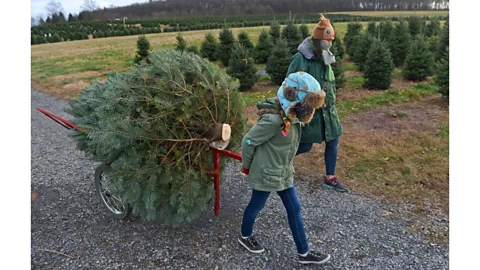
And then there is the carbon. Like any other tree, Christmas trees capture carbon as they grow. When they are cut down, they will begin to release that carbon. “There’s a continuous process of growth and of taking carbon out of the atmosphere, which is a positive thing,” says Kazer. However, as all the carbon absorbed by the tree will eventually be returned to the atmosphere as the tree dies, there is no overall removal of carbon, he adds.
What is CO2e?
CO2 equivalent, or CO2e, is the metric used to quantify the emissions from various greenhouse gases on the basis of their capacity to warm the atmosphere – their global warming potential.
It’s also worth putting the amount of carbon involved in having a Christmas tree in context. The Carbon Trust estimates that a 2m-tall (6.6ft) Christmas tree burnt after use emits only 3.5kg carbon dioxide equivalent (CO2e) – roughly 0.2% of the emissions from a return flight from London to New York. A tree of the same size that ends up in landfill has a carbon footprint of 16kg of CO2e – equivalent to 1% of that return flight, or roughly two hamburgers.
How people dispose of their Christmas trees after use is usually the single most important carbon consideration.
The worst-case scenario happens when Christmas trees end up in landfill: the oxygen poor conditions are conducive to more of the carbon wrapped up in the tree being released as methane rather than CO2. Since methane is greenhouse gas some 80 times more potent than CO2 on a 20-year timescale, a tree that ends up in landfill emits some four-to-five times as much carbon as one that doesn’t, according to Carbon Trust figures.
Ideally, if a tree is still alive with its roots, it will be replanted. A decent alternative is ensuring the tree’s carbon is released slowly back to the atmosphere as CO2 – as happens if the tree is chipped and spread on a garden or park, or composted. If the tree is burned for energy, meanwhile, the carbon it contains will be emitted straight back to the atmosphere as CO2. It’s also worth checking whether the place you bought the tree from offers recycling services, allowing it to be chipped and returned to the fields where it grew.
Whole trees can even be used as habitat restoration tools on riverbanks and along shorelines to prevent erosion. In Vermont, where old Christmas trees are used for everything from biomass burning for energy to goat food, “we’re also seeing folks using them in stream restoration”, says Kosiba. “They’re great at catching dirt and debris, and creating little barriers and pools for fish: a lot of it is mimicking what a beaver would do.”
Aside from disposal, Christmas trees affect the climate due to the fertilisers used to grow them, which are made using fossil fuels and produce nitrous oxide, another powerful greenhouse gas. Managing and harvesting the forests also uses fuel, as does transporting the trees to their final location.
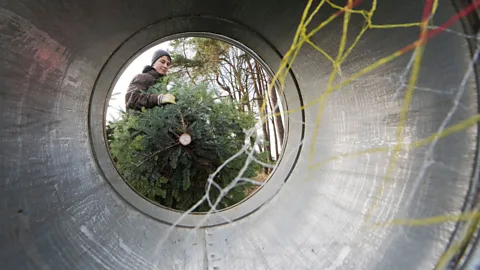
There are some options that can avoid waste altogether, of course. Some businesses now offer Christmas tree rentals – allowing you to borrow a potted tree for a few weeks over Christmas. “It fits perfectly in the sustainability approach of reduce, reuse before recycle,” says Caplat.
For those with the space, another great option is to buy a pot-grown tree for Christmas then keep it in your garden till the following year – perhaps even planting it permanently once it gets too large. “It’s hard to imagine a better solution,” says Finton, who advises getting a local species that will thrive in the area you live in, and making sure to keep it well watered when inside.
And then, of course, there is the question of whether simply to opt for an artificial tree.
These take hundreds of years to break down in landfill, but could be lower carbon overall than buying multiple real trees if reused for long enough. The Carbon Trust estimates the carbon footprint of plastic Christmas trees at around seven to 20 times that of real tree, depending on a range of factors such as whether the real tree went to landfill or how far people travelled to pick it up. If you have an artificial tree, the key is to reuse it for as many years as possible, says Kazar.
“It takes a lot of effort to make [and transport] those trees,” says Kazer. “And at the moment, they’re quite hard things to recycle, because they’re quite complicated.”
It’s a drop in the ocean, but like any drop, it can be very useful as a model of how to approach things – Paul Caplat
So Christmas trees may not be the environmental bane of the festive period and can even provide some ecological benefits. But we can still vastly improve their management.
We can reduce or eliminate the fertilisers and pesticides used to grow them (including by accepting “wonkier” trees), and ensure forests are certified by schemes such as the Forest Stewardship Council, which verifies sustainable sourcing of forest products. We can also try to grow them near to cities, in places where the alternative options for that land use are environmentally worse.
On an individual level, we can consider using pot-grown instead of cut trees, then planting them permanently. We can prioritise buying local trees to reduce travel emissions, and we can definitely aim to ensure that no Christmas trees end up in landfill.
“It’s a drop in the ocean, but like any drop, it can be very useful as a model of how to approach things,” says Caplat. “[Christmas trees] reach out in the areas of the climate change and biodiversity crisis, cost, welfare, affordability and everything basically. Because it’s something that pretty much everyone wants.”