The ‘extinct’ antelope bringing hope in the Sahara Desert
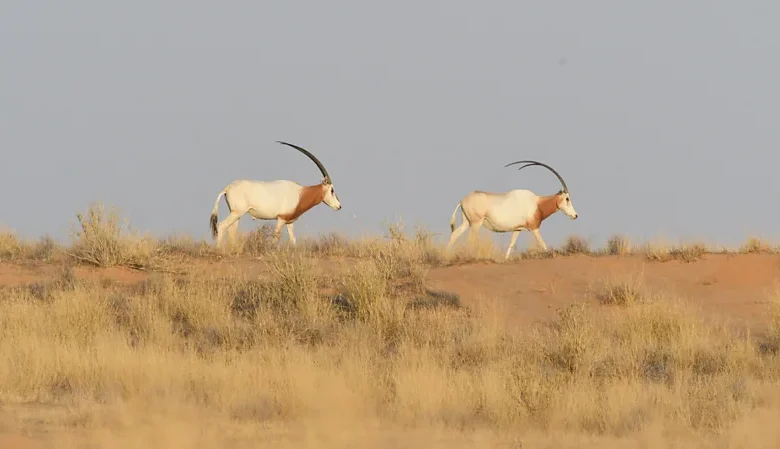
The scimitar-horned oryx has been brought back from extinction through captive breeding. Conservationists hope it could help slow the spread of the Sahara Desert.
When Marie Petretto and John Newby arrived in central Chad in the spring of 2012, they’d been sent with a mission to see this wide, open landscape as an antelope might see it.
The Ouadi Rimé-Ouadi Achim Faunal Reserve, a protected area on the edge of the Sahara, is bigger than the Republic of Ireland, with vast expanses of sun-baked drylands. New arrivals usually assume “it’s just desert”, says Petretto, a biologist and wildlife veterinarian, but as they moved through, their team of ecologists and conservationists documented its vast ranges of Sahelian grasslands and wooded gorges. “At first the desert and arid lands seem very flat and homogeneous,” she says. “Once you start exploring, you realise how incredibly varied they are.”
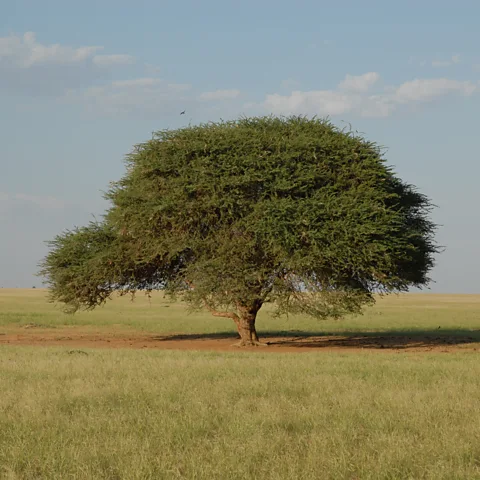
Petretto recalls close to 100 gazelles bounding past their truck and finding sparse clusters of acacia, some filled with vultures. Though ominous, these trees operate like “umbrellas on the beach”, she says, allowing wildlife to rest in a landscape that can reach 50C (122F). River valleys, known as wadis, burst into life during dramatic seasonal rains around July, and hold onto this humidity through drier months, when they support food plants, such as wild bitter melon, and small shrubs where animals can hide.
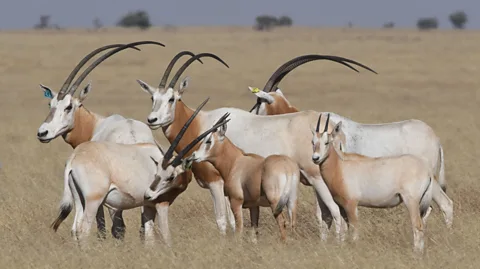
All these signs gave them confidence that this could be the place for an audacious experiment to bring back a species that had vanished entirely from the wild in the 1980s. While the hottest months in Ouadi Achim would be deadly for most animals, the environment was ready-made for the scimitar-horned oryx, an antelope that stands more than 1m (3.3ft) tall at the shoulder, and is named for its long, elegant horns that reach backwards over its body like a curved sword.
The oryx has evolved to live healthily around the edges of Sahara – able to survive for months without water – but, by 2012, it lived only in zoos and reserves scattered across the planet. If successful, their plan to release the oryx would make it just the sixth-ever large mammal to have been declared extinct in the wild then to have been brought back via captive breeding, following the Przewalski’s horse, European Bison, red wolf, Père David’s deer and the Arabian oryx.
‘Tinder for antelopes’
On a drizzly morning in mid-September, Petretto is near England’s southern coast to meet the globally coordinated conservation network that looked after the scimitar-horned oryx for decades – including wildlife keepers, breeders and poaching patrols. In a rolling paddock nearby, five oryx mill around zebras and a handful of rhinos. In the morning mist, a pair of antelopes jerk up and clash their impressive horns – which can grow to 1.5m (5 ft). This determines who sits at the top of the herd’s social hierarchy, say Petretto and Tania Gilbert, head of conservation science at Marwell Wildlife, the conservation charity that runs this wildlife park. It’s nothing to worry about, says Gilbert, although one young male, Conor, “seems to think he can take the rhino”. Faced with this weirdly confident antelope squaring up to him, the large male rhino, surprisingly, backs off.
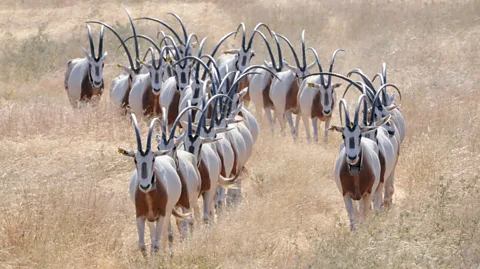
This 400-acre estate, Marwell Hall, was inhabited by monks and aristocratic families for hundreds of years (and is rumoured to be haunted by one of Henry VIII’s wives). In 1969, it was bought by John Knowles, a wealthy chicken farmer who assembled the country’s first zoological collection specifically devised to breed endangered animals. Oryx – whose numbers had plunged from around one million to fewer than – were one of the first animals he bought.
Oryx don’t mind England’s cloud and rain, says Gilbert, although this green paddock – similar to nearby fields filled with sheep and horses – makes an unlikely base from which to save this supremely desert-adapted species. Evolving to survive around the edge of the Sahara, these antelope have wide hooves to navigate loose sand and white backs to reflect the sun. They are able to survive for months on the water they get from food, conserving water through a system of “adaptive hyperthermia”, which makes them able to tolerate their body temperature rising to 46C (115F) without sweating.
Despite once roaming thousands of miles from the Nile to the Atlantic and on both the Sahara’s northern and southern rims, scimitar-horned oryx were last seen in the wild during the 1980s in central Chad and the Aïr Mountains of Niger. Although they had been hunted sustainably for millennia, the arrival of 4x4s and automatic weapons led to rapid declines. “A big part of the reason why they went extinct in the wild is that they’re very tasty,” says Gilbert, while their tough skin – useful when clashing horns – “makes excellent quality leather”.
Since the 1960s a group of oryx have been shuffled around zoos and institutions like Marwell, with keepers acting as matchmakers to prevent inbreeding among the captive population. Marwell is the keeper of the scimitar-horned oryx studbook, a sort of “Tinder” for endangered species, says Sophie Whitemore, a zoologist at Marwell Wildlife and the international studbook keeper. “If an animal is born, it pops up on my system and I know who the parents are and where they come from,” says Whitemore.
Keepers like Whitemore and Gilbert track each animal’s bloodline, similar to the pedigree databases for horses. To prevent inbreeding and keep their genetic stock varied, each year some zoos move individuals, usually males, to replicate the type of shifts that happen in the wild, says Gilbert. Starting out, the studbook had fewer than 50 individuals, mostly captured in Chad, but with notable gaps in early record keeping, she recalls. From such small founder populations, they risked inbreeding of traits that can cause populations to collapse. Yet, today, the studbook lists 3,295 animals in 182 zoos and institutions.
A ‘key ecological component’
Even as the final oryx were disappearing from the wild, Marwell was beginning to send them back to countries where they had once lived. At Bou Hedma National Park on the northern edge of the Sahara, a small herd of 10 oryx from Marwell and Edinburgh Zoo was released in 1985, eight decades after they disappeared from the country. “Nobody knew if it would work,” says Gilbert. “It could’ve gone horribly wrong. And they released these eight-month-old oryx into a fenced area and they just got on with it. They figured out what to eat, where to go, what to do. It’s not a huge area that they’re in [around 120 sq km (46 sq miles)], but they’ve been there ever since.”
Other parks in Tunisia and Morocco followed, and Marwell-born animals were sent to zoos in Japan, Canada and Australia. Some reserves in Tunisia also reintroduced other animals, including dorcas gazelle and North African ostrich, alongside them. Although these were not wide-open wild expanses, they taught important lessons, says Gilbert, including how to assemble herds that could thrive and how to manage their release into the wild, via a “soft release” that temporarily provided supplementary food.
Scimitar-horned oryx have always been an attractive option for reintroduction as their decline was not primarily caused by habitat loss, explains Gilbert. Of the 84 species classified as extinct in the wild, many are unlikely to be reintroduced as their native habitat “is almost gone, or is completely gone,” says Gilbert. Yet vast areas of Sahelian dryland remain accessible – for now.
Abdulaziz Ben Mohamed, who spent his four-decade career protecting wildlife from poaching at Tunisia’s environmental ministry, is visiting Marwell for the first time. Born in Douz, the palm-fringed oasis town known as the “gateway to the Sahara”, he worked across areas where oryx would once have lived – but where, he says, locals had never seen one before they arrived from Marwell. “It’s a species that was extinct, that had disappeared,” he says. Locals are passionate about having the oryx back but there is another problem arising, he says: “The lack of rain, the drought”, with lower rainfall in reintroduction sites in Tunisia like Dghoumes.
Over the last century, the Sahara Desert has grown by around 10%, expanding at a rate of more than 7,600 sq km (2,934 sq miles) a year, according to one study. The Sahel, in the southern Sahara, has been worst affected, as the area is heavily farmed and often overgrazed by livestock. High-profile efforts to prevent the spread of the Sahara have been organised over the last two decades under the banner of the African Great Green Wall Initiative. This campaign initially aimed to build a barrier of trees 8,000km (4,971 miles) long, across 11 nations, although it has since become a more varied set of projects to grow more resilient ecosystems around the Sahara.
Tunisia’s parks point to one approach in which the oryx and other wildlife could play a key role, says Petretto, who spends her time travelling between the country’s reintroduction projects. “Working at the edge of the desert, you can really see the sands move across the ground because there is no obstacle,” in areas where sheep have “eaten every last leaf and grass”, she says. “The reason why villages are now covered by sand is because they did not allow time for the vegetation to recover.”
Where oryx have been reintroduced in Tunisia, vegetation has improved, although we can’t say for sure if this is because of the species or because of barriers to prevent livestock from overgrazing. Tim Woodfine, chief executive at the non-profit Sahara Conservation, says that in ecosystems on the Sahara’s edge, the oryx helped distribute seeds and recycled nutrients during their massive yearly migrations of up to 1,300km (808 miles). “As well as eating grass, they eat herbs and seed pods from trees. These go through their digestive tract and are deposited elsewhere with a helpful amount of dung to fertilise them,” says Woodfine. A recent study showed acacia seeds that had been eaten and excreted by the closely related Arabian oryx were 250 times more likely to germinate than seeds that hadn’t been eaten, helping grow new trees naturally.
Will they be enough to hold back the desert? Both Woodfine and Petretto say it depends on other factors, like how bad climate change gets. But if they’re returned in sustainable numbers to wild ranges, it can only help. “They’re a key ecological component of ecosystem resilience,” says Gilbert. They also provide food for carnivores like African wolves and cheetahs, she says. “Without them you’re missing something fundamental from the ecosystem.”
Return to the wild
On 14 March 2016, an Ilyushin IL-76 cargo plane landed in Chad carrying the first 25 scimitar-horned oryx for release into the Ouadi Rimé-Ouadi Achim Faunal Reserve. The chosen 25 had come from a “World Herd” specially assembled in Abu Dhabi, by the emirate’s environmental agency. This herd included a genetically diverse group from Europe and US, assembled by Marwell, which were bred with oryx kept by the royal family of Abu Dhabi.
The assessment that Newby and Petretto contributed to ultimately concluded that there was sufficient habitat. But when the day came and partners from across the global conservation network lined up to release the oryx from their travelling cases, there were nevertheless many unknowns about whether they would adapt to living in the wild. With no living relatives, their survival would depend on relearning to move across one of the world’s largest protected areas to find the food plants that follow patterns of seasonal rains.
The first phase of the operation has been a success. We’ve got the animals back into the wild, they’re breeding, they are pretty secure – John Newby
As in Tunisia, they adapted quickly, with satellite tracking collars attached to each oryx showing that they changed their behaviour to the three distinct seasons – hot-dry, rainy and cool-dry – in Chad. Newby, who had seen them here in the 1970s, calls it their “apprentisage“, borrowing the French word for a traineeship. “They had to learn where to go and are still learning where to go within this huge space,” says Newby. “And so there must be a lot of trial and error going on.”
So far, 347 oryx have been released, mostly in herds of around 25. In total, there are now somewhere between 550 and 600 oryx free-roaming in Chad, according to research by Sahara Conservation. In December 2023, as a result of the growing wild population, the species was historically downgraded by the IUCN Red List from “extinct in the wild” to “endangered”.
Behind each release is years of effort in places like Marwell to keep the antelope clean and healthy, to matchmake them, and even hand-make the crates in which they fly. “The ‘wow’ moment is always them being let out of the crates,” says Phil Robbins, who manages antelopes and other ungulates at Marwell. Captured in photographs are key players in conservation standing on crates and simultaneously lifting the slide doors for the once-lost beast to bound out. “That’s the picture that makes it. But I think that people probably forget about all the backstory.”
Newby warns that the job is not complete as long as the species are still vulnerable to human impacts. The oryx have done their part in adapting to the wild but their survival will always depend on local communities adapting to their new neighbours, and building local economies that value them alive more than their worth as meat and leather.
“The first phase of the operation has been a success. We’ve got the animals back into the wild, they’re breeding, they are pretty secure. But that’s the beginning. That’s the tip of the iceberg,” says Newby. “The other nine-tenths of the iceberg is hidden under the water – and that’s going to depend on human behaviour and the ability of people to accommodate wildlife within their lives and livelihoods.”