Taiz camps overflow with Yemenis fleeing fighting after Houthi offensive
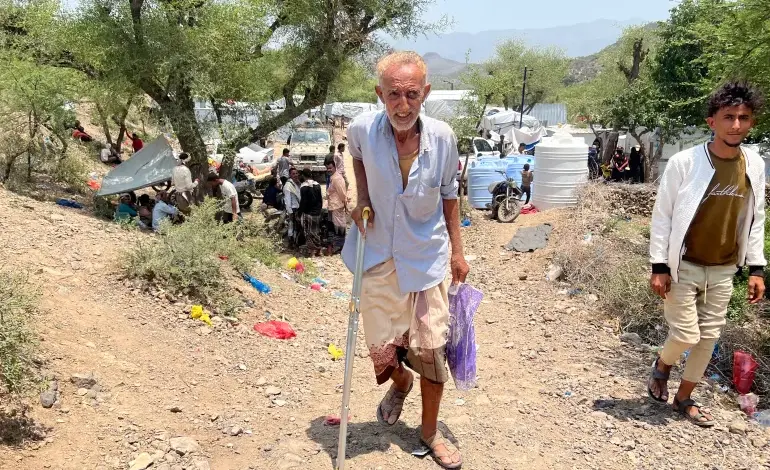
Hajja Fatima Mohammed Saleh, a 70-year-old Yemeni woman, is among the countless people and families displaced from Taiz governorate, southwest Yemen, in recent fighting between government forces and the Houthis.
The Iran-backed rebel group, also known as Ansar Allah (supporters of God), now controls most parts of northwestern Yemen, including the capital, Sanaa.
Saleh’s village in Maqbanah district, on the border of Yemen’s western coast, is situated at the epicentre of last week’s Houthi assault in which the group captured the whole of the Red Sea coast, including the port city of Mocha.
At least 100,000 people have now fled their homes following renewed fighting between the two sides, according to the United Nations’ refugee agency, most leaving with few belongings due to the speed of the Houthi offensive.
Saleh said she had to leave her wheelchair behind as it was unsuitable for the rugged terrain her family had to navigate to find shelter.
“The attack was massive, we had never seen anything like it before. Shells were falling heavily on the village, and bullets were flying in every direction,” she told Al Jazeera.
“We had no choice but to leave and flee to a safe place. We left everything we owned and walked a long distance on foot. For me, I suffered especially because I am disabled and cannot walk, so I had to crawl – using both hands – for a long distance through rain and floods before we found a vehicle to carry us.”
UN agencies and the internationally recognised Yemeni government say that Taiz governorate has witnessed most of the displacements, with Taiz City among the Houthis’ next targets after their victory on the Red Sea coast. This means the humanitarian situation could worsen even further.
Ali al-Shumairi, director-general of the Executive Unit for the Management of IDP Camps in Taiz governorate, told Al Jazeera that 65,845 people were displaced between August 10 and September 15. About 95 percent of those displaced come from the five districts which witnessed the heaviest fighting: Jabal Habashi, al-Maafer, Maqbana, al-Wazi’iyah and Mawza.
Fighting has intensified on several fronts in Yemen as government forces have carried out air attacks on Houthi positions in attempts to retake Mocha, days after the group captured the strategic port city, tightening its grip on the Red Sea – a vital shipping lane.
Malouk Ahmed Ali, 55, from the al-Kadaha area in Taiz, said her family of 14 all escaped drones, shelling and gunfire on foot, including five children under her care, seven under her daughter’s care, and her elderly grandmother.
“We fled to an area near our village in the hope that the war would calm down quickly and we would return to our homes, but the clashes expanded until they reached us, so we were displaced again to here aboard a military vehicle that came to transport the threatened homeless people,” she told Al Jazeera.
“When we arrived at this camp, we were received and placed in this small tent as temporary housing for all members of the large family. Although they took all our information, our situation has not improved much so far, and we still hope it will improve.”
Ali hopes the war will end soon so she can return home but believes her family’s possessions, including solar panels and a battery, will have gone.
“As for our livestock, most of them died, some fled to the mountains and valleys, and what remained was looted,” she said.