Residents of this Beirut neighbourhood felt safe. Then Israel attacked it.
In the early hours of March 11, Mohammad al-Ahmad was asleep at home with his wife and kids when he heard an explosion. It was about 5:20am.
“I woke up in a panic,” he told Al Jazeera, sitting in his tracksuit in a supermarket across the street from the blast site in Beirut’s Aicha Bakkar neighbourhood, his close-cropped brown hair specked with grey.
“I wanted to go see if my kids were all right and then a second explosion happened.”
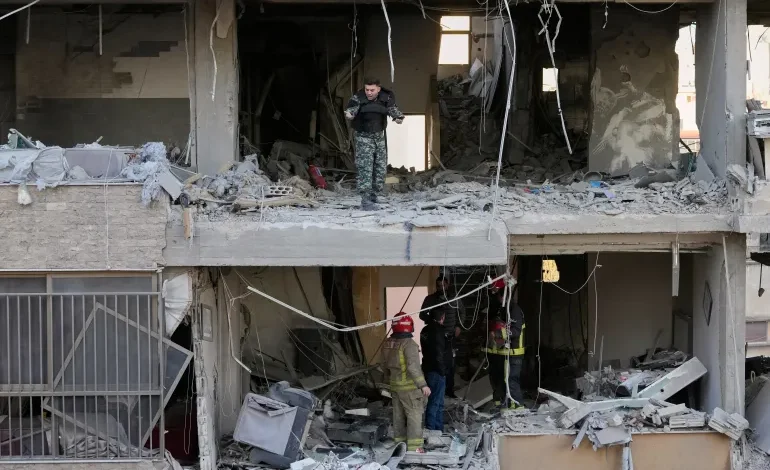
The strike took out two whole floors in a residential building, leaving the street below covered in glass, concrete and dust. The Lebanese Ministry of Health said four people were injured in the attack. Israeli media said the apartment was used by the Jama’a Islamiye (the Islamic Group), though the group denied that any of its members or offices were targeted.
Al-Ahmad said his building was directly next to the one that was hit and his apartment was on the same level. “Glass is all over the floor, it’s all broken. The house has a lot of damage,” he said.
A third ordnance was found unexploded. “Thank God it didn’t explode,” he said. “If it exploded the damage would have been much worse.”
‘Israelis strike wherever they see fit’
Israel intensified its war on Lebanon again on Monday, March 2, after Hezbollah attacked Israel for the first time in more than a year.
Hezbollah said it was responding to the assassination of Iran’s Supreme Leader Ali Khamenei just two days earlier. A ceasefire had ostensibly been in effect since November 27, 2024, despite the United Nations and Lebanese government counting more than 15,000 Israeli ceasefire violations since then.
After Hezbollah’s reply, Israel intensified its attacks on the south and its troops have pushed further into Lebanese territory, engaging Hezbollah in battle in a couple of southern villages. Israel also issued evacuation orders for the entirety of south Lebanon, Beirut’s southern suburbs (known as Dahiyeh), and a few villages in the eastern Bekaa Valley, leading to a massive displacement crisis of at least 800,000 people, according to the Lebanese government.
Israel has since resumed attacking Dahiyeh multiple times a day, though before Wednesday’s strike, it had only attacked central Beirut once. The attack has shaken residents of the city, who were under the impression their areas were deemed safe.
In 2024, Israel struck multiple times in central Beirut and hit targets in every region of Lebanon, including those where Hezbollah or its supporters are not well represented or supported.
Nicholas Blanford, a nonresident fellow at the Atlantic Council, told Al Jazeera that the Israelis were following a similar pattern to 2024.
“They are finding their targets and hitting them wherever they may be,” Blanford said.
“The Israelis will strike targets where they see fit,” Blanford said. “I don’t think they are particularly bothered necessarily where the location is, if it’s in a Sunni area, a Christian area, or whatever.”
The strike damaged many of the surrounding buildings. Two floors in the building where the attack took place were missing exterior walls. Inside, dust and debris covered a carpet that hung over the building’s exterior facade and a mattress that had ended up against an interior wall.