Parents think they know how kids use AI. They don’t
New surveys asked teens how they use AI. Parents have no idea what’s going on, from homework to emotional support.
AI plays a huge role in the life of Isis Joseph’s life. “I use it every day,” she says. The 17-year-old 11th grade student in New York City uses it for homework. AI helps her decide where to eat and provides inspiration for her poetry. Sometimes, she even turns to it with questions about issues in her personal life.
“Parents may inflate AI as this very threatening thing”, and of course, many of those concerns are valid, she says. “But I think AI is generally good.”
Joseph illustrates a larger trend. There’s a wide gap between how parents and teenagers feel about AI in the lives of children, according to a new pair of studies from the Pew Research Center and Common Sense Media, a children’s advocacy group. But there’s a far more startling statistic in the details. The studies show a huge number of parents have no idea what their kids are doing with AI. Some uses are mundane, but some teens use AI in ways their families will find alarming.
One thing is clear: parents need to ask a lot more questions around the dinner table about how their children use chatbots.
There’s a serious lack of communication about AI within families, says Monica Anderson, managing director at the Pew Research Center. “This is not a conversation that is happening with a large swath of parents,” she says.
Pew surveyed 1,458 American teens aged 13-17 and their parents. “We found a gap between what parents believe is happening with AI and what teens tell us that they’re actually doing,” says Anderson.

When Pew asked parents if their children use AI, only 51% said yes. The truth is 64% of teenagers said they use chatbots. Common Sense Media found similarly radical differences. Millions of parents are in the dark about what happens on their kids’ screens.
That makes sense, because according to Pew, four out of 10 parents said they have never had a conversation with their children about AI.
This is a big problem, says Rachel Barr, professor of early child development and chair of the department of psychology at Georgetown University in the US. “That does surprise me,” Barr says. Families should be navigating AI together, rather than leaving teenagers to figure it alone, she says.
Emotional support
When the studies compared what children were doing with their parents’ expectations, they found significant differences. It seems like a lot of teens are making decisions about AI on their own. “A significant minority of kids who have access to AI are using it in social ways that might make parents uncomfortable,” says Michael Robb, head of research at Common Sense.
Of all parents’ anxieties about what their children are doing with chatbots, companionship stood out. According to Pew, 58% of American parents said they’re not ok with their teens using AI for emotional support and another 20% said they weren’t sure. But it’s happening.
Red Flags
According to the American Psychological Association, the signs of problematic AI use in teens may include:
• They describe AI as their “best friend” or primary confidant
• They fall apart when they can’t access it
• School, sleep or real friendships are slipping
• They’re using AI to dogde hard conversations
• Noticeable changes in mood, behaviour or thinking
Seek help immediately if someone is using AI to discuss self-harm, serious depression or mental health crises.
“Sometimes I tell AI something about how I’m feeling, or like a situation that may have happened to me. And it’ll respond back to me basically putting it in perspective, or [explaining] the best way to go about a situation,” Joseph says. “It can definitely be emotionally supportive, but of course, it’s a robot.”
The teens I spoke to about this are savvier than you might expect. Joseph, for instance, says she recognises the AI may just be saying what she wants to hear and takes the advice with caution. But most of them, Joseph included, say using AI for advice or companionship can go too far. Several mentioned the story of a 14-year-old boy who took his own life after obsessive conversations with a chatbot.
“One of my friends, at one point, he talked to AI all the time,” says Kingston Rieban, 16, of San Diego, California. “Sometimes we’d just be sitting and we’d hear him laughing next to us, typing stuff down on his phone.”
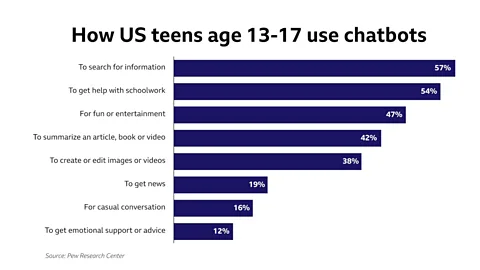
When Pew asked US teenagers about AI, 12% said they use it for advice or emotional support and 16% said they use it for casual conversation. Those proportions may be small, but they still amount to millions of children across the US if the survey is representative. And there were huge racial disparities.
According to the study, 21% of Black teenagers use AI for emotional support, compared to just 13% of Hispanic teens and 8% of White teens. (There weren’t enough Asian teenagers in the study to break out a separate analysis.)
“We also see a lot of evidence, using regressions and other analysis, that race does stand out on its own, even when controlling for other factors like income,” says Anderson.
Keeping Tabs
Thomas Germain is a senior technology journalist . He writes the column Keeping Tabs and co-hosts the podcast The Interface. His work uncovers the hidden systems that run your digital life, and how you can live better inside them.
The Pew study didn’t address reasons for these differences. Barr suggests teens with fewer support systems may turn to AI as a resource because it’s so accessible, but it’s impossible to know for sure without more research.
As long as chatbots are on the market, it’s probably inevitable that people are going to use them like friends and therapists. The American Psychological Association offers a guide for parents whose teens turn to chatbots. Among the key tips, it recommends asking questions instead of lecturing and watching for red flags that teens are using AI in ways that replace human interaction.
Work and play
Among teens, some the most common AI habits are what you might expect. “I usually use it to study,” says Eloise Chu, a 13-year-old from Chatham, New Jersey in the US. “Like if I have a math test, I’ll give it a problem I don’t know how to do so it can generate more questions, so I can get good at it.”
According to Pew, teenager’s number one use of AI is just looking stuff up (the way you might have Googled it back in the stone ages when I was a teenager). Help with schoolwork comes in next. About half of US teens say they use AI for research, and many use it for help with maths and writing. One in 10 teenagers say they do all or most of their schoolwork with the help of AI. A lot of the teens I spoke to say their teachers actively encourage the use of AI, with restrictions to ensure it doesn’t stand in the way of learning.
Almost none of the teenagers I chatted with admit to cheating with AI. When you ask teenagers about other students, however, you get a very different picture – 59% of teenagers told Pew that students at their school use AI to cheat while 34% said it happens extremely or very often.
“I’ve had classmates who like literally yell at the teacher, ‘Hey, if you don’t come answer my question, I’m just gonna get AI to do this for me’,” Rieban says. Cash, his 14-year-old brother, has similar stories. “In science class, we had to research a topic and write about it and one of the kids at my table had just completely copied what the AI told him,” he says. “But then he couldn’t read his own handwriting and he didn’t even remember what he wrote.”
But it’s not all work and cheating, 47% of US teenagers said they use AI for entertainment. Chu, for example, says she has a lot of fun using AI to generate pictures of penguins and pancakes, two of her favourite things. I promised her I’d try it. I can report it’s just as great as Chu says.
Attitude problems
Some of the biggest differences in the study came down to how parents and teenagers feel about AI, and it’s not all bad news. There’s a big generational divide, and there are good reasons for optimism if you can accept that young people aren’t completely oblivious.
According to a study from Common Sense Media, 52% of parents say using AI in school assignments is “unethical and should have consequences”. But ask the teenagers, and the exact same number say using AI for schoolwork is “innovative and should be encouraged”. Either the children are missing something, or the parents are.
“I feel like adults might think kids are only using AI badly, to cheat on homework and stuff,” Chu says. “I don’t think most kids are doing that.” (Chu’s mother told me she’s comfortable with how her children use AI, though.)
But teens seem more comfortable with the tools in general. Common Sense Media found that 92% of teens say they can tell when they’re interacting with an AI system or a real human, compared to 73% of parents. According to Pew, almost six out of 10 teenagers say they’re confident about their ability to use chatbots, and a quarter said they’re very or extremely confident.
“Kids are often the vanguard of new technologies and more comfortable testing the boundaries of what new tech can do,” Robb says.
Most teenagers don’t share the doomsday view of AI that plagues so many adults. When Pew asked, 36% of teens said they expect AI will have a positive impact on them in the long term, and only 15% expected it to be negative.
Parents don’t need to have all the answers, Robb says, but they do need to start asking questions. “It’s okay to ask your kids to take you on a tour of how they’re using AI in their lives,” he says. “At the very least, it’s a conversation starter.”