‘Nothing else looks like them’: Saving Japan’s exceptionally rare ‘snow monsters’

A unique natural wonder is being eroded. Can Japan bring its breathtaking “juhyo” back from the brink?
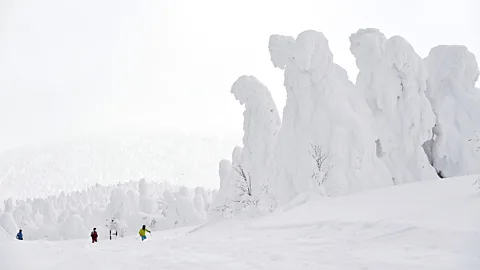
Each winter, the upper slopes of Mount Zao in northern Japan – one of the country’s best-known ski areas – are transformed. Fir trees coated in thick frost and snow swell into ghostly figures known as “juhyo” or “snow monsters”.
Juhyo form only under exceptionally rare atmospheric conditions, emerging when strong, persistent winter winds carry supercooled water droplets that freeze on contact with the local evergreen Aomori todomatsu trees, gradually layering into rime ice.
At Mount Zao, these formations occur during sustained westerly winds of up to 26m per second (85ft per second), with surface air temperatures between -6.3C to -0.1C (21-31F) and unusually high cloud liquid water content. Under these precise conditions, the rime thickens on the windward side of trees into overlapping ridges known as “shrimp tails”, the distinctive shapes that cluster together to form the towering juhyo figures.
“Because such precise meteorological and ecological conditions align in very few places, Zao’s snow monsters are a phenomenon almost unique to northern Japan,” says Fumitaka Yanagisawa, an emeritus professor of geochemistry who studies the juhyo at Yamagata University.
The snow monsters are the biggest winter draw of the Zao area, a mountain range which lies between Japan’s Yamagata and Miyagi prefectures and attracts tens of thousands of visitors annually.
But recent research indicates that the monsters are becoming slimmer.
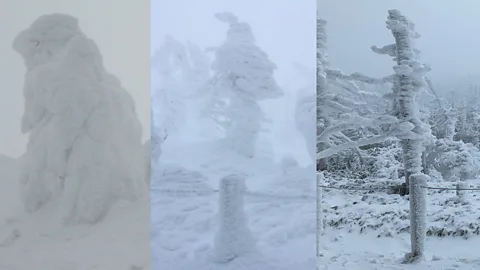
In August 2025, a research team led by Yanagisawa announced findings that quantified what locals have long observed. By analysing identical-angle photographs of Zao’s summit taken since 1933, the team measured the thickness of the figures on a six-point scale. The findings (which have not yet been published in a scientific journal) indicate a widespread shrinking of the juhyo.
“In the 1930s, we saw juhyo five to six metres [16-20ft] across,” Yanagisawa says. “By the postwar decades, they were often two to three metres [7-10ft]. Since 2019, many are half a metre [1.6ft] or less. Some are barely columns.”
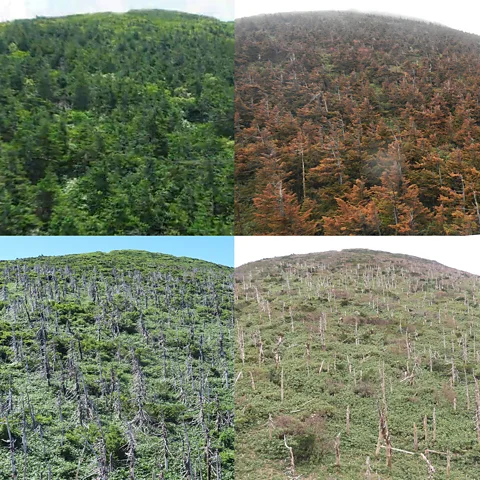
The cause is twofold, says Yanagisawa: a warming climate and a forest under attack. The host tree, Aomori todomatsu, suffered a moth outbreak in 2013 that stripped its needles. Bark beetles followed in 2015, boring into weakened trunks. Yamagata officials report that around 23,000 firs, about a fifth of the prefectural side’s stands, have died. With fewer branches and leaves, there is little surface for snow and ice to cling to.
Another 2019 study found that in nearby Yamagata City, average temperatures from December to March have risen by about 2C (3.6F) over the past 120 years. The lower altitude limit of juhyo formation has shifted upward in step with this warming, it found, while the juhyo also last for fewer days of the year.
“Unique landscapes are already being lost to climate change,” says Akihiko Ito, an ecologist who specialises in forests and climate change at the University of Tokyo.
Research shows that Japan’s warming climate and extreme weather are already damaging many of its high mountain forests. “Seasonal shifts in spring and autumn can harm leaves, and insect outbreaks are expanding. These stresses may reduce forest growth and density,” Ito says.
Across Japan’s alpine zones, temperatures have been rising faster than the global average since the 1980s. “In scenarios where climate change continues to advance significantly by the end of this century, it is possible that in warmer-than-usual winters, juhyo may no longer form at all,” Ito says.
The threat has prompted action across Yamagata. In March 2023, the prefecture launched the Juhyo Revival Conference – a permanent council bringing together researchers, officials, local businesses and residents to coordinate long-term efforts to restore the fir forests and preserve Mount Zao’s snow monsters.
Juhyo are not only a natural spectacle but also a pillar of the local economy. “The influx of tourists supports hotels, restaurants and souvenir shops throughout the area,” says Genji Akiba, deputy director of the Zao Onsen Tourism Association. “If the juhyo disappear, it would be a huge blow.”
“Revival is a strong wish of our citizens,” says Yoko Honma, a conservation specialist at Yamagata Prefecture’s nature division. Since 2019, the local forest office has transplanted more than 190 naturally regenerated saplings from lower slopes to the summit zone near the ropeway station. “Because it takes 50 to 70 years for these firs to mature, the key is sustaining conservation across generations,” says Honma. “We need patience and continuity.”
In Murayama, about 20km (12 miles) north-west of Zao, students from a forestry and environmental science course at Murayama Technical High School have also taken up the challenge of reviving the firs.
Since 2022, the students have been planting Aomori todomatsu trees and studying how to propagate and protect the species. Together with staff from the Yamagata Forest Office, they visit Mount Zao to collect young fir saplings and bring them back to their school for research. There, they cultivate stems through cuttings and experiment with methods for artificially propagating and efficiently producing seedlings.
“It’s been challenging,” says Rin Oizumi, a second-year student in the course. “When the seeds we sowed in heavy rain finally sprouted, I felt both relief and excitement. But it was heartbreaking to find that some plots had been damaged by field mice, which had eaten the young shoots.” The students have also conducted preliminary experiments using branches of a related fir species, which have shown successful germination.

Kanon Taniai, Oizumi’s classmate, recalls seeing more and more fallen or dead trees as she and other students neared the summit one day in July 2024. “It made me feel really sad,” she says. “Growing seedlings is hard work, but we want to do what we can to help bring Mount Zao back to life.”
For Taniai, protecting the Juhyo means passing their legacy to the next generation. “They are called snow monsters because nothing else looks like them,” she says. “I want the world to see them, and to feel how special Japan’s nature is.”