‘No freedom at all’: Israeli closures leave West Bank patients trapped
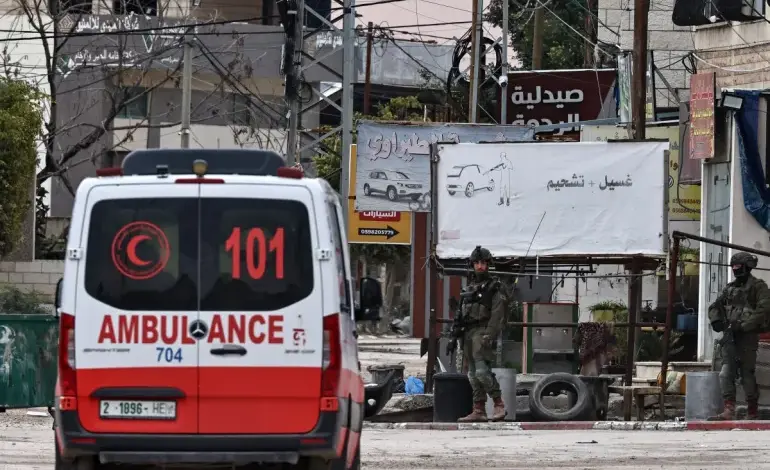
On Friday evening, after Israeli Prime Minister Benjamin Netanyahu ordered a “wide-scale military operation” across the occupied West Bank following a settler attack in the village of Tal that morning, Palestinian ambulance driver Yousef Diriya, 50, found himself trapped for four hours at Awarta checkpoint while transporting kidney dialysis patients.
In the days since, much of the West Bank – particularly Nablus Governorate, but also Ramallah and towns stretching as far south as the Bethlehem Governorate – has been sealed off, forcing ambulance crews to navigate lengthy detours and prolonged checkpoint delays to reach hospitals.
An ambulance trip that normally required Diriya to drive 20 kilometres (12 miles) can now require as much as 100 kilometres (60 miles), by his estimation. And even with prior coordination and permission to pass, it has taken hours at a time for Diriya to pass checkpoints to bring patients to hospitals in Nablus, the closest place offering sufficient medical services for critical cases from the surrounding villages, but which has had its entrances sealed off completely in recent days.
“Even if you’ve coordinated in advance, and they know the same woman is with you – it makes no difference,” said a tired Diriya. “Whether you’re entering Nablus or leaving through the checkpoint, it’s the same procedure every time: inspection, photographing IDs, photographing the ambulance, and then you just wait.”
Waiting at the checkpoints as each precious minute slips away for his patients requiring emergency medical attention leaves Diriya on edge.
‘Collapsing’ healthcare system
Israel’s illegal settlements have choked Palestinian life in the occupied West Bank in the past few decades, but restrictions have grown on Palestinians since a far-right government came to power in Israel at the end of 2022, and Israel’s genocidal war on Gaza began in October 2023.
Even before the de facto lockdown that began on Friday evening, towns and villages in the West Bank have had checkpoints multiply and entrances increasingly sealed off entirely – with fatal results.
On July 5, in Deir Ammar refugee camp northwest of Ramallah, three-month-old Ahmad Zaid stopped breathing, and his family raced to get him past a locked Israeli military gate that has blocked the camp and two neighbouring villages from Ramallah’s hospitals since February.
Soldiers refused to open the gate even after Ahmad’s father carried the infant towards them, pleading to be let through. By the time the family reached an ambulance by another route, it was too late; the infant was pronounced dead en route to a hospital.
Then, on July 18, less than a week before the lockdown began, 30-year-old Sujood Fuqahaa from Sinjil died of cardiac arrest after soldiers would not allow her ambulance to pass while the town experienced a weeklong siege that sealed off all of its entrances. Such recent cases follow two years in which paramedics often reported being stopped on the way to reach injured victims of attacks from Israeli soldiers and settlers.
Adding to such access restrictions is the worsening medical supply shortage across the West Bank, as well as a healthcare system that is barely able to fund itself as a result of Israel’s systemic withholding of tax revenues designed for the Palestinian Authority. “The whole healthcare system is collapsing,” said Imran Anati, a researcher at Physicians for Human Rights-Israel.