‘Naturally scared’: India’s Muslims denied public spaces for Eid prayers
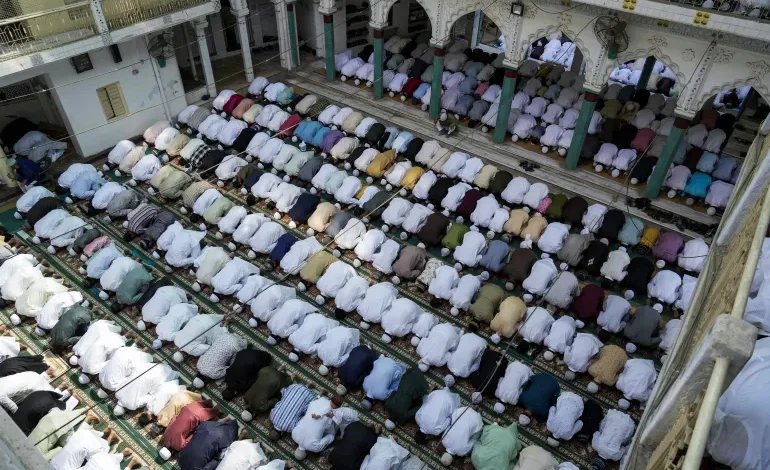
The mood is barely festive as a group of Muslim men huddle inside a small mosque to discuss the arrangements for Eid al-Adha prayers in Meerut district of India’s Uttar Pradesh state.
Ceiling fans hum above to beat the brutal north Indian heat as nearly 50 worshippers listen to the members of the mosque management committee in Maliyana village, about 80km (50 miles) from New Delhi, the national capital.
The conversation is not about sacrificial animals or charity, but a more pressing issue before them: roads, barricades, police permissions, and where and how exactly they would offer the Eid prayers on Thursday.
“Please don’t gather outside the mosque gates,” instructs a member. “If the mosque fills up, wait for the next prayer shift. Avoid arguments. Avoid videos. Don’t respond to provocations.”
Men in the audience silently nod. Some scroll through WhatsApp groups where local police advisories have already begun circulating, urging Muslims to refrain from public prayers. Others in the audience exchange worried glances.
Maliyana has a history. In May 1987, 72 Muslims were massacred here by a mob of Hindu locals and personnel belonging to the state government’s Provincial Armed Constabulary (PAC). After 36 years of hearings, a district court in 2023 acquitted dozens of the accused over insufficient evidence.
But the concerns that prompted the mosque committee and worshippers there to review their Eid plans are more recent.
‘People are naturally scared’
For more than a decade now, right-wing Hindu groups, emboldened by the election of Hindu nationalist Narendra Modi as India’s prime minister in 2014, have been protesting against Muslims offering public prayers on Fridays and festivals, citing traffic and security concerns.
These groups, and even politicians from Modi’s Bharatiya Janata Party (BJP), have disrupted namaz on roads, in parks, or on vacant plots of land. Viral videos showing Muslims praying in open areas have sparked outrage and online campaigns, prompting the authorities, in some cases, to withdraw permissions granted to Muslims to offer namaz prayers at such sites.
Last week, the Vishwa Hindu Parishad (VHP), a prominent far-right Hindu group aligned with the BJP, demanded a complete nationwide ban on namaz on roads, calling the practice a “show of strength” by the community.
But Muslims argue that a crackdown on public prayers ignores a practical reality: many mosques and designated grounds for Eid prayers, called “Eidgahs”, cannot accommodate all the worshippers during mass congregations on Fridays or Eid, especially in densely populated urban areas.
A day before Eid al-Adha, the central question before Muslims is whether they will be allowed to pray peacefully, without attracting scrutiny, confrontation, or public hostility, particularly in BJP-governed Uttar Pradesh, a state almost as populous as neighbouring Pakistan and home to nearly 39 million Muslims, more than the population of Saudi Arabia.
The BJP government in Uttar Pradesh, led since 2017 by Yogi Adityanath, a saffron-clad hardline Hindu monk known for his vitriol against Muslims, has intensified crackdowns on Muslim prayers on roads and open spaces.
On May 18, Adityanath said Muslims should offer Eid al-Adha prayers “in shifts”.
“Pyaar se maanenge theek hai, nahi maanenge to doosra tareeqa apnayenge … (If they agree peacefully, that is good; if not, we will adopt another method),” he posted on X.
To the Muslims of Uttar Pradesh, the threat of Adityanath’s “another method” is not unfamiliar.
“Last year, people were booked for praying in open spaces. In some places, homes were demolished and there were even reports of driving licences and passport verifications being cancelled. After seeing all this, people are naturally scared,” a Muslim man in Meerut told Al Jazeera, requesting anonymity since he feared reprisal from the authorities.
Arif Malik, a shopkeeper in Aligarh district, about 130km (80 miles) from New Delhi, said that on Eid al-Adha last year, Muslims in his neighbourhood “offered namaz for barely a few minutes in an open ground, but police chased the worshippers afterwards”.