NATO assessing details of US troop withdrawal from Germany
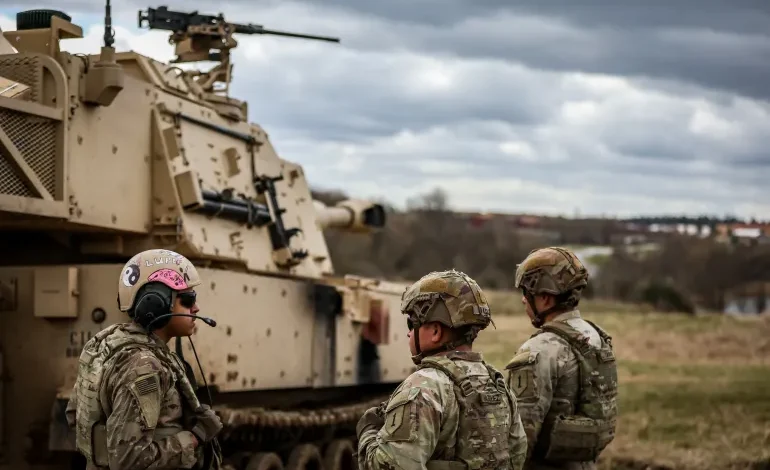
NATO says it is assessing the details of the United States’s decision to withdraw about 5,000 troops from Germany, a key partner in the Western security alliance, amid tensions over the war on Iran.
In a statement on Saturday, NATO spokesperson Allison Hart said the bloc is “working with the US to understand the details of their decision on force posture in Germany”, a process the US Pentagon estimates will unfold over the next six to 12 months.
The planned drawdown comes as US President Donald Trump feuds with European allies for not doing more to assist in the US-Israel war against Iran. He has voiced particular ire at Germany’s Chancellor Friedrich Merz, who recently said the US was being “humiliated” by Iran’s leadership.
Trump responded by urging Merz to stop “interfering” over Iran and spend more time “fixing his broken country”. The US president has also called NATO a “paper tiger” and “absolutely useless”.
Al Jazeera’s Dominic Kane, reporting from Berlin, said the US troop reduction appears to be among a series of measures aimed at “really hitting the Germans where it hurts”, including tariffs on EU automobiles that are expected to cost Germany’s economy billions.
The actions “needs to be seen through the prism of this tension between the Trump administration and the Merz government,” said Kane.
‘Changing US objectives’
Former US diplomat Donald Jensen said the US’s announced troop withdrawal reflects shifting US military priorities and could signal a longer-term reconfiguration of Europe’s security framework.
“The reduction or repositioning, whatever you want to call it, suggests a changing US strategic set of objectives,” Jensen told Al Jazeera, adding that more American troops could now be sent closer to China, which Washington views as a greater threat than Russia.
Jensen said the US military shift is likely to cause a “permanent change in that security architecture [of Europe], the final form of which we don’t know yet”.
“But certainly, it portends a more transactional view by Washington of our European partners,” he said.
Reacting to the US announcement, German Defence Minister Boris Pistorius said Germany had anticipated a US drawdown and that Europeans must take greater responsibility for their own security.
“Germany is on the right track” in this regard, Pistorius said, pointing to the expansion of its armed forces, the greater and faster procurement of equipment and the construction of infrastructure.
NATO’s Hart echoed that view, saying the US decision “underscores the need for Europe to continue to invest more in defence and take on a greater share of the responsibility for our shared security”.
“We remain confident in our ability to provide for our deterrence and defence as this shift towards a stronger Europe in a stronger NATO continues,” she added.
During last year’s NATO summit in The Hague, members agreed to boost defence spending to up to 5 percent of their budgets, more than doubling the previous 2 percent target.