Murder in Okinawa: The US military’s history of alleged crime in Japan
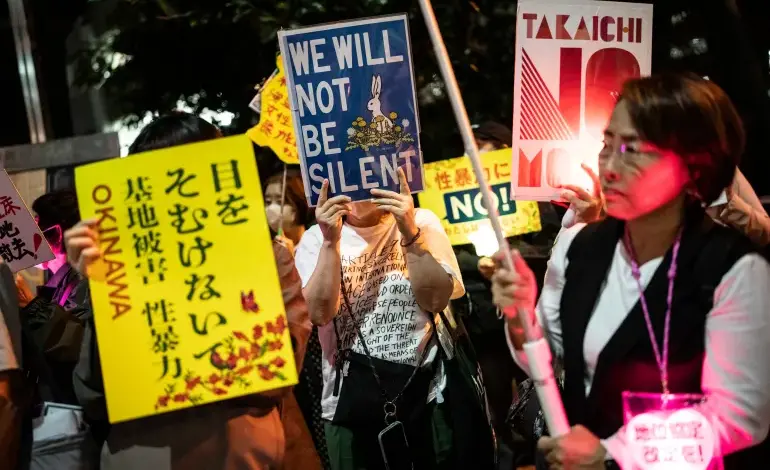
About 100 people participated in a rally in Naha, the capital of Okinawa, on Sunday, as news spread that a US marine had, a day earlier, allegedly killed a 39-year-old woman at a hotel in the city and stolen her wallet.
Public broadcaster NHK reported that security camera footage from near the scene showed a foreign man entering a room with a woman and later leaving alone with her belongings. Police then found a 20-year-old man who matched the description. The suspect has reportedly denied the allegations.
Police identified the suspect as Devin Jacob Ballard and the victim as Anna Yagi.
Kozue Akibayashi, a professor of gender and peace studies at Doshisha University in Kyoto, Japan, said the incident reflects a decades-long issue. “The Japanese government has always chosen the US-Japan alliance over the safety and lives, and voices of the people of Okinawa,” she told Al Jazeera.
Why are US marines stationed in Okinawa?
The United States has about 54,000 military personnel stationed in Japan. Okinawa bears a disproportionate burden, hosting about 70 percent of US military facilities in the country, set up under a bilateral security treaty and Status of Forces Agreement (SOFA) signed first in 1951 and then revised in 1960.
Japan has the “primary right to exercise jurisdiction” for crimes committed off-base while US personnel are not on duty, while the US has the “primary right” for crimes committed on the base or while on duty.
Okinawa is viewed by Tokyo and Washington as key in deterring potential military aggression from China. “The US and the Japanese governments have always cited ‘geopolitical’ importance of the location of the archipelago to justify not only the presence itself but also the disproportionately high concentration of the US military there,” Akibayashi, at Doshisha University, said.
“However, in reality, it was convenient for the Japanese government to keep the larger number of US troops and military facilities in Okinawa that nobody wants.”
The professor said Okinawa, one of Japan’s 47 prefectures, represents 1 percent of the entire population of Japan and less than 1 percent of the entire Japanese territory.
“Their political voice does not seem to bear significance to the Japanese government,” she added. “Probably more importantly, Okinawa was colonised by Japan in the late 19th century and has always been a subject of discrimination within Japan.”
Okinawa was historically an independent trading nation called the Ryukyu Kingdom before Japan annexed it in 1879. The US held Okinawa, which is 100 kilometres (60 miles) from Taiwan at the closest point, from the end of World War II until 1972.
“Many US military bases located on the main islands of Japan were transferred to the islands of Okinawa … because the mainland Japanese people had started to protest the presence of the US military in their neighbourhood,” Akibayashi said.
The presence of US marines has repeatedly stirred resentment among residents over issues such as noise, aircraft crashes and the conduct of personnel.
Have US marines been accused of crimes before?
Yes, there is a long history of crimes including rapes, assaults, hit-and-run and drunk-driving accidents allegedly committed by US personnel, triggering protests on Okinawa.
Last year, a Japanese court sentenced a US marine accused of choking and attempting to rape a woman in her 20s to seven years in prison.
In 2017, a former US marine and civilian military base worker was sentenced to life in prison for the rape and murder of a local woman in Okinawa. The same year, an intoxicated US marine crashed his vehicle into a mini-truck, killing its 61-year-old local driver.
In 1995, the rape of a 12-year-old Okinawan girl by three US servicemen led to mass protests.