Jerome Powell: Steering the US Fed through COVID-19 and political pressures
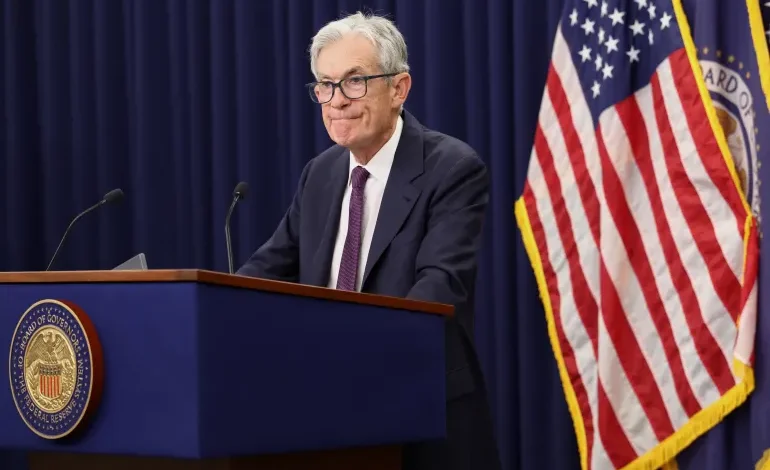
On Friday, Jerome Powell’s term as chair of the United States Federal Reserve Board of Governors will come to a close after months of tension between the White House and the central bank, as US President Donald Trump pushes for more aggressive interest rate cuts.
Powell’s term ends on May 15, and he will be succeeded by Trump appointee Kevin Warsh, who served on the central bank’s board of governors from 2006 to 2011. Powell will continue on the board as a governor after stepping down as chair.
Powell, who was first appointed by Trump in 2018, said he planned to stay on to help preserve the central bank’s independence.
The announcement came after Trump said he would fire Powell if he remained at the Fed beyond the end of his term as chair.
Al Jazeera takes a look back at the central bank chair’s career.
Trump tensions
Powell’s tenure as Fed chair during Trump’s second term has been marked by political pressure as Trump pushed for more aggressive interest rate cuts than the Fed was willing to implement.
Powell stressed the central bank’s independence and consistently deflected criticism and rhetoric from the president, who gave him the nickname “Too Late Powell” in reference to the Fed’s hesitancy to cut rates quickly and sharply.
Under Powell’s leadership, the Fed did not begin cutting interest rates until September.
“His legacy was, ‘We need to reclaim independence for the Federal Reserve,’ and I think that’s exactly what he did,” Babak Hafezi, a professor of international business at American University, told Al Jazeera, referring to views that the Fed had been a little too close and in lockstep with the US government previously. “He fought the Trump administration on lowering interest rates.”
Apart from a barrage of rude, threatening and demeaning comments from Trump targeted at Powell, the administration also launched an investigation into the Fed chair related to renovations at the Federal Reserve’s Washington headquarters. Government prosecutors found no evidence of wrongdoing.
The investigation, however, stood in the way of Trump’s latest appointment.
Republican Senator Thom Tillis of North Carolina said he would not vote for any nominee to the central bank until the Department of Justice dropped its investigation into Powell.
The investigation was later suspended, and the Senate Banking Committee voted to advance Warsh.
It was not until his final news conference that Powell spoke more candidly about the political pressure.
“I worry these attacks are battering the institution and putting at risk the thing that matters to the public, which is the ability to conduct monetary policy without taking into consideration political factors,” Powell told reporters.
Those concerns come alongside other appointments and investigations that have raised questions among experts about the central bank’s independence.
Among them are Trump’s firing of Fed Governor Lisa Cook, who was appointed by former US President Joe Biden, a Democrat, over alleged mortgage fraud; the appointment of Trump ally Stephan Miran, previously chair of the White House Council of Economic Advisers; and Trump’s remarks in December that he would only appoint someone who agreed with him on interest rates.
Although Trump in his first term as president had appointed Powell as Fed chair in 2018, by October of that year, Powell was already in Trump’s crosshairs as the Fed raised interest rates. Trump called the Fed “crazy” on X, then known as Twitter.
In an interview with The Wall Street Journal, Trump claimed that Powell “almost looks like he’s happy raising interest rates”. The central bank raised rates four times in 2018, from 1.25–1.50 percent at the start of the year to 2.25-2.50 percent by the year’s end.
“The desires of Trump 1 and Trump 2 are the same, and that is lower Fed policy rates. Neither during the early days of the first Trump administration nor now is there a clear justification for cuts in the Fed funds rate target,” Brett House, an economics professor at Columbia University’s Business School, told Al Jazeera.
Trump continued the rhetorical pressure on Powell, calling him an “enemy” in August 2019 and pushing for his removal.
In the summer of 2019, Powell cut rates.
“Inflation was running pretty low, and the economy looked like it was slowing down,” Skanda Amarnath, a former analyst for the New York Federal Reserve, told Al Jazeera. “The Fed did show a lot of flexibility on that side. At the same time, when the data changed in 2021 and 2022, he was more than willing to raise interest rates if he thought inflation was a serious problem.”
The COVID-19 conundrum
Powell’s monetary policy took centre stage during the economic fallout at the onset of the COVID-19 pandemic.
Under Powell’s leadership, the Federal Reserve, alongside the Treasury Department, issued direct payments to individuals as part of the Coronavirus Aid, Relief, and Economic Security (CARES) Act.
The central bank also worked with the Treasury to launch several lending programmes, including the Paycheck Protection Program (PPP), which provided short-term relief to help small businesses stay afloat.
Among the measures the central bank took was the purchase of both US government and mortgage-backed securities. The Fed also cut short-term interest rates to a range of zero to 0.25 percent.
By the fall, Trump’s criticism of Powell had eased. In a November 2020 interview, Trump told Fox Business that he was “very happy with his performance”, Amarnath said.
When Powell’s term expired in 2021, Biden, then president, nominated him for another term as head of the central bank’s board of governors.
With inflation soaring to a 40-year high during the pandemic, the central bank ended up raising interest rates to 5.5 percent by July 2023.
“It turned out, both in retrospect and at the time, that they did need to raise rates substantially in the fastest rate-hiking cycle we’d seen in decades to address that spike in inflation,” House said.
“When one looks at the recovery from the COVID-induced shutdowns in 2020, it was a very fast recovery, and some inflation was one of the unfortunate byproducts of it. But in contrast with the 2008 financial crisis, the Fed and other policy institutions helped ensure a very quick rebound from the massive public health-related restrictions on the economy we put in place in March 2020,” House added.
Before taking on a leadership role, Powell served as one of the board’s seven governors. First appointed by US President Barack Obama in 2012, Powell advocated reforming “too big to fail” policies involving taxpayer-funded bailouts of large firms.
“Too big to fail must end, even if more intrusive measures prove necessary in the end,” Powell said in a 2013 speech.
By 2017, Powell asserted that regulators “made a great deal of progress” and concerns that banks were “too big to fail” were quelled.
Warsh’s task
Kevin Warsh is now set to take the helm of the central bank. During a contentious confirmation hearing before the Senate Banking Committee in April, Senator Elizabeth Warren, a Democrat, accused Warsh of being a “sock puppet” for the president. Warsh denied such claims.