Israel’s ‘two-tier’ policing and the crime epidemic in Palestinian towns
Addressing the cameras following reports of spiralling youth violence, including the killing of the 21-year-old former Israeli soldier Yemanu Binyamin Zalka last week, Israel’s National Security Minister Itamar Ben-Gvir was clear.
“This will be a total war,” he said, announcing a national operation to target a surge in youth violence. “We will restore security to the streets and calm to parents. Anyone who harms Israeli civilians will face the strong hand of the Israel Police and pay a heavy price.”
The response was sharp, aligned itself with the victim, and promised a solution.
That, critics say, is a sharp contrast to Ben-Gvir’s response – or lack of one – to the ongoing epidemic of violence in Israeli towns and villages populated by Palestinians, which has so far led to the deaths of almost 100 people and, according to Israel’s own finance ministry, costs the country up to $6.7bn a year.
Allegations of two-tier policing, to the detriment of what Israelis refer to as the “Arab sector”, have dogged Israel’s police for decades. But the situation has gotten worse under the current administration of Prime Minister Benjamin Netanyahu, which has been in power since the end of 2022, and Ben-Gvir, a far-right politician who is in charge of the police.
The statistics since Ben-Gvir came into office back up the narrative that the crime wave in Palestinian communities has gotten significantly worse. The Israeli newspaper Haaretz reported that the murder rate in Israel’s Palestinian communities increased from 4.9 per 100,000 in 2020, to 11 per 100,000, on par with the murder rate in Sudan and Iraq.
In contrast, the murder rate in Israel’s Jewish society stood at approximately 0.6 per 100,000.
That increase can not totally be attributed to the current government – Netanyahu himself was prime minister in 2020, when the murder rate was lower. But critics argue that the introduction into government of figures like Ben-Gvir and Finance Minister Bezalel Smotrich, who they say are openly disdainful of Palestinians, has contributed to the sharp uptick in violence.
Analysts and experts who spoke to Al Jazeera had little doubt over the Netanyahu government’s culpability in the increased murder rate.
“They really don’t mind that Palestinians are killing each other, as they’ve been left to do for years,” lawmaker Aida Touma-Suleiman, a Palestinian member of the Hadash party and a longstanding critic of the lack of policing in Palestinian communities in Israel, said.
“It would never occur to the police that they should provide a service to Arab neighbourhoods,” she said of the lack of physical police presence within Palestinian communities. “It’s about enforcement. It’s hostile.”
While police stations are standard in Israel’s Jewish-majority areas, there are only about 10 in Palestinian-majority areas.
Among the decisions that have most angered Palestinian advocacy groups in Israel was the government’s December approval of a $68.5m cut to an economic development programme for Palestinian communities in Israel, in order to fund more policing in the communities.
Critics agreed that more funding was needed for the police, but bemoaned that the money was coming from a fund designed to address the root causes of criminality by addressing housing and economic development, areas where Palestinian communities are notoriously underfunded in comparison to Jewish ones.
Hardwired poverty
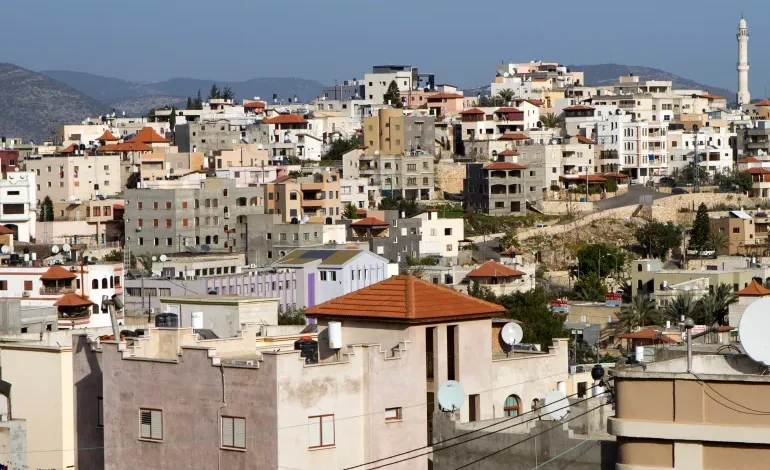
Palestinian citizens of Israel make up around 21 percent of the country’s population. Disadvantaged economically, they are the descendants of Palestinians who did not flee after the 1948 establishment of Israel – an event they know as the Nakba, when an estimated 750,000 Palestinians were ethnically cleansed and forced out.
Often concentrated in separate towns and villages from Israeli Jews, Palestinians frequently describe a reality of chronic underinvestment, with the presence of the state either limited or non-existent.