Israel deprives Palestinians of proper education by withholding revenues
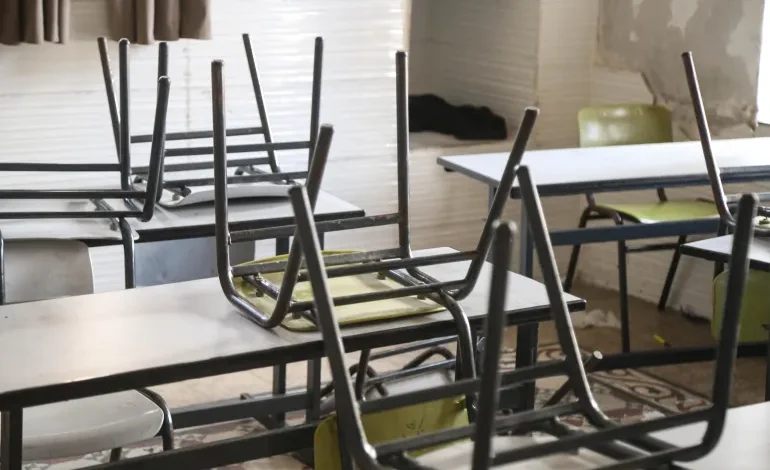
For decades, the Zenabia Elementary School has been offering an intimate learning environment to aspiring young students from across the educational spectrum in the northern West Bank city of Nablus.
But now, due to Israel’s years-long withholding of tax revenues owed to the Palestinian Authority, the Palestinian school system is effectively broke. Like administrators at all government-run schools in the West Bank, the Zenabia school principal, Aisha al-Khatib, is struggling to keep her small, public school in session.
For most of the week, the Zenabia school is shuttered, and children roam the streets or stay at home. School supplies are woefully missing, with even regular schoolbooks now reduced to “bundles of pages”.
“We do everything we can, but we do not have the time or the materials or the consistency to properly teach our children and keep them off the streets,” says al-Khatib. “And this is everywhere in the West Bank.”
Targeting the education of Palestine’s children, she says, “means destroying the nation”.
Under the direction of far-right Finance Minister Bezalel Smotrich, Israel has systematically been withholding billions of dollars in tax revenues over the past two years that Israel collects on behalf of the Palestinian Authority (PA). The measure is partly intended to punish the PA for its longstanding policy of paying families of Palestinians imprisoned by Israel for resisting the occupation – even after the PA announced early last year that it was reforming such policies.
Public services have faced severe cuts, affecting the salaries of bureaucrats, sanitary workers, and the police.
But possibly nowhere has that budgetary crisis been felt more than in the education sector.
At Zenabia and elsewhere in the West Bank, public schools are currently only open for a maximum of three days a week. Teachers face long stretches of not being paid, and when they are, they only receive about 60 percent of what they were earning before, resulting in strikes.
And the effects of these cuts in education are showing up on the days when school is in session. Class time is so diminished at Zenabia that teachers focus almost solely on teaching mathematics, Arabic, and English, with subjects like the sciences being essentially cut altogether.
The result, educators warn, could be lasting educational gaps for a generation of Palestinian students.
“As principal of the school, I know that [the students] are not [at] the same [educational] level as before,” al-Khatib says.
‘We are always absent from school’
Spending most of his days out of school, star student Zaid Hasseneh, 10, tries to keep improving his English by looking up words on Google Translate. Zaid dreams of going to university someday in the United States, with hopes of becoming a doctor.
“I want my son to grow up to be cultured – not just memorise the material he learns at school,” says his mother, Eman. “No, I want his cultural knowledge to develop and become diverse and advanced.”
Eman helps Zaid when she can with his studies, but she is busy keeping the family afloat financially after her husband lost his work in Israel. Before Israel’s war on Gaza began in 2023, Eman’s husband worked in Tel Aviv as a mechanic. After Israel revoked his work permit, along with those of some 150,000 other West Bank Palestinians, he has been unable to find work. Eman now works in a halawa factory as the sole breadwinner.
“I go home tired from work, but I have to keep up with [Zaid] regularly,” says Eman. “I tell him, ‘The most important thing is studying. Studying is essential for life.’”
But Eman realises how limited she is in helping her son with his studies. “The teacher knows one thing, but I don’t know how to explain it,” says Eman. “And now, the books [they receive in school] aren’t complete books anymore. They’re bundles. Regular books are 130 pages, but these are 40 or 50 pages.”
To compound the dearth in school resources, students and their families describe erratic schedules that make cumulative learning a near impossibility. “The whole family’s routine is affected,” says Eman.