Iran producing 50 missiles per month despite crippled industry: Western intelligence
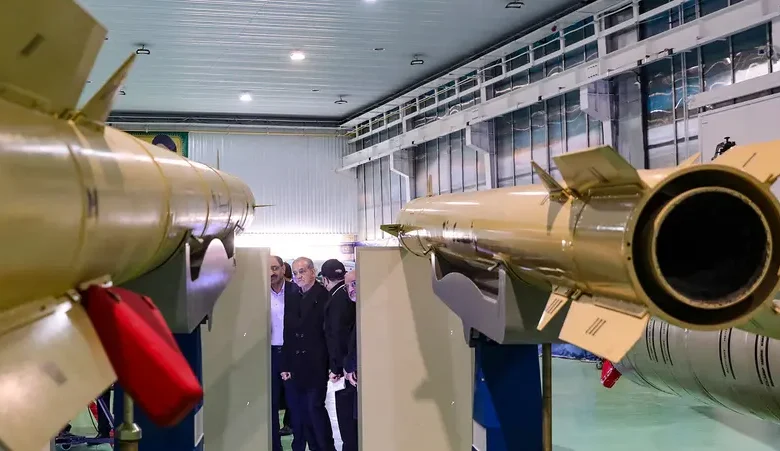
A western intelligence estimate says Iran can build about 50 ballistic missiles per month — roughly half its prewar capacity — providing a formidable means of retaliation if hostilities resume, despite months of airstrikes.
The US has said since the early days of the war that Tehran’s arsenal, and its ability to reconstitute it, had been thoroughly degraded. Defense Secretary Pete Hegseth reiterated that in remarks on Tuesday, saying 80 percent of Iran’s industrial base had been destroyed.
Iran’s conventional military has largely been wiped out by US and Israeli airstrikes. But it most likely has at least 1,700 ballistic missiles remaining and is building more at roughly half the rate possible before the war, according to a western official citing military intelligence reports. The IRGC — the most powerful wing of Iran’s military — also released footage on Tuesday of what it described as the unveiling of a new underground “missile city.”
There could also be thousands of Shahed-type strike weapons remaining in its arsenal, said Jim Lamson, a visiting research fellow in the Department of War Studies at King’s College London and former CIA analyst focused on Iran and the Middle East. The exact number of both ballistic missiles and Shaheds is difficult to pin down because the size of Iran’s prewar weapons stockpile is unknown, as is the degree to which it has been able to reconstitute fired or destroyed missiles.
Hegseth held a news conference on Tuesday to defend himself against pending impeachment charges, largely for his conduct of the Iran war and military actions in the Caribbean. Part of his defense was to declare US military operations a success and note that “more than 80 percent of Iran’s nuclear industrial base is gone.”
Despite reports of declining stockpiles, the US still has hundreds of thousands of precision-guided bombs, thousands of Raytheon BGM-109 Tomahawk cruise missiles and hundreds of stealthy JASSM cruise missiles available. But some of those supplies have come at the expense of other regions, such as the Indo-Pacific and Europe.
Although US President Donald Trump said this week that he didn’t see the need for more strikes, the blockade of Iran remains in place — an act of war that has imposed severe economic pain on Tehran — and Iran has continued to strike commercial shipping.
“It was never a direct contest between Iran and American missile stockpiles,” said Becca Wasser, Bloomberg Economics defense lead. “The US outguns Iran, but Iran’s strategy requires just enough capability to disrupt, impose costs and endure.”
Iran’s Ministry of Foreign Affairs didn’t immediately reply to a message requesting comment late on Tuesday.
In the IRGC video, published by the Fars news agency, Gen. Ali Abdollahi, the armed forces’ chief of staff, told troops in the missile facility that “surprises in a future war will be revealed one after the other.”
A bigger issue for US forces is missile interceptors: the more than 6,000 weapons Iran launched around the region ate up at least 1,000 Lockheed Martin Corp. Patriot PAC-3 interceptors, according to Bloomberg Economics analysis, $4 million weapons that are produced at a rate of just 650 a year.
Israel estimated that Iran had about 2,500 ballistic missiles before the war. Lt. Gen. James Adams, head of the US Defense Intelligence Agency, told Congress in April — about a month after the war began — Iran had “thousands of missiles and one-way attack UAVs” remaining, and Western intelligence assessments in June said Iran held about three-quarters of the munitions it had before the war.
Iran has launched more than 4,900 Shahed propeller-driven cruise missiles, and at least 2,200 ballistic missiles since the conflict began on Feb. 28, according to Bloomberg Economics.
A stockpile of missile components means Tehran can continue to assemble weapons, even though US airstrikes have severely degraded its ability to manufacture them at scale, said Lamson, the former CIA analyst focused on Iran and the Middle East.
Western intelligence officials have also said Russia is providing strike weapons to Iran, although the type and number are not known.
Lamson said, however, that public estimates of its stockpile now were “all over the map,” with even more uncertainty than prewar numbers — partly because the baseline number is a range, and partly because how many new missiles Iran has built since the war began in February is unknown.
“The Iranians have likely reconstituted a substantial amount of drones and missiles,” said Ankit Panda, a senior fellow in the Nuclear Policy Program at Carnegie Endowment for International Peace. “Given regional diplomatic efforts, they may focus on cost imposition on the United States and Israel.”