How the US attack on Venezuela, abduction of Maduro unfolded
In a move that stunned the world, the United States bombed Venezuela and abducted President Nicolas Maduro amid condemnation and plaudits.
In a news conference on Saturday at his Mar-a-Lago resort in Florida, US President Donald Trump praised the operation to seize Maduro as one of the “most stunning, effective and powerful displays of American military might and competence in American history”.
It was the riskiest and most high-profile military operation sanctioned by Washington since the US Navy’s SEAL team killed al-Qaeda leader Osama bin Laden in a safe house in Pakistan’s Abbottabad in 2011.
News of the 63-year-old Maduro being abducted took over the global news cycle.
After months of escalation and threats over Maduro’s alleged involvement in shipping drugs to the US, the Trump administration had increased pressure on Caracas with a military buildup in the Caribbean and a series of deadly missile attacks on alleged drug-running boats. The legality of the strikes, which killed more than 100 people, has been heavily questioned by the United Nations and legal experts.
The US had also offered a $50m reward for information leading to Maduro’s arrest.
But while the military was conducting operations in the Caribbean, US intelligence had been gathering information about Maduro. Meanwhile, special forces were covertly rehearsing a plan to forcibly remove him from power.
Here’s everything we know about how Maduro and his wife, Cilia Flores, were “captured”.
How was Maduro abducted?
The operation, named “Absolute Resolve”, was carefully rehearsed for months, according to General Dan Caine, chairman of the Joint Chiefs of Staff, who spoke at Trump’s news conference.
“They actually built a house, which was identical to the one they went into, with all the same – all that steel all over the place,” Trump said.
At 11:46pm local time on Friday (03:46 GMT on Saturday), Trump gave the green light.
On Friday night, Caine said that “the weather broke just enough, clearing a path that only the most skilled aviators in the world could move through”. About 150 aircraft were involved in the operation, taking off from 20 different airbases across the Western Hemisphere.
As part of the operation, US forces disabled Venezuela’s air defence systems, with Trump saying that the “lights of Caracas were largely turned off due to a certain expertise that we have”, without elaborating.
Several deafening explosions rang out across Caracas, with Pete Hegseth, the US defence secretary, describing it as part of a “massive joint military and law enforcement raid”, which lasted less than 30 minutes.
US helicopters then touched down at Maduro’s compound in the capital at 2:01am (06:01 GMT) on Saturday, with the Venezuelan president and his wife then being taken into US custody.
There has been no readout on whether there was an exchange of fire in the chaotic scramble, or if they were taken without a struggle.
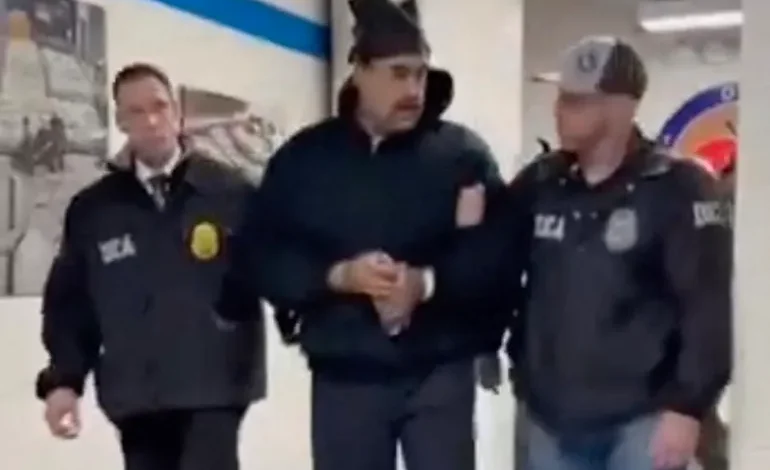
At 4:29am (08:29 GMT), just two and a half hours later, Maduro was put on board a US aircraft carrier, en route to New York.
Trump later posted a photograph of the Venezuelan leader on his Truth Social platform, blindfolded and wearing a grey tracksuit.
After departing the USS Iwo Jima, US forces escorted Maduro onto a flight, touching down in New York’s Stewart Air National Guard Base at about 4:30pm (21:30 GMT).
How many people were killed in the US strikes?
The US strikes hit Caracas as well as the states of Miranda, Aragua and La Guaira, according to the Venezuelan government.
To Linda Unamumo, a public worker, the US attacks caused an explosion that was so strong, it destroyed the roof of her house.
“Even up until a little while ago, I was still crying… I was crying because I was so scared… I had to leave my house with my daughter, with my family, and go to another house, a neighbour’s house. It was really traumatic. I wouldn’t wish it on anyone, really,” she told the AFP news agency.
While official casualty counts have yet to be released, an official told The New York Times on condition of anonymity that at least 40 people had been killed in the attacks.