Has the Pentagon really exonerated Pete Hegseth over Signal leaks?
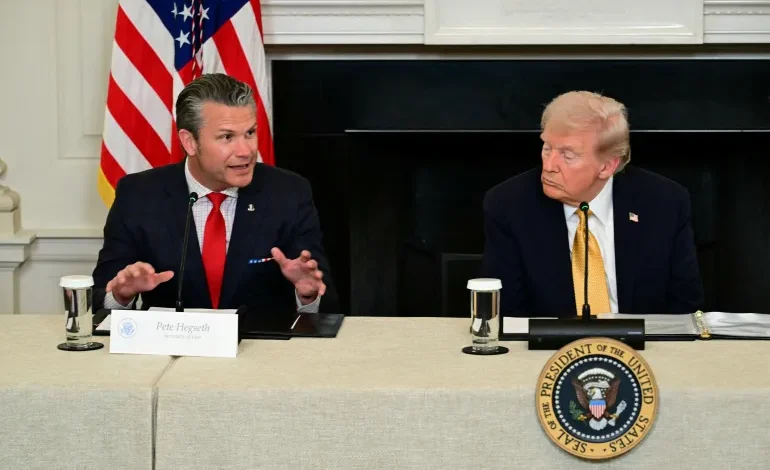
United States Defense Secretary Pete Hegseth put defence personnel and their missions at risk when he used the messaging app Signal to discuss sensitive information about military strikes on Yemen’s Houthis, a classified Pentagon watchdog report has found.
In a report provided to Congress on Tuesday, the Pentagon inspector general said its investigation concluded that Hegseth violated protocol when he used his personal phone for official communications, and recommended that all Pentagon officials be better trained, according to US media reports quoting sources familiar with the findings.
US officials are not authorised to use Signal for classified information as it is not part of the Pentagon’s secure communications network.
However, as Hegseth has the authority to declassify information, the Pentagon report found that the consequences of this were unclear.
The report, which has not yet been made public, could ramp up pressure on Hegseth, who has come under intense bipartisan scrutiny from lawmakers since March when the messages were first revealed by a journalist who appeared to have been accidentally added to a Signal chat group being used by Hegseth to discuss strikes.
Some lawmakers called for Hegseth’s firing at the time, but US President Donald Trump downplayed the significance of the scandal even as public outrage grew.
Hegseth has described the findings of the investigation as a “total exoneration”, even though they do not appear to categorically clear him from wrongdoing.
Lawmakers are also investigating a separate case in which Hegseth is alleged to have verbally ordered a second strike on a boat which had been destroyed in the Caribbean. The second strike is alleged to have killed two survivors of an earlier strike amid President Donald Trump’s deadly crackdown on drug smugglers.
What has the Pentagon’s inspector general found?
Pentagon acting inspector general Steve Stebbins’ classified report to Congress stated that Hegseth had risked compromising sensitive military information, which could have endangered US troops when he shared details of an air strike in Yemen via the Signal messaging app in March this year, CNN first reported on Wednesday. Participants in the Signal chat group included Hegseth, Vice President JD Vance, Secretary of State Marco Rubio, and National Intelligence Director Tulsi Gabbard.
Hegseth used Signal to share highly sensitive information with unauthorised persons, the report found, and failed to preserve those communications as required by US law.
It also found that he shared information about a Yemen operation in a separate Signal group chat which included his wife, brother and personal lawyer – all unauthorised people, CNN revealed.
However, the inspector general’s findings also stated that, as Hegseth has the authority to declassify sensitive information, the consequences of his actions are less clear.
Hegseth, a military veteran and former Fox News host who had no prior government experience before his appointment, has maintained that he declassified the information before sharing it on the Signal chat and thus did nothing wrong, although he has not presented documentation to back that claim.
Stebbins began his investigation on April 3, following an outcry from both Democrat and Republican lawmakers who pointed out that the Signal chat could have put US personnel in danger if it had fallen into the wrong hands. The inspector general, who was appointed by Trump in January, revealed in a memo at the time that he had been prompted by the leadership of the Senate Armed Services Committee to begin a probe.
“The objective of this evaluation is to determine the extent to which the Secretary of Defense and other DoD [Department of Defense] personnel complied with DoD policies and procedures for the use of a commercial messaging application for official business,” Stebbins wrote in a short memo published on April 3, adding that compliance with classification and records retention would also be reviewed.
Did Hegseth declassify the information before he divulged it on Signal?
Stebbins’s report detailed how Hegseth’s staff set up Signal so that the defence secretary could use it from his office at the Pentagon, where personal devices are not allowed and where he could not have physically accessed his phone.
While the inspector general’s report states that Hegseth has the authority to determine the classification level of military intelligence – and could have declassified the information if he wanted to – it does not conclusively determine whether the material he transmitted over Signal had been declassified.
According to a report by CNN, the information shared by Hegseth on the Signal chat was taken from a classified US Central Command document marked “Secret/NOFORN”, meaning no foreign nationals were permitted to view it.
Stebbins’s report referenced a broader review of how federal officials use Signal and recommended more training for Pentagon officials to ensure compliance.
Hegseth refused to be interviewed by the inspector general and instead submitted his arguments in writing, The Associated Press reported. Investigators relied on screenshots shared by the journalist who broke the story in March because Hegseth failed to provide all of his Signal messages.
How has Hegseth responded to the report?
In a post on X on Tuesday, Hegseth claimed the inspector general report revealed “no classified information” was shared and that it represented “total exoneration” for him.
That post followed one by his office’s spokesperson Sean Parnell, who wrote: “This Inspector General review is a TOTAL exoneration of Secretary Hegseth and proves what we knew all along – no classified information was shared.”
“This matter is resolved and the case is closed,” he continued.
Parnell also responded to A New York Times post which raised the potential dangers of Hegseth’s actions as highlighted in the report, saying: “There is zero evidence that supports this conclusion. None.”
He added that the “flawless execution & success of Operation Rough Rider” – the name of the Yemen bombing campaign discussed on Signal – was evidence that no troops had been placed at risk.
Parnell and Hegseth’s stances align with those of the Trump administration since the scandal first broke in March. President Trump’s office did not publicly admonish Hegseth, and Trump himself called the scandal a “witch-hunt”. Trump also attempted to blame the messaging app by questioning whether Signal itself was “defective”.
Some Democrats on the House and Senate intelligence committees, however, said that Hegseth’s actions would be a fireable offence for any other official.
“This was not an isolated lapse. It reflects a broader pattern of recklessness and poor judgment from a secretary who has repeatedly shown he is in over his head,” Senator Mark Warner said in a statement on Wednesday.