Gaza’s second front: The battle against disease-carrying rats
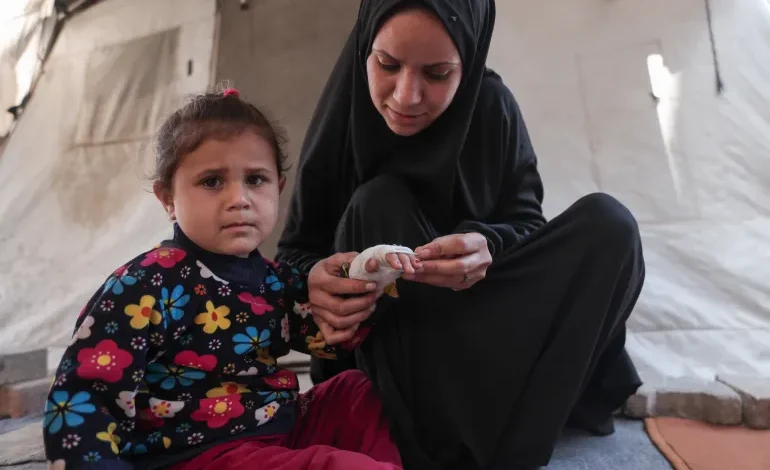
A week ago, she was woken up in the middle of the night by Mayaseen screaming, “Thief, thief”. At first, Samah did not understand what was happening, but when she picked up her daughter, she noticed blood on her hand.
“Her father turned on a flashlight, and we saw the rat running inside the tent … it was very large, like a rabbit.”
The parents realised the animal had attacked Mayaseen and bitten her hand, causing visible bleeding on her body and staining her mattress with blood. The local medical clinic was unable to treat Mayaseen, who was instead taken to central Gaza City’s al-Shifa Hospital. Despite receiving treatment, the child continues to be terrified by what happened.
“She has become very afraid,” Samah says. “Every night she wants to sleep in my arms. She wakes up terrified, afraid of hearing the sounds of rats near us.” Samah herself struggles to sleep, fearing a repeat of the incident.
Samah adds that she believes the rats have become more aggressive because they “have become used to eating human bodies under the rubble” – more than 72,000 Palestinians have been killed in Israel’s genocidal war in Gaza.
“The situation is very frightening … rats and mice are everywhere,” Samah tells Al Jazeera, pointing to a pile of rubble in front of her filled with holes that the rodents use as shelters.
“Every day, when evening comes, I feel terror because the rats spread in a horrifying way,” she adds in a tired voice.
“Yesterday, I returned to my tent at night and found them all over that hill … a terrifying scene no human can imagine.”
Rodent haven
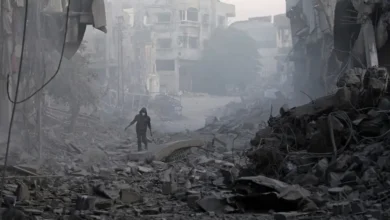
Hundreds of thousands of people in Gaza are living in tents, forced out of their homes by Israeli attacks and forced evacuation orders.
With no sign of reconstruction on the horizon, despite the beginning of a ceasefire in October, they are having to manage with the living situation as it is.
That can mean trying to source clean water, figuring out how to get power and internet, finding food, and dealing with disease-carrying pests like rats – a problem that is only getting worse as the summer approaches.
Samah, displaced from Beit Lahiya in northern Gaza, has tried to buy rat poison, but says the prices are too high, and they already barely have enough money to feed their family.
Before the war, her husband worked as a strawberry farmer, and their financial situation was relatively stable. Today, the family’s income has completely stopped, and securing food has become the top priority.
The problem is, any food she does get for her family can attract more rats.
“Many times I’ve brought food from the community kitchen, covered it, and then returned after a short time to find rat droppings on it,” Samah says. “I had to throw it all away … they always ruin our flour bags.”
They also destroy clothes, personal belongings, and even tents. “Rats ate our clothes and bags … the edges of our tent, everything,” she adds.
Despite her continuous efforts to keep things clean, Samah says the rats keep coming. She stresses that the problem is general and not limited to her tent.
She also adds that individual attempts by people around her to clear rubble sometimes lead to more rodents spreading into the surrounding areas.
“Everyone around me is suffering … neighbours, relatives … everyone is complaining because of the rats … every time they clean a place, the rats come to us … the issue needs an organised official effort to control them.”
The arrival of summer is expected to worsen the crisis, along with the spread of insects and mosquitoes.
But the biggest fear remains the rats, whose numbers have increased recently.
Samah and those around her believe the solution requires collective intervention, with municipalities and institutions urgently stepping in to remove rubble and provide pest control materials and poisons to eliminate the rodents.
Difficult to confront
Dr Ayman Abu Rahma, director of preventive medicine at the Ministry of Health, describes Gaza as a “health hazard environment” that has led to an unprecedented spread of rodents.
He attributes this to three main reasons: accumulated waste, destruction of sewage infrastructure, and the presence of rubble and decomposing bodies beneath it.
Abu Rahma explains that there has been a steady increase in emergency and primary care cases as a result of bites, especially among children and the elderly. Diabetic patients are particularly vulnerable, as they may not feel bites, leading to severe complications.
He adds that rats also transmit diseases through urine and waste, causing fever and other symptoms.
Gaza Municipality officials say the situation is worsened by the Israeli ban on importing pest-control materials, including a poison previously used for rodent control, and that efforts to find alternatives have been unsuccessful.
Waste management problems are also worsening, with Gaza City’s main landfill containing about 300,000 cubic metres (10.5 million cubic feet) of waste, creating a breeding ground for rodents in a densely populated area.
Officials are exploring converting waste into organic fertiliser, but solutions remain limited due to the destruction of much of the equipment the municipality would need for such a project in the war.