From war to winter: Gaza couple wait to welcome baby in flooded tent
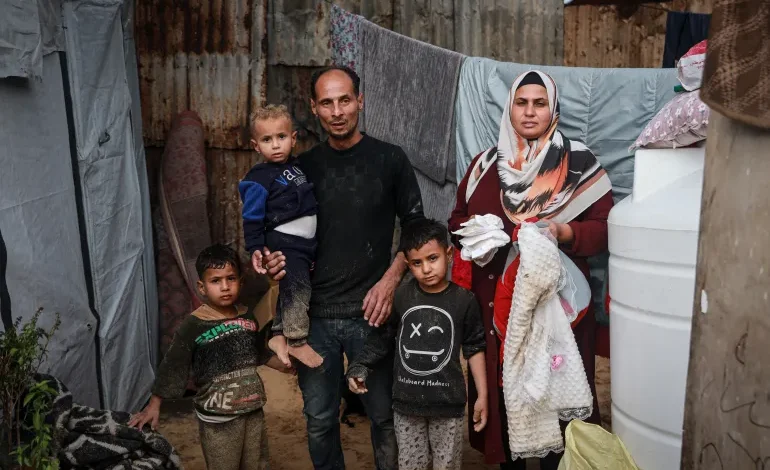
The first heavy rain of the winter season arrived not as a blessing, but as a new catastrophe for Samar al-Salmi and her family.
Early in the morning, torrents of water crashed through their worn-out tent in a displacement camp, jolting them awake as the ground beneath them turned into a muddy pool.
All around them, displaced people scrambled to repair what the rain had destroyed, filling waterlogged holes with sand and lifting drenched mattresses into the weak winter sun.
For 35-year-old Samar, the timing could not have been worse.
She is due to give birth imminently, and everything she has prepared for her newborn daughter was drenched.
“All the baby’s clothes were soaked in mud, as you can see,” she says, lifting tiny garments covered in brown stains. “Everything I prepared was submerged, even the diapers and the box of milk formula.”
Samar, her husband, and their three children live in a tent in Deir el-Balah, near tents where her mother and siblings live. They are all displaced from their home in Tal al-Hawa in southwest Gaza City, as a result of Israel’s genocidal war on Gaza.
“There are no words to describe how I feel right now,” Samar says, her voice almost breaking. “I feel like my mind is going to freeze. How am I supposed to welcome my baby girl like this?”
While Samar tries to salvage clothes and blankets, her husband and brothers shovel sand into the pools of water that have swallowed their living space. Mattresses, clothing, and basic belongings lie scattered around them, soaked and unusable.
“I put the baby’s hospital bag in my mother’s tent, thinking it would be safe,” she says. “But the rain rushed in there first and flooded everything, including the bag.”
“I don’t know where to start,” she adds. “Should I care for my children, whose clothes are full of mud and sand so I need to heat water and bathe them?
“Or do I try to dry the mattresses that will be so difficult in this cold? Or should I prepare myself so I’m ready to give birth at any moment?” she asks.
Since the war began two years ago, aid organisations have warned that Gaza’s displaced families would face catastrophe each time winter arrived, as they live in thin, tattered tents as a result of a strict Israeli ban on construction materials and caravans entering the Gaza Strip.
“A tent is not a solution,” Samar says. “In the summer, it’s unbearably hot, and in the winter, we flood. This is not a life. And winter hasn’t even started yet. What will we do when the real cold arrives?”
“At the very least, why weren’t caravans allowed in? Any roof to shelter us until this ends.”
A father overwhelmed
Samar’s husband, Abdulrahman al-Salmi, sits quietly, busy repairing the tents with her brothers. At first, he is so discouraged that he says he doesn’t even feel like talking to Al Jazeera. But gradually, he begins to open up.
“As a father, I’m helpless,” the 39-year-old says. “I try to hold our life together from one side, and it collapses on the other. That’s our life during and after the war. We’ve been unable to find any solution.”
He recounts the moment Samar called him earlier that morning while he was on his way to his first day of work at a small barbershop.
“She was crying and screaming, and everyone around her was screaming,” he recalls. “She told me, ‘Come quickly, the rain has invaded our tent from every direction.’”
He dropped everything and ran back under the rain.
“The place was completely flooded, like a swimming pool,” he says, tears filling his eyes. “My wife and mother-in-law were screaming, my children were outside shivering from the cold, the tents were flooded, the street was flooded… people were scooping water out of their tents with buckets. Everything was extremely difficult.”
For Abdulrahman, the rain feels like the final blow.
“We’ve been struggling in everything since the war began, and now the rain has come to finish us off completely.”
The father spoke of his immense difficulty in providing essentials for the newborn amid severe shortages and skyrocketing prices.
“I bought the diapers for 85 shekels ($26), the same type we used to get for 13 ($4),” he says. “The milk formula is 70 ($21). Even the pacifier is expensive. And now everything we prepared for tomorrow’s delivery is ruined. I don’t know what to do.”The couple cannot help but remember the life they once had; their warm, clean second-floor apartment in Tal al-Hawa, where they once lived a dignified and peaceful life, as they put it.
“Now the apartment, the building, and the entire neighbourhood are destroyed,” Samar says. “All our family homes are gone. We have no option but to live in tents.”
What terrifies the couple most is welcoming their baby girl into these conditions. Samar is scheduled for a C-section and will return afterwards to the tent.
“I never imagined this,” she says softly. “I never imagined I would welcome the daughter we dreamed of under these conditions.”
She admits, through guilt, that she sometimes regrets getting pregnant during the war.
“In my previous deliveries, I returned from the hospital to my apartment, to my comfortable bed, and I took care of myself and my baby peacefully,” she adds with grief.
“Any mother in the world would understand my feelings now, the sensitivity of the last days of pregnancy, the delivery itself, and the early days afterward.”